Within South Australia UFOs
Did Woomera Radar Track Something Extraordinary?
Woomera's 1954 reports combined radar returns, trained observers and incomplete records, making them unusually strong but still inconclusive.
On this page
- The May 1954 radar visual incident
- What the surviving records actually establish
- Radar anomalies, missing files and later doubts
Page outline Jump by section
Introduction
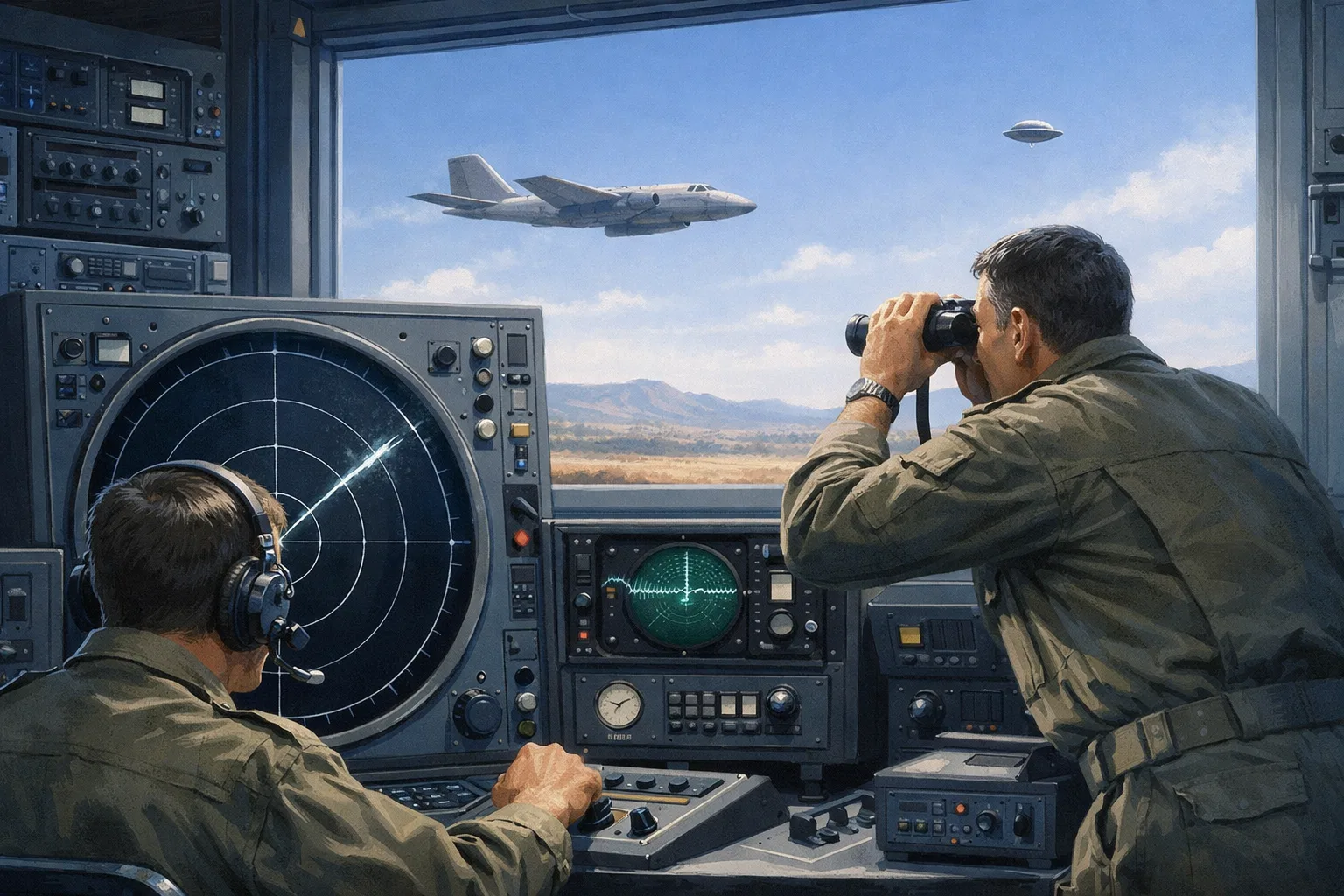
The Woomera radar case of 5 May 1954 is one of the most intriguing incidents in South Australia’s UFO history. A radar operator reported a fast, high-altitude target, while a technical observer using binoculars described a circular grey object near the flight path of a Canberra bomber. Official correspondence treated the accounts as mutually supporting, giving the event a rare combination of trained witnesses, instrumentation and contemporary documentation.
Yet the case is not as complete as later retellings often suggest. The surviving papers contain no radar photograph, calibration record, aircraft log, meteorological analysis or confirmed testimony from the bomber crew. The radar operator’s referenced diagram is absent from one archival file, while the recorded times of the radar and visual observations do not match neatly. The incident therefore remains genuinely unexplained in the ordinary sense, but it does not establish that radar tracked an extraordinary craft. Its importance lies equally in what survives and in what is missing.
The May 1954 radar-visual incident
Woomera was not an ordinary place to report something unusual in the sky. The Long Range Weapons Establishment operated aircraft, radar, guided weapons and tracking systems across a vast South Australian test range. Personnel regularly watched fast-moving targets and were expected to document unexpected activity because it might affect trials or represent a security concern.
The surviving paperwork for 5 May consists principally of two witness statements and a covering letter. The letter, sent by the range superintendent on 20 May, said the reporting men were approximately 300 yards apart and had given “corroborative accounts” of what they observed. This is the administrative basis for describing the incident as radar-visual rather than as two unrelated reports.[Project 1947]project1947.comProject 1947PROJECT 1947: Keith Basterfield - LISTING OF REPORTS FROM WOOMERA, SOUTH AUSTRALIA…
The radar statement was made by Staff Sergeant George Trotter. He reported that at about 4 pm an unidentified target appeared on the high beam of an AA No. 4 Mk 6 radar at approximately 60,000 yards, on a bearing close to north. According to his account, it traced a curved course over the radar post, departed towards the east and was followed to about 70,000 yards. Trotter timed the return over 15,000 yards in ten seconds, producing the often-repeated calculated speed of about 3,600 miles per hour. Because the target remained on the radar’s high beam at long range, he estimated its altitude as greater than 60,000 feet. Another serviceman, Keane, was named as having observed the radar occurrence with him.[documents.theblackvault.com]documents.theblackvault.comOpen source on theblackvault.com.
The visual statement came from Sydney Baker, identified in the file with Vickers-Armstrong, one of the British firms involved in the weapons programme. Baker said he was outside near the R1 radar post at approximately 4.45 pm, watching a trial through binoculars as a Canberra bomber approached. He noticed an object apparently travelling towards him or across the aircraft’s path. It then turned, moved back in the direction from which the Canberra had come and appeared to slow or become stationary above the bomber’s flight path.[Project 1947]project1947.comkb uasgovAUSTRALIAN GOVERNMENT’S RECORDS SYSTEMS…
Baker described the object as perfectly circular, dark grey and seemingly translucent, without a shiny or glinting surface. Through the binoculars, it appeared similar in angular size to the Canberra. He nevertheless acknowledged that he did not know its distance or altitude, making a true size or speed estimate impossible. When he tried to locate it with his unaided eyes and then returned to the binoculars, he could no longer find it.[documents.theblackvault.com]documents.theblackvault.comOpen source on theblackvault.com.
These accounts are unusual because neither witness was merely watching the evening sky. One was operating a radar set; the other was observing an organised aircraft trial with binoculars. Their reports were written within a day or two rather than reconstructed decades later. That gives the case more evidential value than a distant memory published only after UFO stories became popular.
However, the surviving documents do not demonstrate that both men detected the same object. The radar report gives a time of about 4 pm, while Baker places his observation at approximately 4.45 pm. Later summaries often compress both into a single five-minute encounter around 4.30 pm, but that reconstruction is not what the two statements literally record. The discrepancy could be a loose or mistaken time entry, yet without range logs or synchronised records it cannot simply be dismissed.[Project 1947]project1947.comProject 1947PROJECT 1947: Keith Basterfield - LISTING OF REPORTS FROM WOOMERA, SOUTH AUSTRALIA…
What the surviving records actually establish
The strongest conclusion supported by the papers is narrow: Woomera personnel submitted official reports of an unusual radar return and a circular object seen through binoculars during activities involving a Canberra bomber. Their superiors considered the accounts sufficiently similar to forward them through official channels.
Several features make that conclusion meaningful.
The reports were contemporary. The witnesses recorded their observations immediately after the event, reducing the risk of decades of memory alteration.
The observers had relevant experience. Baker was watching a weapons trial rather than casually scanning the sky, and Trotter was using equipment intended to detect and track aerial targets.
The radar report included measured values. It supplied bearings, ranges, a timed interval and an inferred altitude, rather than merely describing an unexplained mark on a screen.
The paperwork entered an official intelligence system. Other correspondence in the same archival material indicates that original reports of unusual occurrences were being sent to Melbourne, where the Royal Australian Air Force’s Directorate of Air Force Intelligence served as the central authority for investigation.[documents.theblackvault.com]documents.theblackvault.comOpen source on theblackvault.com.
Those points explain why the Woomera incident continues to attract attention. They do not, however, validate every figure in the report. The celebrated speed of 3,600 mph was a calculation based on the operator’s timing of a displayed return. Its reliability depends on assumptions that cannot now be tested: that the return represented one solid object, that the radar had a correct range solution, that the tracking geometry was understood and that no propagation or equipment effect displaced the apparent target.
The claimed height of more than 60,000 feet is likewise an interpretation of the high-beam contact, not an independently verified altitude from several radars. No surviving record shows triangulation, a second radar station confirming the track or an aircraft making a direct interception.
The visual evidence is also less precise than the phrase “object over the Canberra” may imply. Baker was describing an apparent alignment in his field of view. Without knowing the object’s range, he could not establish that it was physically close to the bomber. A small object nearer the observer and a larger object many kilometres away can appear beside an aircraft from one viewing position. Baker himself explicitly recognised this distance problem when discussing speed and size.[Project 1947]project1947.comkb uasgovAUSTRALIAN GOVERNMENT’S RECORDS SYSTEMS…
There is no surviving statement from the Canberra crew confirming that they saw anything. A later account associated with Australian UFO researchers says the aircraft and unknown return were both shown on radar while the crew saw no object, but the presently accessible witness papers do not provide the bomber’s flight log, crew report or radio transcript needed to reconstruct that part of the event independently.[Project 1947]project1947.comProject 1947PROJECT 1947: Keith Basterfield - LISTING OF REPORTS FROM WOOMERA, SOUTH AUSTRALIA…
Radar anomalies, missing files and later doubts
Radar is often treated in popular UFO accounts as an objective camera for the sky. In reality, especially with mid-century equipment, it displayed echoes that operators had to interpret. Aircraft, birds, balloons, weather, ground reflections and unusual bending of radio waves through layers of air could all generate confusing returns. An unexplained radar contact is therefore evidence that the instrument received a signal, but not automatic proof of a structured vehicle.
Woomera’s own files contain a useful warning from only eighteen months before the May 1954 event. On 8 October 1952, an operator locked on to an invisible target near Shell Lagoon for at least 24 minutes. Its radar signal was reportedly comparable to that of a large aircraft, and smaller returns appeared to detach from it. Yet no object could be seen through the radar-mounted optical tracker, even when the indicated range was about one mile. After consulting meteorological and radar personnel, officials considered ice or cloud-related effects the most probable explanation.[documents.theblackvault.com]documents.theblackvault.comOpen source on theblackvault.com.
That earlier incident does not explain the 1954 return, whose reported speed and path were different. It demonstrates, however, that apparently strong returns at Woomera could arise from something other than a conventional aircraft. The range’s technicians were aware of such problems and did not assume that every well-defined echo represented a machine.
The May case lacks the material needed to test those possibilities. Trotter referred to a diagram on the following page, but the diagram was not present in the archival file examined by researcher Keith Basterfield. His later catalogue states that a tracking plot was found in another Weapons Research Establishment file, D250, control symbol 56/483, alongside copies of the 1954 documents. That discovery reduces the impression that the plot vanished completely, but a plotted line is still not the same as raw radar data or a photographed display. It records an operator’s reconstruction and remains dependent on the original tracking assumptions.[Project 1947]project1947.comProject 1947PROJECT 1947: Keith Basterfield - LISTING OF REPORTS FROM WOOMERA, SOUTH AUSTRALIA…
Other potentially decisive records have not emerged publicly:
- the radar’s maintenance and calibration history;
- the original scope photograph or recording, if one existed;
- exact weather profiles capable of testing abnormal radio propagation;
- trial-control logs establishing the Canberra’s route and timing;
- statements from all radar staff and the named witness Keane;
- aircrew testimony or radio communications;
- an official technical conclusion addressing alternative causes.
The wider history of Australian UFO files further complicates the picture. In 2011, the Department of Defence reported that it could not locate much of its former UFO material after a Freedom of Information search. The surviving folder identified at that time concerned unusual occurrences around Woomera, while other files were described as lost or destroyed. This does not prove deliberate concealment: government records are commonly culled, transferred, misfiled or lost when organisations change. Nevertheless, it means that historians cannot assume the present archive represents the complete investigation conducted in the 1950s.[SBS Australia]sbs.com.auSBS Australia'Australia's military loses its UFO X-Files' | SBS News | SBS NewsSBS Australia'Australia's military loses its UFO X-Files' | SBS News | SBS News
Some Woomera documents survived precisely because records from the restricted testing region travelled through several administrative systems. Material could be copied by range security, the Department of Supply, the Weapons Research Establishment and the RAAF. The May 1954 papers appearing in more than one file therefore suggest bureaucratic duplication rather than a single preserved case dossier. It also explains why one file may lack an attachment found elsewhere.
Later retellings have sometimes strengthened the story beyond those documents. Statements that a disc “paced” the Canberra, performed controlled manoeuvres or was conclusively recorded at 3,600 mph treat uncertain interpretations as established facts. The original visual witness described apparent motion relative to the aircraft but admitted that the object’s height was unknown. The original radar operator calculated an impressive speed, but the surviving evidence does not prove that the visual object generated that return.

Did Woomera radar track something extraordinary?
The fairest assessment is that the May 1954 case is unresolved but evidentially incomplete.
A simple hoax appears unlikely. The reports were made through official channels by personnel working at a sensitive testing range, and the witnesses included details that exposed the limits of their observations rather than claiming certainty. Baker, for example, openly stated that he could not estimate speed properly without knowing the object’s height.
A straightforward identification is also unavailable. No surviving investigation securely matches the observations to a balloon, bird, aircraft, cloud or known trial vehicle. The circular, grey binocular object does not obviously resemble the bright astronomical lights or meteors responsible for many outback reports.
At the same time, an extraordinary craft is not required by the evidence. The visual and radar times differ, the two observations were not geometrically correlated, the Canberra crew supplied no surviving confirmation, and the original instrumental data are absent. A radar artefact combined with a separate airborne object remains plausible. So does an error in the recorded times, followed by a genuine radar-visual observation whose cause can no longer be recovered. The archive is too fragmentary to choose confidently between those possibilities.
This is why Woomera occupies an important but carefully limited place in South Australia’s UFO history. It is stronger than a lone light-in-the-sky account because it involves trained observers, radar and official documentation. It is weaker than a scientifically secure multi-sensor event because the measurements cannot be reproduced, cross-checked or tied conclusively to the visual object.
The missing evidence does not make the incident worthless. It defines the incident. Woomera shows both the promise and the weakness of historical radar cases: instruments can elevate a report above ordinary testimony, yet without preserved data, synchronised observations and a documented technical investigation, even an apparently spectacular track may remain permanently ambiguous.
Amazon book picks
Further Reading
Books and field guides related to Did Woomera Radar Track Something Extraordinary?. Use these as the next step if you want deeper reading beyond the article.
The Report on Unidentified Flying Objects
Book Excerpt: ing can never be positively identified. It might have been a hallucination or it might have been some vehicle from outer sp...
The UFO Experience: A Scientific Inquiry
Cited by the New York Review of Books as "the best brief for visitation," this classic study presents an analysis of UFO reports and conc...
UFOs: Generals, Pilots, and Government Officials Go on the Re...
NEW YORK TIMES BESTSELLER • Impeccably researched, this riveting journalistic investigation separates fact from fiction, and documents th...
The UFO Files
'What does all this stuff about flying saucers amount to? What can it mean? What is the truth?' Winston Churchill, prime minister's perso...
eBay marketplace picks
Marketplace Samples
Live-tested eBay searches with available results related to this page.
Selected fromUFO poster oneBay.co.uk.

Current eBay listing
I Want To Believe UFO Poster Giclée Fine Art Heavyweight Print


Current eBay listing
VINTAGE UFO FLYING SAUCERS COMIC ADVERTISING A2 POSTER PRINT

Endnotes
1.
Source: project1947.com
Link:https://www.project1947.com/kbcat/kbwoomera.htm
Source snippet
Project 1947PROJECT 1947: Keith Basterfield - LISTING OF REPORTS FROM WOOMERA, SOUTH AUSTRALIA...
2.
Source: project1947.com
Title: kb uasgov
Link:https://www.project1947.com/kbcat/kb_uasgov.htm
Source snippet
AUSTRALIAN GOVERNMENT’S RECORDS SYSTEMS...
3.
Source: documents.theblackvault.com
Link:https://documents.theblackvault.com/documents/ufos/australia/D174_SA5281_1012736.pdf
4.
Source: project1947.com
Title: kbsaufo05 1
Link:https://www.project1947.com/kbcat/kbsaufo05-1.htm
6.
Source: project1947.com
Link:https://www.project1947.com/fig/1954a.htm
7.
Source: project1947.com
Title: sea fury 1954
Link:https://www.project1947.com/kbcat/sea_fury_1954.htm
8.
Source: project1947.com
Link:https://www.project1947.com/fig/outspan54.htm
9.
Source: sbs.com.au
Title: SBS Australia’Australia’s military loses its UFO X-Files’ | SBS News | SBS News
Link:https://www.sbs.com.au/news/article/australias-military-loses-its-ufo-x-files/bdnn5c5oz
Additional References
10.
Source: newdawnmagazine.com
Title: Harry Turner & the Secret UFO Science Wars of OZ
Link:https://www.newdawnmagazine.com/articles/harry-turner-the-secret-ufo-science-wars-of-oz
Source snippet
He opened his UFO files to me. Turner told me that the case which impressed him the most was when radar at the restricte...
11.
Source: centroufologiconazionale.eu
Title: il caso woomera 1954
Link:https://www.centroufologiconazionale.eu/il-caso-woomera-1954/
Source snippet
Il Caso Woomera (1954) - CENTRO UFOLOGICO NAZIONALEMarch 17, 2026 — IL CASO WOOMERA (1954) Giuliano Amoruso 17 Marzo, 2026 17 Marzo, 2026...
Published: March 17, 2026
12.
Source: space.com
Title: Australian Government Loses All Its UFO Files | Space
Link:https://www.space.com/11892-australian-government-loses-ufo-files.html
Source snippet
Australian Government Loses All Its UFO Files | Space...
13.
Source: archives.gov
Link:https://www.archives.gov/research/catalog/catalog-bulk-downloads/uap-bulk-download
14.
Source: war.gov
Link:https://www.war.gov/ufo/
15.
Source: archives.gov
Link:https://www.archives.gov/research/topics/uaps%3E
16.
Source: archives.gov
Link:https://www.archives.gov/research/topics/uaps/rg-collections
17.
Source: archives.gov
Link:https://www.archives.gov/research/topics/uaps/textual-and-microfilm
18.
Source: loc.gov
Link:https://www.loc.gov/collections/finding-our-place-in-the-cosmos-with-carl-sagan/articles-and-essays/life-on-other-worlds/ufos-and-aliens-among-us
19.
Source: researchgate.net
Link:https://www.researchgate.net/publication/342042187_Ground-penetrating_radar_survey_at_Falerii_Novi_a_new_approach_to_the_study_of_Roman_cities