Within Remote Skies
Why Outback Lights Seem to Break Physics
Featureless darkness can make distant lights appear to hover, accelerate, reverse or vanish without revealing their true range.
On this page
- How darkness removes distance and scale
- Why stationary lights appear to move
- What evidence can test extraordinary speed claims
Page outline Jump by section
Introduction
Across the Northern Territory, some of the most puzzling UFO reports begin with a single light seen against a vast, featureless horizon. Witnesses often describe lights that seem to hover motionless, surge away at impossible speed, reverse direction or vanish without warning. Those observations are genuine experiences, but the apparent behaviour is not always a reliable guide to what the object was actually doing.

The key reason is simple: the Outback often removes the visual cues that people normally use to judge distance, height and motion. On remote roads and open plains, there may be no nearby buildings, trees, hills or other landmarks to provide scale. A distant aircraft, vehicle or bright star can therefore appear to behave in ways that seem to defy physics, even though the underlying object is moving in an entirely ordinary way. This mechanism helps explain why remote Northern Territory locations generate sincere but difficult-to-interpret UFO reports without assuming that every sighting has the same explanation.[Federal Aviation Administration]faa.govFederal Aviation Administration Chapter 8. Medical Facts for PilotsFederal Aviation Administration Chapter 8. Medical Facts for Pilots
How darkness removes distance and scale
Human vision estimates distance by comparing objects with their surroundings. During the day, roads, vegetation, buildings and terrain all provide reference points. At night across much of the Northern Territory, many of those cues disappear.
A single bright light suspended above a dark landscape carries remarkably little information. An observer usually cannot tell:
- whether it is tens of metres away or many kilometres distant;
- whether it is low over the ground or high in the atmosphere;
- whether it is large and distant or small and nearby;
- whether it is moving sideways, towards the observer or away from them.
Brightness alone offers little help. A powerful aircraft landing light many kilometres away may appear similar to a much weaker nearby light because the eye has no reliable way to judge its true range.
This problem becomes especially pronounced on the Territory’s long highways, cattle stations and open plains, where uninterrupted horizons allow distant lights to remain visible for extended periods without revealing their true position.
Why stationary lights appear to move
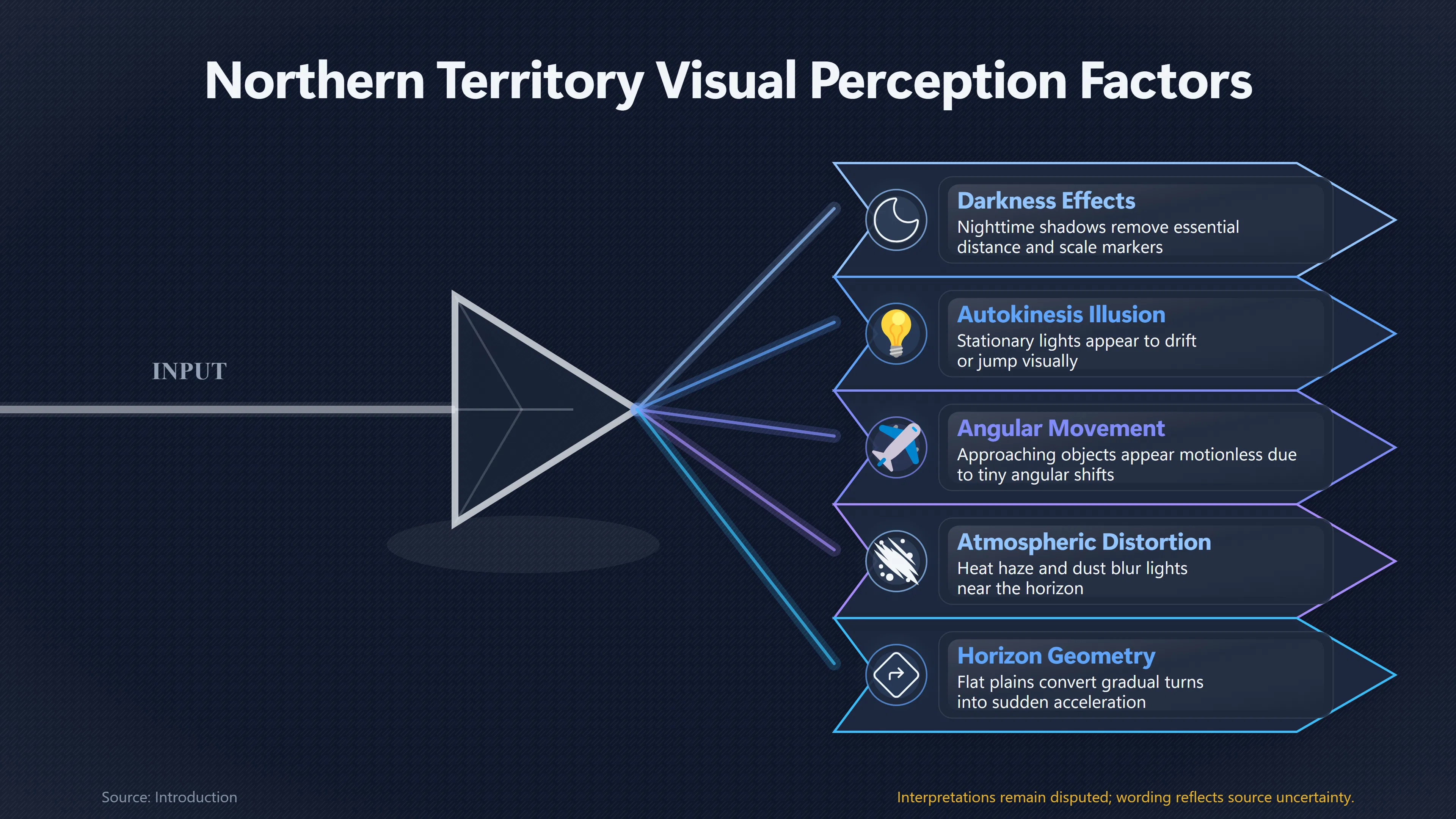
One of the best-known visual effects in aviation is autokinesis. When someone stares at a single point of light against a dark, featureless background, the light can appear to drift, circle or jump despite remaining stationary.
This is not movement of the light itself. Instead, the brain struggles to separate tiny involuntary eye movements from actual motion when no surrounding reference points exist. Aviation authorities teach pilots to avoid fixating on isolated lights because the illusion is well documented and can contribute to spatial disorientation.[faa.gov]faa.govFederal Aviation Administration Chapter 8. Medical Facts for PilotsFederal Aviation Administration Chapter 8. Medical Facts for Pilots
The same mechanism can influence ground observers watching an unexplained light over the Northern Territory. Someone standing beside a remote road may honestly perceive a light weaving or accelerating when a fixed camera later shows little or no movement.
This does not mean witnesses are imagining things. It means the human visual system is interpreting an unusually difficult scene.
Why ordinary movement can look extraordinary
Flat horizons also change how genuine movement appears.
A light travelling almost directly towards an observer changes its apparent position very slowly. Even at hundreds of kilometres per hour, an approaching aircraft may seem almost motionless because its angular movement across the sky is tiny.
The opposite can happen when the object’s path changes slightly. A modest turn may suddenly produce much faster sideways motion, creating the impression that the light accelerated instantaneously.
Similarly:
- a distant vehicle travelling along a straight highway may appear to hover above the horizon;
- an aircraft turning away can seem to disappear almost instantly as its landing lights are no longer directed towards the observer;
- lights viewed while the observer is driving may appear to pace the vehicle for many kilometres, much like the Moon appears to follow a moving car.
Without reliable depth cues, the brain often converts gradual changes in viewing geometry into dramatic changes in speed.
Why the Outback makes these effects stronger
Many of Australia’s cities contain countless visual references that help the brain estimate motion and distance. The Northern Territory often removes those references almost completely.
Several local conditions reinforce the illusion:
- exceptionally dark skies;
- broad, unobstructed horizons;
- long viewing distances across flat country;
- sparse artificial lighting;
- dry air that allows distant lights to remain visible;
- occasional heat haze, dust or atmospheric layers that blur or distort lights near the horizon.
Tourism authorities actively promote Central Australia as one of Australia’s premier stargazing regions because of these exceptionally dark conditions. The same qualities that reveal the Milky Way also expose observers to more distant aircraft, satellites and celestial objects than many urban residents ever notice.[Federal Aviation Administration]faa.govFederal Aviation Administration Chapter 8. Medical Facts for PilotsFederal Aviation Administration Chapter 8. Medical Facts for Pilots
What evidence can test extraordinary speed claims
Descriptions such as “it shot across the sky” or “it stopped instantly” are valuable witness observations, but investigators try to support them with independent evidence before concluding that an object truly displayed extraordinary performance.
Useful evidence includes:
- multiple observers viewing from different locations;
- photographs or video showing the surrounding horizon rather than only the light;
- timestamps that can be matched with aircraft, satellite or astronomical data;
- radar information where available;
- consistent accounts from independent witnesses;
- known locations of roads, mining operations or air traffic.
Conversely, reports become harder to evaluate when they involve only a single distant light viewed from one position without any fixed landmarks. In those situations, estimating speed, altitude and direction is often impossible from human observation alone.
This is why many historical Northern Territory light sightings remain unresolved rather than confirmed. The available evidence may establish that something unusual was seen, while remaining insufficient to measure what the object actually did.
Why this matters when assessing Northern Territory UFO reports
Understanding flat-horizon perception does not dismiss unusual sightings. Instead, it explains why sincere witnesses can report apparently impossible manoeuvres without implying that the object itself broke the laws of physics.
Within the wider history of Northern Territory UFO reports, this mechanism helps distinguish between two different questions:
- What did the witness experience? The witness may accurately describe seeing a light that appeared to hover, dart or vanish.
- What was the object physically doing? That requires evidence beyond visual impression alone.
Recognising this distinction allows investigators to treat witnesses respectfully while remaining cautious about claims of impossible acceleration or motion. In a landscape where darkness removes scale and distance, apparent performance is often the least reliable part of the observation, even when the sighting itself is entirely genuine.[Federal Aviation Administration]faa.govFederal Aviation Administration Chapter 8. Medical Facts for PilotsFederal Aviation Administration Chapter 8. Medical Facts for Pilots
Amazon book picks
Further Reading
Books and field guides related to Why Outback Lights Seem to Break Physics. Use these as the next step if you want deeper reading beyond the article.
The Invisible Gorilla: How Our Intuitions Deceive Us
NEW YORK TIMES BESTSELLER • Our minds don’t work the way we think they do. Two renowned psychologists explain how and why our intuitions...
Sleights of Mind: What the Neuroscience of Magic Reveals Abou...
What can magic tell us about ourselves and our daily lives? If you subtly change the subject during an uncomfortable conversation, did yo...
eBay marketplace picks
Marketplace Samples
Live-tested eBay searches with available results related to this page.
Selected fromMin Min lights poster oneBay.co.uk.
Endnotes
1.
Source: faasafety.gov
Title: Your Senses In The Shadows
Link:https://www.faasafety.gov/files/events/SO/SO15/2024/SO15134204/YourSensesInTheShadows.pdf
Source snippet
Your Senses in the Shadows. Nighttime Visual Illusions and Spatial… | by FAA Safety Briefing Magazine | Jan, 2025 | Medium...
2.
Source: faasafety.gov
Link:https://www.faasafety.gov/gslac/ALC/libview_chapter.aspx?chapter=Illusions+-+Have+I+Considered+Them%3F&id=6580
3.
Source: faa.gov
Title: Federal Aviation Administration Chapter 8. Medical Facts for Pilots
Link:https://www.faa.gov/Air_traffic/publications/atpubs/aim_html/chap8_section_1.html
4.
Source: faa.gov
Title: Federal Aviation Administration PHAK Chapter 17
Link:https://www.faa.gov/sites/faa.gov/files/19_phak_ch17.pdf
5.
Source: faa.gov
Title: Chapter 8. Medical Facts for Pilots
Link:https://www.faa.gov/air_traffic/publications/atpubs/aim/aim0801.html
6.
Source: media.bom.gov.au
Title: bom.gov.au Mirrors in the sky: Demystifying the legend of the Flying Dutchman
Link:https://media.bom.gov.au/social/blog/292/mirrors-in-the-sky-demystifying-the-legend-of-the-flying-dutchman
7.
Source: atsb.gov.au
Title: dark night take accidents australia
Link:https://www.atsb.gov.au/publications/research-and-analysis-report/2022/aviation/dark-night-take-accidents-australia
8.
Source: faa.gov
Link:https://www.faa.gov/air_traffic/publications/atpubs/aip_html/chap8_section_1.html
9.
Source: faa.gov
Link:https://www.faa.gov/air_traffic/publications/atpubs/aim_html/chap7_section_6.html
10.
Source: faa.gov
Link:https://www.faa.gov/data_research/research/med_humanfacs/oamtechreports/1960s/1969/196923
11.
Source: faa.gov
Link:https://www.faa.gov/data_research/research/med_humanfacs/oamtechreports/1960s/1967/196719
12.
Source: atsb.gov.au
Link:https://www.atsb.gov.au/node?page=911
Additional References
13.
Source: sciencedirect.com
Title: ScienceDirect Imaging the visual autokinetic illusion with f MRI
Link:https://www.sciencedirect.com/science/article/abs/pii/S1053811905002168
Source snippet
Imaging the visual autokinetic illusion with fMRI - ScienceDirect...
14.
Source: youtube.com
Link:https://www.youtube.com/watch?v=zsZHfZz4Vr8
Source snippet
Chapter 17 Aeromedical Factors | PHAK | AGPIAL Audio/Video Book...
15.
Source: australiangeographic.com.au
Title: Great Aussie mysteries
Link:https://www.australiangeographic.com.au/news/2025/01/great-aussie-mysteries/
Source snippet
Australian GeographicJanuary 22, 2025 — SPOOK LIGHTS OF THE OUTBACK STATUS: PARTIALLY SOLVED When the National Museum of Australia opened...
Published: January 22, 2025
16.
Source: youtube.com
Title: HOW TO SAY AUTOCINESIS? #autocinesis
Link:https://www.youtube.com/watch?v=kmAg08j2nyU
Source snippet
PPGS Lesson 14.2 | Aeromedical: Illusions Epic Flight Academy · 3.7K views Part 107 Night Training (full course) Pilot Institute · 58K views...
17.
Source: science.nasa.gov
Title: chapter6 6
Link:https://science.nasa.gov/learn/basics-of-space-flight/chapter6-6/
Source snippet
6: Electromagnetics - NASA ScienceJanuary 16, 2025 — CHAPTER 6: ELECTROMAGNETICS CONTENTS * Refraction * Refraction in Earth's Atmosphere...
Published: January 16, 2025
18.
Source: youtube.com
Title: Part 107 Night Training (full course)
Link:https://www.youtube.com/watch?v=f_YfFRxOr9o
Source snippet
Night Flying Ground Lesson for Private Pilot: Logging, Illusions and 3 Types of Night (E17)...
19.
Source: journals.sagepub.com
Link:https://journals.sagepub.com/doi/10.1177/00187208261419347
Source snippet
Allison, Elizabeth L. Irving, Sion Jennings, Laurie M. Wilcox, 2026February 11, 2026 — First published online February 11, 2026 Re-use pe...
Published: February 11, 2026
20.
Source: journals.sagepub.com
Link:https://journals.sagepub.com/doi/abs/10.1177/00187208261419347
Source snippet
Allison, Elizabeth L. Irving, Sion Jennings, Laurie M. Wilcox, 2026February 11, 2026 — First published online February 11, 2026 Re-use pe...
Published: February 11, 2026
21.
Source: ufouap.net
Link:https://www.ufouap.net/en/explainers/autokinesis-stationary-light-illusion
Source snippet
Autokinesis: Why a Stationary Light Seems to Move | Global UFO ArchiveJuly 11, 2026 — Evidence / Updated 2026-07-11 / 7 min read AUTOKINE...
Published: July 11, 2026
22.
Source: faraim.org
Link:https://www.faraim.org/faa/aim/chapter-8/section-8-1-5.html