Within Tully Nest
Could Weather Have Made the Tully Saucer Nest?
The RAAF favoured localised wet-season turbulence, although no weather event was directly observed or conclusively reconstructed at the lagoon.
On this page
- Why investigators considered waterspouts
- How turbulence could uproot and rotate reeds
- What the weather theory still cannot prove
Page outline Jump by section
Introduction
The weather explanation for the Tully saucer nest is not that a conventional storm simply flattened the reeds. Rather, investigators proposed that a small, highly localised rotating wind feature—described in official correspondence as a waterspout, “willy willy”, down-draught or severe turbulence associated with tropical thunderstorms—might have disturbed the lagoon while also creating the brief visual impression that George Pedley interpreted as a rising object. This became the Royal Australian Air Force’s preferred natural explanation, although it was never proven. The evidence shows that such weather phenomena are plausible in north Queensland’s wet season, but no observer actually saw a waterspout over Horseshoe Lagoon that morning, and no meteorological reconstruction has conclusively linked one to the nest.[Project 1947]project1947.comProject 1947PROJECT 1947 - Forum - Bill Chalker - 1966 Tully Saucer NestJanuary 1, 1997…

Why investigators considered waterspouts
The Tully incident occurred during the tropical wet season, when intense thunderstorms, line squalls and rapidly changing air masses are common across north Queensland. Because the disturbed reeds showed no convincing evidence of heat, radiation or mechanical impact from a solid object, official investigators looked first for natural explanations consistent with local weather.[Project 1947]project1947.comProject 1947PROJECT 1947 - Forum - Bill Chalker - 1966 Tully Saucer NestJanuary 1, 1997…
The RAAF’s investigation gathered several observations that pointed towards atmospheric causes:
- Local residents reportedly said similar reed disturbances were not unknown during the onset of the wet season.
- The University of Queensland advised that the reed samples showed nothing abnormal and suggested severe turbulence associated with seasonal storms could account for the damage.
- Official correspondence concluded that down-draughts, “willy willies” and waterspouts were known to occur in the district and represented plausible mechanisms.[Project 1947]project1947.comProject 1947PROJECT 1947 - Forum - Bill Chalker - 1966 Tully Saucer NestJanuary 1, 1997…
One supporting anecdote also influenced investigators. An electrician from the nearby district reportedly told officials he had previously seen similar circular reed patterns at Kurrimine Beach which he believed had been created by a whirlwind drawing water upward into a waterspout. Although this was not direct evidence for the Tully event, it suggested that comparable natural formations were considered possible by experienced local observers.[Project 1947]project1947.comProject 1947PROJECT 1947 - Forum - Bill Chalker - 1966 Tully Saucer NestJanuary 1, 1997…
How turbulence could uproot and rotate reeds
The weather theory depends on the behaviour of small rotating vortices rather than broad, straight-line winds.
A compact vortex passing across shallow water could, in principle:
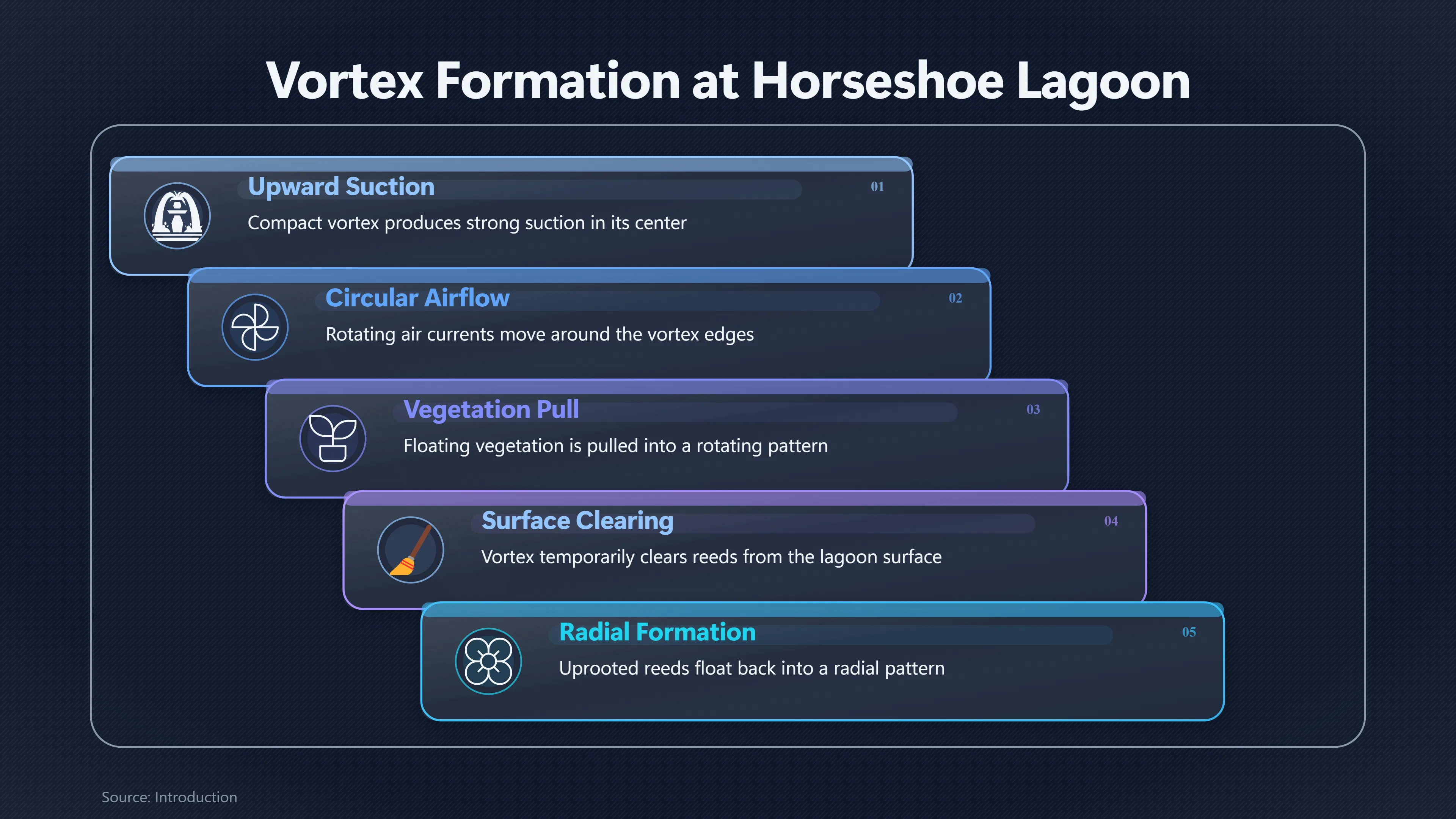
- produce strong upward suction in its centre;
- create circular airflow around the edges;
- pull floating vegetation into a rotating pattern;
- temporarily clear reeds from part of the lagoon surface;
- leave a roughly circular patch once the disturbed vegetation floated back together.
This mechanism broadly matches several observed features of the Tully nest, including the circular shape, the apparent rotation of the water immediately after the sighting, and the later appearance of a floating mat of uprooted reeds arranged in a radial pattern. The official explanation suggested that if such a vortex developed over a swampy reed bed, it could flatten the vegetation into a circular formation while lifting spray and debris into the air.[Project 1947]project1947.comProject 1947PROJECT 1947 - Forum - Bill Chalker - 1966 Tully Saucer NestJanuary 1, 1997…
Several years later, the Department of Air’s public relations office described what it regarded as the most probable explanation: a circular wind phenomenon flattened the reeds, lifted debris to around 30 feet (about nine metres), and created the appearance of a disc-shaped object before dissipating. The reported hissing noise was also considered compatible with a rapidly rotating vortex.[Project 1947]project1947.comProject 1947PROJECT 1947 - Forum - Bill Chalker - 1966 Tully Saucer NestJanuary 1, 1997…
Importantly, this was presented as the most likely hypothesis rather than a demonstrated reconstruction of what happened.
What the weather theory still cannot prove
Although the waterspout explanation remains one of the strongest conventional interpretations, it leaves important questions unanswered.
First, nobody independently observed a waterspout over Horseshoe Lagoon. The proposed vortex was inferred after the event rather than directly witnessed. Weather conditions in the region were certainly favourable for turbulent phenomena, but there is no contemporaneous meteorological record showing that a waterspout formed at the lagoon itself.[Project 1947]project1947.comProject 1947PROJECT 1947 - Forum - Bill Chalker - 1966 Tully Saucer NestJanuary 1, 1997…
Second, George Pedley consistently maintained that he saw a distinct object rather than a whirlwind. He was familiar with tropical weather and rejected the suggestion that he had mistaken an ordinary atmospheric phenomenon for a solid craft. While witness confidence cannot establish what was present, it means the official explanation never fully resolved his account.[Project 1947]project1947.comProject 1947PROJECT 1947 - Forum - Bill Chalker - 1966 Tully Saucer NestJanuary 1, 1997…
Third, later discoveries of additional smaller nests in the surrounding area complicated interpretation. Some showed clockwise rotation while others rotated anti-clockwise. These findings demonstrate that circular reed formations could occur more than once, but they do not by themselves identify the mechanism responsible for each formation. Whether they reflected multiple weather events, different local water movements or another process remains uncertain.[Project 1947]project1947.comProject 1947PROJECT 1947: Keith Basterfield - A CATALOGUE OF AUSTRALIAN PHYSICAL TRACE CASESMay 15, 2005…
Finally, the theory explains the physical disturbance more readily than the reported sighting. A small vortex could plausibly disturb reeds, produce a hissing sound and lift spray or debris, yet reconstructing exactly how such a phenomenon would appear to an observer for only a few seconds is much more difficult. That gap is why official investigators regarded the weather explanation as plausible rather than conclusive.[Project 1947]project1947.comProject 1947PROJECT 1947 - Forum - Bill Chalker - 1966 Tully Saucer NestJanuary 1, 1997…
How the waterspout theory fits the Tully case today
Within Queensland’s UFO history, the waterspout hypothesis remains the principal natural explanation for the Tully saucer nest because it accounts for many of the physical features without requiring an unknown craft. It also fits the broader context of tropical north Queensland, where violent localised air movements are a recognised feature of the wet season.[Project 1947]project1947.comProject 1947PROJECT 1947 - Forum - Bill Chalker - 1966 Tully Saucer NestJanuary 1, 1997…
At the same time, the explanation has important limits. No waterspout was directly observed, no reconstruction has demonstrated that one definitely created the nest, and the official investigation itself stopped short of claiming the matter was solved. The evidence therefore supports a cautious conclusion: weather-driven turbulence is a credible mechanism for the disturbed reeds, but it remains an informed hypothesis rather than a proven account of everything reported at Horseshoe Lagoon.[Project 1947]project1947.comProject 1947PROJECT 1947 - Forum - Bill Chalker - 1966 Tully Saucer NestJanuary 1, 1997…

Amazon book picks
Further Reading
Books and field guides related to Could Weather Have Made the Tully Saucer Nest?. Use these as the next step if you want deeper reading beyond the article.
Meteorology Today
METEOROLOGY TODAY has for many years been one of the most widely used and authoritative texts for the introductory meteorology course. Ea...
Weather
The Weather Forecasting Red Book is a groundbreaking reference that breaks away from theory and helps forecasters tackle everyday predict...
The Demon-Haunted World
NEW YORK TIMES BESTSELLER • From the renowned astronomer and author of Cosmos comes a “powerful [and] stirring defense of informed ration...
The UFO Experience: A Scientific Inquiry
Cited by the New York Review of Books as "the best brief for visitation," this classic study presents an analysis of UFO reports and conc...
eBay marketplace picks
Marketplace Samples
Live-tested eBay searches with available results related to this page.
Selected fromflying saucer model oneBay.co.uk.
Endnotes
1.
Source: project1947.com
Link:https://www.project1947.com/forum/bctully.htm
Source snippet
Project 1947PROJECT 1947 - Forum - Bill Chalker - 1966 Tully Saucer NestJanuary 1, 1997...
Published: January 1, 1997
2.
Source: project1947.com
Link:https://project1947.com/kbcat/kbtrace0505.htm
Source snippet
Project 1947PROJECT 1947: Keith Basterfield - A CATALOGUE OF AUSTRALIAN PHYSICAL TRACE CASESMay 15, 2005...
Published: May 15, 2005
3.
Source: project1947.com
Link:https://project1947.com/forum/bctrace2.htm
4.
Source: project1947.com
Link:https://www.project1947.com/forum/bcoz5.htm
5.
Source: forecast.weather.gov
Link:https://forecast.weather.gov/glossary.php?word=WATERSPOUT
6.
Source: weather.gov
Link:https://www.weather.gov/apx/waterspout
7.
Source: oceanservice.noaa.gov
Link:https://oceanservice.noaa.gov/facts/waterspout.html?os=android
8.
Source: education.nationalgeographic.org
Link:https://education.nationalgeographic.org/resource/waterspout/
9.
Source: uforq.org
Title: the tully saucer nest
Link:https://uforq.org/the-tully-saucer-nest/
10.
Source: ufoencounters.co.uk
Link:https://www.ufoencounters.co.uk/the-tully-saucer-nest.html
11.
Source: ufouap.net
Title: tully saucer nest
Link:https://www.ufouap.net/en/cases/tully-saucer-nest
Additional References
12.
Source: music.amazon.co.uk
Title: This contained an area of water about 6 feet deep and one hundred feet across
Link:https://music.amazon.co.uk/podcasts/41ca76f8-0f68-4c24-a438-6386b189487f/episodes/27453230-9fdb-41bb-9838-50938ad45cf5/encounters-down-under-60-years-of-the-tully-nests-with-shane-pennisi?tag=searcht-20
Source snippet
amazon.co.uk60 years of The Tully Nests With Shane Pennisi | Encounters Down Under Episode on Amazon MusicMay 10, 2026 — The farm track a...
Published: May 10, 2026
13.
Source: shows.acast.com
Title: This contained an area of water about 6 feet deep and one hundred feet across
Link:https://shows.acast.com/encounters-down-under/episodes/s6-e1-60-years-of-the-tully-nests-with-shane-pennisi
Source snippet
acast.comS6 E1 60 years of The Tully Nests With Shane Pennisi - Encounters Down Under | AcastMay 10, 2026 — The farm track along which he...
Published: May 10, 2026
14.
Source: theozfiles.blogspot.com
Title: The RAAF (Royal Australian Air Force) files describe the famous Tully incid
Link:https://theozfiles.blogspot.com/2025/08/the-prime-ministers-flying-saucer.html
Source snippet
The Prime Minister’s “flying saucer” briefing - Tully ’66: George Pedley, Harold Holt, & John BusstAugust 20, 2025 — q=Casey】...
Published: August 20, 2025
15.
Source: slq.qld.gov.au
Title: State Library of Queensland The Truth Is Out There
Link:https://www.slq.qld.gov.au/blog/truth-out-there-queensland-ufo-related-periodicals
Source snippet
State Library of QueenslandThe Truth Is Out There - Queensland UFO related periodicals | State Library of Queensland...
16.
Source: podscan.fm
Title: The Tully Nest’s With Shane Pennisi
Link:https://podscan.fm/podcasts/encounters-down-under/episodes/the-tully-nests-with-shane-pennisi
Source snippet
Just twenty or thirty feet ahead of him, a large disc-shaped object was rising out of the lagoon. It was roughly 25 feet acr...
17.
Source: youtube.com
Title: Global crop circle phenomenon inspired by UFO mystery in Far North Queensland?
Link:https://www.youtube.com/watch?v=0YvaAlgokSs
Source snippet
The Tully Saucer Nest: Australia's 1966 UFO Landing Case...
18.
Source: youtube.com
Link:https://www.youtube.com/watch?v=U2f1WBkYphY
Source snippet
A Floating Circular Formation: Atmospheric or Extraterrestrial?...
19.
Source: raf.mod.uk
Link:https://www.raf.mod.uk/our-organisation/units/defence-accident-investigation-branch/
20.
Source: youtube.com
Title: A Floating Circular Formation: Atmospheric or Extraterrestrial?
Link:https://www.youtube.com/watch?v=a7SfB3zIQKQ
Source snippet
Yowie Bites - The Tully Saucer Nest...
21.
Source: abc.net.au
Title: Tully’s cane farm crop circles and an enduring 58yo UFO mystery
Link:https://www.abc.net.au/news/2024-11-24/sugar-cane-farm-ufo-mystery-expanse-podcast-series-uncropped/104559256