Within Remote Skies
Why Stationary Lights Seem to Dart in WA
A single steady light can appear to drift or dart when a driver watches it against a dark, featureless Western Australian sky.
On this page
- What autokinesis does to a lone light
- Why remote roads create ideal viewing conditions
- How to separate eye movement from real motion
Page outline Jump by section
Introduction
A common reason for reports of “darting” or “zig-zagging” lights on remote Western Australian roads is not that the light is physically moving, but that the observer is experiencing autokinesis. This is a well-documented visual illusion in which a single stationary point of light appears to drift, jump or change direction when viewed against a dark, featureless background. Aviation authorities teach pilots to recognise the effect because it can be convincing enough to influence judgement during night flying.[faa.gov]faa.govFederal Aviation Administration Fitness for FlightFederal Aviation Administration Fitness for Flight
The mechanism is especially relevant to Western Australia’s UFO history because vast stretches of the state’s highways and pastoral regions provide almost ideal conditions for the illusion. Long periods of driving through darkness, sparse roadside landmarks and isolated lights on a distant horizon make it unusually difficult to judge whether a light is genuinely moving or only appears to be.
What autokinesis does to a lone light
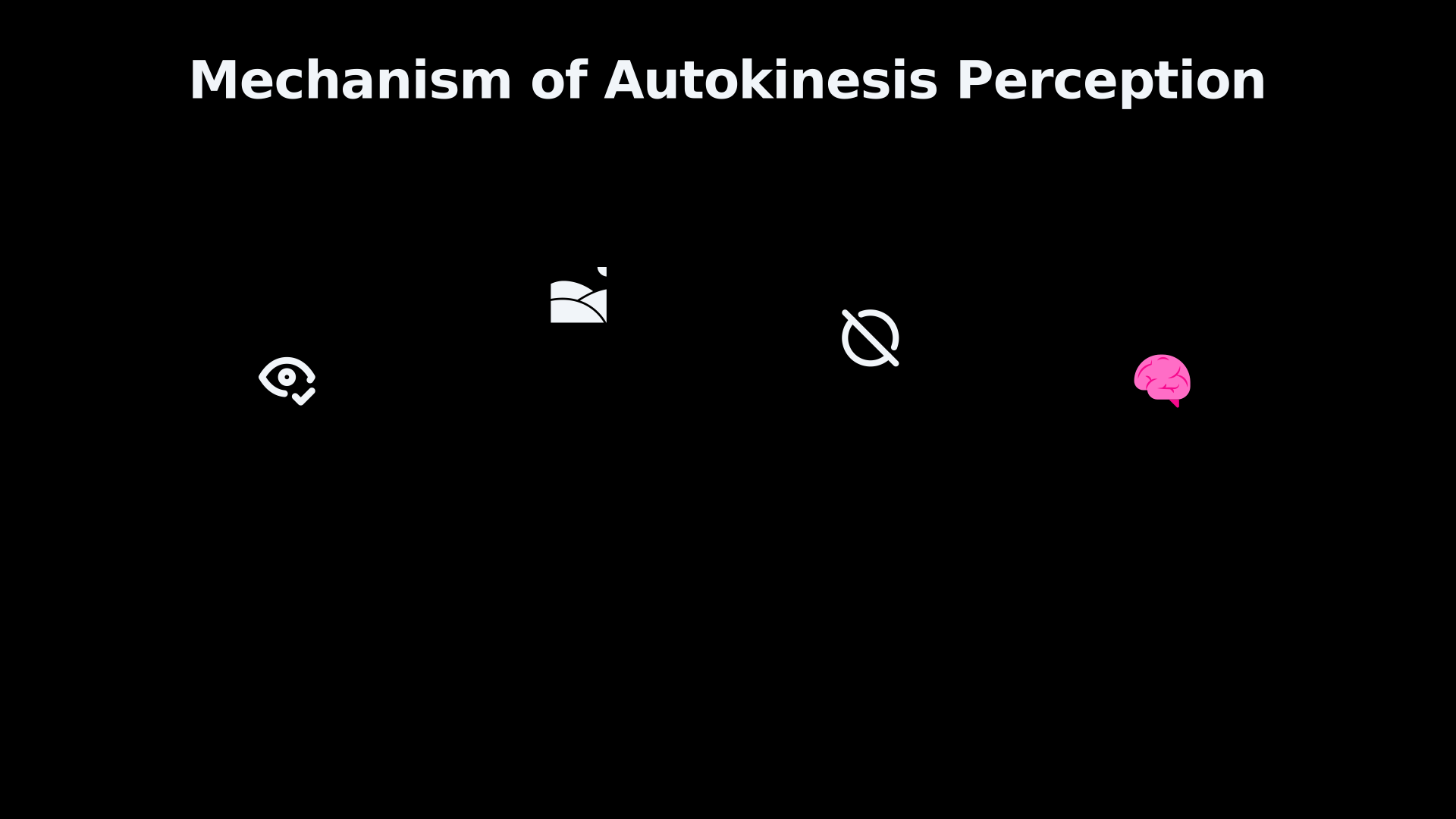
Autokinesis is the apparent movement of a stationary light seen against an otherwise dark scene. The light itself does not move, but the observer experiences subtle drifting, wobbling, short darts or slow directional changes.
The effect is strongest when:
- only one bright light is visible;
- there are few surrounding stars, buildings or landscape features for comparison;
- the observer stares continuously at the light for several seconds; and
- the surrounding environment provides almost no stable visual references.[faa.gov]faa.govFederal Aviation Administration Fitness for FlightFederal Aviation Administration Fitness for Flight
Researchers have investigated the phenomenon for many decades because it illustrates how the brain estimates motion. Human eyes are never perfectly still. Tiny involuntary eye movements normally go unnoticed because the visual system constantly compares them with the surrounding scene. When almost all reference points disappear, the brain can misattribute these small movements to the light itself rather than to the observer’s own visual system. Neuroimaging studies have shown that motion-processing regions of the brain become active even though the light remains physically stationary.[PubMed]pubmed.ncbi.nlm.nih.govPub Med Imaging the visual autokinetic illusion with f MRIImaging the visual autokinetic illusion with fMRI - PubMedAugust 1, 2005…
Importantly, autokinesis changes perception, not reality. A witness who sincerely reports that a light zig-zagged may accurately describe what they experienced without the light having performed extraordinary manoeuvres.
Why remote WA roads create ideal viewing conditions
Western Australia contains some of Australia’s longest and least populated roads. Drivers can spend hours travelling through country where there are few houses, trees, hills or illuminated structures.
These conditions encourage autokinesis for several reasons.
First, the horizon is often exceptionally open. A distant aircraft landing light, communications tower, mining installation or bright planet may be viewed against an almost completely black sky, leaving few fixed points for comparison.
Second, prolonged driving naturally encourages visual fixation. A driver may watch the same distant light for many seconds while travelling towards it. Aviation guidance notes that prolonged fixation greatly increases the likelihood of autokinesis becoming noticeable.[Federal Aviation Administration]faa.govFederal Aviation Administration PHAK Chapter 17Federal Aviation Administration PHAK Chapter 17
Third, darkness removes depth cues. During daylight the brain constantly estimates distance using terrain, vegetation, buildings and shadows. At night these cues largely disappear, making it difficult to judge whether a light is nearby and small or distant and powerful.
Finally, fatigue can make sustained concentration on isolated lights more likely during long-distance driving, although fatigue itself is a separate issue from autokinesis.
These factors help explain why reports from remote roads often describe lights that appear to hover briefly before suddenly sliding sideways or making abrupt changes of direction, despite no independently verified movement.
Why the illusion can seem so convincing
One reason autokinesis has remained relevant in aviation and UFO investigations is that the apparent movement often feels completely real.
Observers commonly describe a stationary light as:
- drifting slowly across the horizon;
- making sudden sideways jumps;
- tracing small circles;
- moving towards or away from them; or
- repeatedly stopping and starting.
The illusion can persist even when the observer knows about it intellectually. That is why pilot training does not simply tell aviators that the effect exists—it teaches practical techniques for avoiding fixation and relying on multiple visual references rather than a single isolated light.[Federal Aviation Administration]faa.govFederal Aviation Administration Fitness for FlightFederal Aviation Administration Fitness for Flight
In UFO reports, this means that witness confidence alone cannot determine whether unusual motion actually occurred. A confident description may accurately reflect perception while remaining an inaccurate description of the light’s physical behaviour.
How to separate eye movement from real motion
Autokinesis has identifiable characteristics that distinguish it from genuine movement.
A light is more likely to be affected by autokinesis if:
- only one isolated light is visible;
- apparent movement begins after several seconds of staring;
- the movement is irregular rather than following a steady course;
- different observers disagree about the exact direction of movement; or
- looking away briefly causes the apparent motion to stop or change.[Federal Aviation Administration]faa.govFederal Aviation Administration PHAK Chapter 17Federal Aviation Administration PHAK Chapter 17
Conversely, genuine movement is more likely if the light changes position relative to multiple stars, hills, buildings or other fixed landmarks, or if several independently positioned observers record the same displacement.
Modern cameras can also be informative. Although cameras have their own limitations, a fixed camera may show a light remaining stationary even when the observer remembers it moving dramatically. Such discrepancies are consistent with autokinesis because the illusion occurs within human visual perception rather than in the external scene.[ufouap.net]ufouap.netAutokinesis: Why a Stationary Light Seems to Move | Global UFO ArchiveJuly 11, 2026…

What this means for Western Australia’s UFO reports
Autokinesis does not explain every unusual light reported in Western Australia. Some sightings involve multiple objects, radar information, structured craft descriptions or independent witnesses observing genuine movement relative to terrain. Those cases require separate evaluation.
However, the mechanism is particularly important when reports share several features:
- a single bright light;
- observation from an isolated road at night;
- few visible landmarks;
- prolonged watching; and
- dramatic claims of darting or hovering based solely on visual observation.
Within the broader history of Western Australian UFO reports, autokinesis therefore provides a well-established perceptual explanation for one recurring pattern of sightings. It neither proves that every report is misidentified nor dismisses witnesses as unreliable. Instead, it demonstrates that remote viewing conditions can produce compelling experiences in which a genuinely stationary light appears to perform extraordinary manoeuvres. Recognising this distinction helps separate cases that primarily reflect known properties of human perception from those that warrant closer investigation on other grounds.
Amazon book picks
Further Reading
Books and field guides related to Why Stationary Lights Seem to Dart in WA. Use these as the next step if you want deeper reading beyond the article.
Sleights of Mind
What can magic tell us about ourselves and our daily lives? If you subtly change the subject during an uncomfortable conversation, did yo...
The Invisible Gorilla
NEW YORK TIMES BESTSELLER • Our minds don’t work the way we think they do. Two renowned psychologists explain how and why our intuitions...
Visual Intelligence
A unique, illustrated popular study reveals the way the human eye acts on the visual world not just to represent but to create the things...
Human Factors in Flight
The late Captain Frank H Hawkins FRAes, M Phil, was Human Factors Consultant to KLM, for whom he had flown for over 30 years as line capt...
eBay marketplace picks
Marketplace Samples
Live-tested eBay searches with available results related to this page.
Selected fromaviation poster oneBay.co.uk.
Endnotes
1.
Source: medium.com
Link:https://medium.com/faa/your-senses-in-the-shadows-5ed018e015b5
Source snippet
Nighttime Visual Illusions and Spatial… | by FAA Safety Briefing Magazine | Cleared for Takeoff | MediumJanuary 17, 2025 — Cleared for Ta...
Published: January 17, 2025
2.
Source: ufouap.net
Title: Autokinesis: Why a Stationary Light Seems to Move | Global UFO Archive
Link:https://www.ufouap.net/en/explainers/autokinesis-stationary-light-illusion
Source snippet
July 11, 2026...
Published: July 11, 2026
3.
Source: faa.gov
Title: Federal Aviation Administration Fitness for Flight
Link:https://www.faa.gov/air_traffic/publications/atpubs/aip_html/chap8_section_1.html
4.
Source: faa.gov
Title: Federal Aviation Administration PHAK Chapter 17
Link:https://www.faa.gov/sites/faa.gov/files/19_phak_ch17.pdf
5.
Source: pubmed.ncbi.nlm.nih.gov
Title: Pub Med Imaging the visual autokinetic illusion with f MRI
Link:https://pubmed.ncbi.nlm.nih.gov/15878673/
Source snippet
Imaging the visual autokinetic illusion with fMRI - PubMedAugust 1, 2005...
Published: August 1, 2005
6.
Source: atsb.gov.au
Link:https://www.atsb.gov.au/investigations/ao
Source snippet
5 | ATSBMay 6, 2026 — FINAL REPORT Report release date: 06/05/2026 INVESTIGATION SUMMARY WHAT HAPPENED On the evening of 9 October 2025...
Published: May 6, 2026
7.
Source: atsb.gov.au
Link:https://www.atsb.gov.au/investigations/ro
8.
Source: casa.gov.au
Title: Flying at night | Civil Aviation Safety Authority
Link:https://www.casa.gov.au//drones/flight-authorisations/flying-night
9.
Source: pmc.ncbi.nlm.nih.gov
Link:https://pmc.ncbi.nlm.nih.gov/articles/PMC10965040/
10.
Source: wa.gov.au
Link:https://www.wa.gov.au/government/publications/automated-vehicles-and-the-readiness-of-western-australian-roads-phase-2-suitability-of-wa-roads-lane-departure-warning-systems
11.
Source: atsb.gov.au
Link:https://www.atsb.gov.au/investigations/ro
12.
Source: atsb.gov.au
Link:https://www.atsb.gov.au/taxonomy/term/3
13.
Source: atsb.gov.au
Link:https://www.atsb.gov.au/investigations/ro
14.
Source: atsb.gov.au
Title: which way is up
Link:https://www.atsb.gov.au/media/news-items/2015/which-way-is-up
15.
Source: faa.gov
Title: Chapter 8. Medical Facts for Pilots
Link:https://www.faa.gov/air_traffic/publications/atpubs/aim/aim0801.html
16.
Source: atsb.gov.au
Title: dangers of flying with reduced visibility
Link:https://www.atsb.gov.au/media/news-items/2014/dangers-of-flying-with-reduced-visibility
17.
Source: atsb.gov.au
Title: Avoidable Accidents No. 7
Link:https://www.atsb.gov.au/publications/avoidable-accidents/2013/aviation/avoidable-accidents-no-7-visual-flight-night
18.
Source: atsb.gov.au
Title: taking off in the darkness
Link:https://www.atsb.gov.au/media/news-items/2013/taking-off-in-the-darkness
19.
Source: atsb.gov.au
Title: dark night take accidents australia
Link:https://www.atsb.gov.au/publications/research-and-analysis-report/2022/aviation/dark-night-take-accidents-australia
20.
Source: atsb.gov.au
Title: dark night take off accidents in australia
Link:https://www.atsb.gov.au/publications/1995/dark-night-take-off-accidents-in-australia
21.
Source: faa.gov
Link:https://www.faa.gov/Air_traffic/publications/atpubs/aim_html/chap8_section_1.html
22.
Source: faa.gov
Link:https://www.faa.gov/data_research/research/med_humanfacs/oamtechreports/1960s/1969/196923
23.
Source: atsb.gov.au
Link:https://www.atsb.gov.au/node?page=911
24.
Source: mainroads.wa.gov.au
Link:https://www.mainroads.wa.gov.au/community-environment/bridges-lighting/
Additional References
25.
Source: researchgate.net
Title: The FAA advises pilots to conduct thorough pre-flight briefings th
Link:https://www.researchgate.net/publication/400386255_Physiology_in_Aviation_Hearing_Vision_Spatial_Disorientation_and_Visual_Illusions
Source snippet
(PDF) Physiology in Aviation: Hearing, Vision, Spatial Disorientation, and Visual IllusionsFebruary 3, 2026 — runway creates a false high...
Published: February 3, 2026
26.
Source: youtube.com
Title: Conformity Research: Sherif’s Autokinetic Effect Experiment
Link:https://www.youtube.com/watch?v=1-pbW6kc7q0
Source snippet
This PPGS Aeromedical Illusions ground school lesson is directly relevant because it breaks down how autokinesis occurs in dark, featurel...
27.
Source: youtube.com
Title: Chapter 17 Aeromedical Factors: Spatial Disorientation and Illusions
Link:https://www.youtube.com/watch?v=n1UYc615ZTQ
Source snippet
The Moving Statues Phenomenon, Ireland 1985...
28.
Source: thepilotexam.com
Link:https://thepilotexam.com/glossary/autokinetic-illusion
29.
Source: af.mil
Link:https://www.af.mil/News/Article-Display/Article/2209213/black-box-sheds-light-on-night-vision-challenges-for-aircrew-students/
30.
Source: youtube.com
Link:https://www.youtube.com/watch?v=k9uNpszPV7s
Source snippet
Conformity Research: Sherif's Autokinetic Effect Experiment...
31.
Source: youtube.com
Title: Aviation Visual Illusions
Link:https://www.youtube.com/watch?v=zZOhH07h4Iw
Source snippet
Chapter 17 Aeromedical Factors: Spatial Disorientation and Illusions...
32.
Source: sciencedirect.com
Title: Imaging the visual autokinetic illusion with f MRI
Link:https://www.sciencedirect.com/science/article/abs/pii/S1053811905002168
33.
Source: youtube.com
Title: PPGS Lesson 14.2 | Aeromedical: Illusions
Link:https://www.youtube.com/watch?v=ZBPmFaqECdM
Source snippet
Aviation Visual Illusions...
34.
Source: aopa.org
Title: Tricked by Illusions
Link:https://www.aopa.org/training-and-safety/online-learning/safety-spotlights/spatial-disorientation/tricked-by-illusions