Within Maralinga Light
Was Maralinga's Light Natural After All?
The official report favoured a meteor or static electricity, but the surviving evidence cannot confirm either explanation.
On this page
- The case for a meteor
- What static electricity might mean
- Why no explanation can now be proven
Page outline Jump by section
Introduction
The official investigation into the July 1960 Maralinga light did not conclude that the witnesses had seen an extraordinary object. Instead, after ruling out several local possibilities, the security report stated that the most likely explanations were either a meteor or static electricity while also admitting that the source could not be positively identified. That combination is important. It means the inquiry ended with a preferred natural explanation, not with proof. Because no photograph, radar track or instrument recorded the event, and because the eyewitnesses could not reliably judge its distance or height, neither proposed mechanism can now be confirmed.[NAA]naa.gov.auNAAUFO sightings at weapons testing site, Woomera | naa.gov.auJuly 24, 1960…
This unresolved balance between plausible natural causes and missing evidence is one reason the Maralinga sighting remains part of South Australia’s UFO history. It illustrates how an official investigation can eliminate some possibilities without establishing exactly what was seen.
Was Maralinga’s Light Natural After All?
The case for a meteor
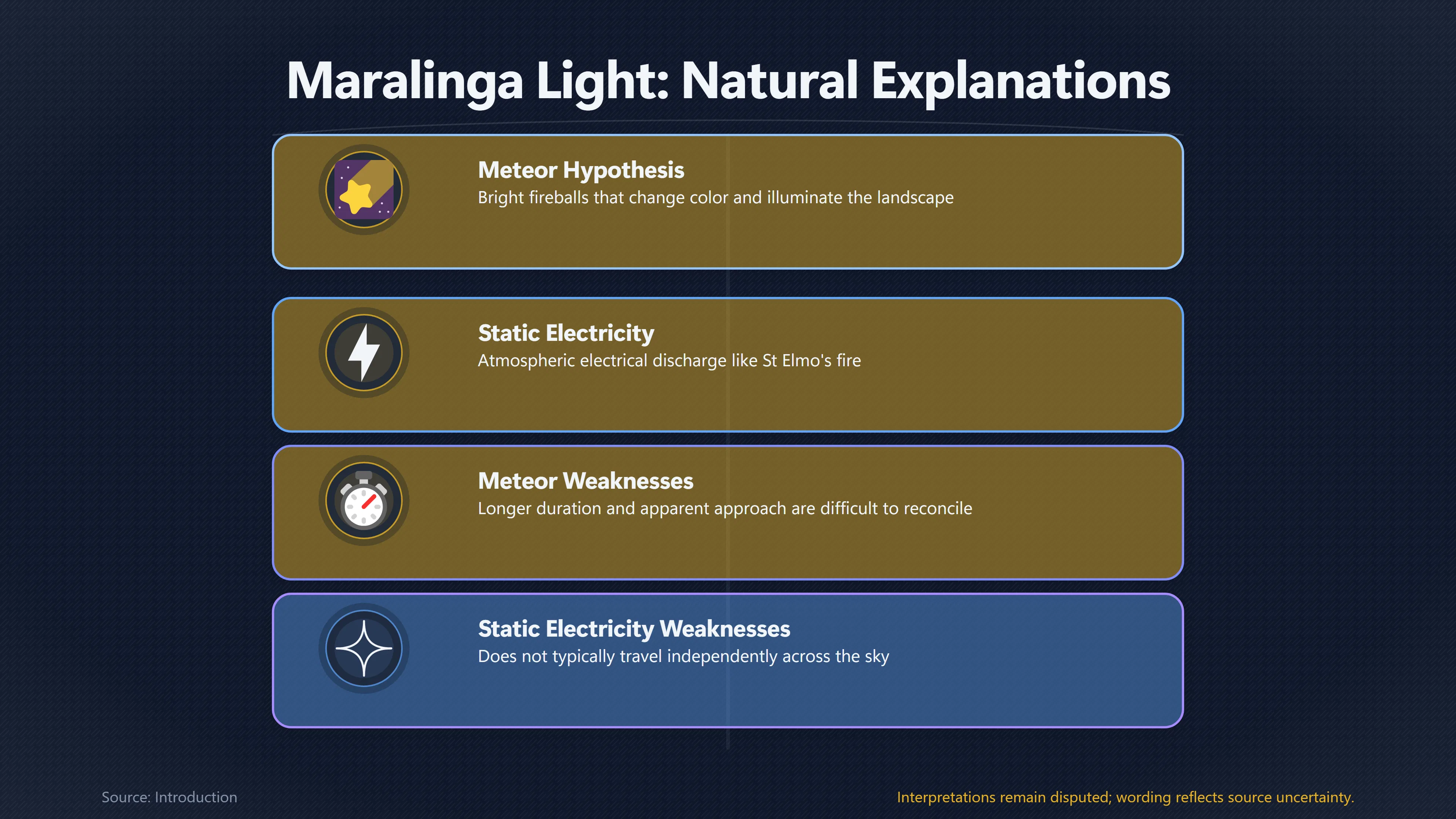
A meteor is the simpler of the two official suggestions. Bright fireballs can illuminate the landscape, change colour as they pass through the atmosphere and appear dramatic enough to be mistaken for aircraft, explosions or burning objects. A particularly bright meteor can also be visible over a wide area, matching the fact that more than one observer reported seeing a luminous object.[NAA]naa.gov.auNAAUFO sightings at weapons testing site, Woomera | naa.gov.auJuly 24, 1960…
Several features of the Maralinga observations are broadly compatible with a meteor:
- the light was seen only briefly;
- witnesses described an intense white light that later appeared reddish;
- there was no evidence that anything landed or remained airborne afterwards;
- searches found no damaged balloons, aircraft or other local source.[NAA]naa.gov.auNAAUFO sightings at weapons testing site, Woomera | naa.gov.auJuly 24, 1960…
However, the meteor explanation also has weaknesses.
The principal witness estimated the display lasted around 30 seconds, while other witnesses recalled much shorter durations. Although eyewitness timing during unexpected events is often inaccurate, half a minute is longer than many bright meteor sightings. Likewise, descriptions suggesting that the object appeared to approach the observers are difficult to interpret because apparent changes in brightness and perspective can create an illusion of closing distance without any actual approach. Since nobody could determine the object’s true range, these impressions cannot be converted into a reliable trajectory.[NAA]naa.gov.auNAAUFO sightings at weapons testing site, Woomera | naa.gov.auJuly 24, 1960…
Most importantly, the investigators did not identify an independently recorded meteor over South Australia that evening. Their report simply regarded a meteor as the best available natural explanation after other local possibilities had been examined.
What “static electricity” might mean
The report’s second suggestion has generated more confusion than the meteor explanation because it was never fully developed in the surviving documents.
The investigators were considering atmospheric electrical effects rather than an electrically powered craft. Their report notes that they researched static electricity in Adelaide and found little directly applicable information. The only phenomenon specifically mentioned was St Elmo’s fire, a glow produced by atmospheric electrical discharge around pointed objects under suitable weather conditions.[UFO Transparency]ufotransparency.comOpen source on ufotransparency.com.
That reference suggests officials were exploring whether electrical conditions around the instrumentation balloons or surrounding atmosphere could have produced an unusual luminous effect. Such ideas were reasonable to investigate because Wewak contained static balloons used in support of the Vixen A weapons trials, making atmospheric electricity a practical operational concern rather than an exotic hypothesis.[NAA]naa.gov.auNAAUFO sightings at weapons testing site, Woomera | naa.gov.auJuly 24, 1960…
Even so, the static electricity explanation faces significant problems.
St Elmo’s fire normally appears as a glow attached to masts, aircraft, towers or other projecting objects during highly electrified weather. It is not generally described as a bright light travelling independently across the sky from east to west. The surviving report never explains exactly how static electricity would account for the witnesses’ descriptions, nor does it identify weather conditions that would support such an interpretation. Instead, the idea appears as a tentative possibility rather than a demonstrated solution.[UFO Transparency]ufotransparency.comOpen source on ufotransparency.com.
Why neither explanation can now be proven
The greatest obstacle is not choosing between meteor and static electricity but recognising how little measurable information survives.
The investigation itself acknowledged several critical limitations:
- witnesses could estimate only the apparent size of the light, not its actual distance;
- estimates of duration varied between observers;
- there were no photographs or film;
- radar did not record the event;
- no physical evidence remained afterwards;
- no instrumented balloon or other equipment captured relevant data.[NAA]naa.gov.auNAAUFO sightings at weapons testing site, Woomera | naa.gov.auJuly 24, 1960…
These missing measurements matter because almost every physical interpretation depends on knowing the object’s distance. A nearby atmospheric glow, a distant meteor and another bright aerial phenomenon can all occupy a similar apparent angle in the sky while differing enormously in true size and speed.
The report also records that Health Physics Officer Oliver Harry Turner reached a very different conclusion after conducting his own calculations, arguing that the light was not a natural phenomenon. Those calculations do not survive with the brief security report, making it impossible to assess or reproduce his reasoning. As a result, neither Turner’s interpretation nor the security officer’s preferred natural explanations can be independently verified today.[UFO Transparency]ufotransparency.comOpen source on ufotransparency.com.
What the official conclusion really means
The final sentence of the Maralinga report is often quoted selectively. Read in full, it is more cautious than either believers or sceptics sometimes suggest.
The investigators first stated that all reasonable lines of inquiry had been exhausted and that the source could not be positively identified. Only then did they add that they felt the light was the result of either a meteor or static electricity. In other words, the report expressed a judgement rather than documenting a solved case.[NAA]naa.gov.auNAAUFO sightings at weapons testing site, Woomera | naa.gov.auJuly 24, 1960…
That distinction explains why the Maralinga incident continues to occupy an intermediate place in South Australia’s UFO history. It is not a confirmed example of an unexplained craft, but neither is it a straightforward debunking. The surviving evidence supports plausible natural explanations, yet lacks the measurements needed to prove either one. Consequently, the case remains officially unresolved while leaning towards a natural interpretation rather than an extraordinary one.
Amazon book picks
Further Reading
Books and field guides related to Was Maralinga's Light Natural After All?. Use these as the next step if you want deeper reading beyond the article.
The Demon-Haunted World
NEW YORK TIMES BESTSELLER • From the renowned astronomer and author of Cosmos comes a “powerful [and] stirring defense of informed ration...
The UFO Experience: A Scientific Inquiry
Cited by the New York Review of Books as "the best brief for visitation," this classic study presents an analysis of UFO reports and conc...
eBay marketplace picks
Marketplace Samples
Live-tested eBay searches with available results related to this page.
Selected fromUFO poster oneBay.co.uk.
Current eBay listing
VINTAGE UFO FLYING SAUCERS COMIC ADVERTISING A2 POSTER PRINT



Current eBay listing
I Want To Believe UFO Poster Giclée Fine Art Heavyweight Print
Endnotes
1.
Source: naa.gov.au
Title: NAAUFO sightings at weapons testing site, Woomera | naa.gov.au
Link:https://www.naa.gov.au/students-and-teachers/student-research-portal/learning-resource-themes/war/defence-equipment-and-weapons/ufo-sightings-weapons-testing-site-woomera
Source snippet
July 24, 1960...
Published: July 24, 1960
2.
Source: ufotransparency.com
Link:https://ufotransparency.com/files/intl-au-woomera-weapons-testing-ufo-sightings-at-weapons-testing-site
3.
Source: naa.gov.au
Title: NAABritish nuclear tests at Maralinga | naa.gov.au
Link:https://www.naa.gov.au/explore-collection/first-australians/other-resources-about-first-australians/british-nuclear-tests-maralinga
4.
Source: naa.gov.au
Title: Some records include ter
Link:https://www.naa.gov.au/students-and-teachers/learning-resources/learning-resource-themes/war/defence-equipment-and-weapons/nuclear-bomb-test-maralinga
Source snippet
Nuclear bomb test at Maralinga | naa.gov.auAboriginal and Torres Strait Islander people should be aware that the National Archives' websi...
Additional References
5.
Source: commons.wikimedia.org
Link:https://commons.wikimedia.org/wiki/File%3AThe_NBS_meteor-burst_propagation_project_-a_progress_report%28IA_nbsmeteorburstpr86horn%29.pdf
Source snippet
wikimedia.orgFile:The NBS meteor-burst propagation project - a progress report (IA nbsmeteorburstpr86horn).pdf - Wikimedia CommonsFILE:TH...
6.
Source: nist.gov
Title: nbs meteor burst propagation project progress report
Link:https://www.nist.gov/publications/nbs-meteor-burst-propagation-project-progress-report
Source snippet
The NBS meteor-burst propagation project::a progress report | NISTJanuary 1, 1960 — THE NBS METEOR-BURST PROPAGATION PROJECT::A PROGRES...
Published: January 1, 1960
7.
Source: ufomagazines.com
Link:https://www.ufomagazines.com/disclosure-australia-aura-disclosure-australia-aura-no-25-oct-2005/
Source snippet
NEWSLETTER TWENTY-FIVE — Disclosure Australia (AURA) | UFO Magazine ArchiveREPORT FROM MARALINGA SOUTH AUSTRALIA IN 1960 The National Arc...
8.
Source: arxiv.org
Title: arXiv Physics of Meteor Generated Shock Waves in the Earth’s Atmosphere
Link:https://arxiv.org/abs/1805.07842
Source snippet
Physics of Meteor Generated Shock Waves in the Earth's Atmosphere - A Review...
9.
Source: nist.gov
Title: Field strength calculations for E.L.F
Link:https://www.nist.gov/publications/field-strength-calculations-elf-radio-waves
Source snippet
radio waves: | NISTJanuary 1, 1960 — FIELD STRENGTH CALCULATIONS FOR E.L.F. RADIO WAVES: Published January 1, 1960 AUTHOR(S) James R Wait...
Published: January 1, 1960
10.
Source: youtube.com
Link:https://www.youtube.com/watch?v=KJCbi0sxX9Q
Source snippet
Australia's Secret Nuclear Test Zone | Maralinga! Ric Johnstone tells his story...
11.
Source: youtube.com
Title: Australia’s Secret Nuclear Test Zone | Maralinga! Ric Johnstone tells his story!
Link:https://www.youtube.com/watch?v=jYkT86DA4Zw
Source snippet
Ball Lightning: Weather's Biggest Mystery | Answers With Joe...
12.
Source: llifs.com.au
Title: LLIF S
Link:https://www.llifs.com.au/blog/woomera-ufos/
Source snippet
Reading Time: 5 minutes General, UFO Encounters, Famous Paranormal Cases. 3112 page views. 0 comments. ON THE 15TH OF JULY 1960, THERE WE...
Published: JULY 1960
13.
Source: ntrs.nasa.gov
Link:https://ntrs.nasa.gov/search.jsp?R=19920049582
Source snippet
nasa.govMaralinga, a metamorphosed carbonaceous chondrite found in Australia - NASA Technical Reports Server (NTRS)March 1, 1992 — Back t...
Published: March 1, 1992
14.
Source: agupubs.onlinelibrary.wiley.com
Link:https://agupubs.onlinelibrary.wiley.com/doi/abs/10.1029/JZ065i007p01947
Source snippet
1947-1952 BALL LIGHTNING AS A PHYSICAL PHENOMENON E. L. Hill, E. L. Hill Search for more papers by this author First...