Within NSW UFO History
Who Preserved New South Wales's UFO Stories?
Civilian researchers preserved many New South Wales reports after official collection declined, but their archives vary greatly in sourcing and reliability.
On this page
- Sydney's Early Civilian Research Groups
- Investigators, Interviews and Private Collections
- How to Judge Uneven Archival Evidence
Page outline Jump by section
Introduction
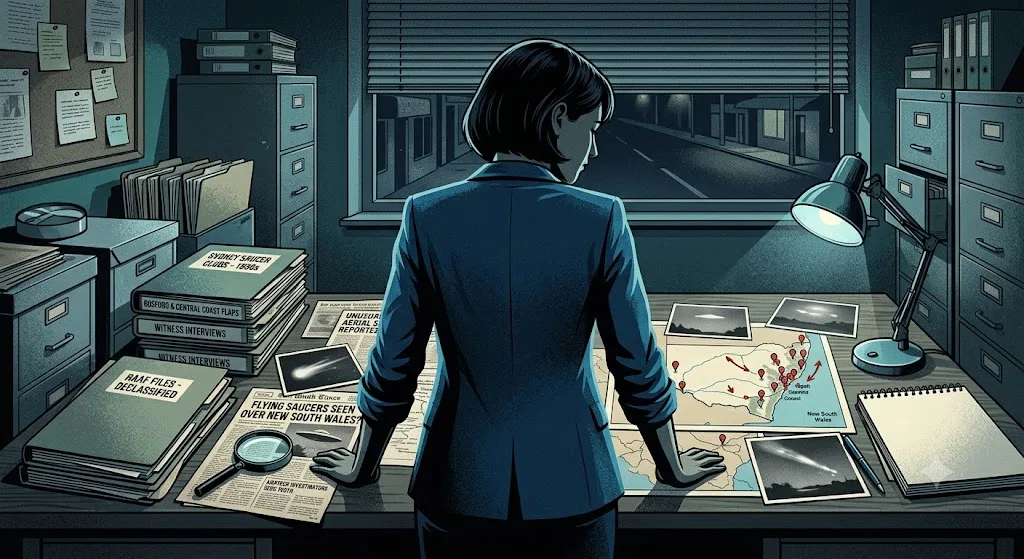
Civilian investigators preserved much of New South Wales’s UFO record. From Sydney’s flying-saucer clubs of the 1950s to later researchers who interviewed witnesses, copied government files and assembled regional case collections, volunteers saved reports that official agencies, newspapers and witnesses themselves might not have retained. Their work matters especially because the Royal Australian Air Force eventually stopped routinely collecting unusual aerial sighting reports, leaving civilian organisations as the most visible destination for many members of the public.[ABC News]abc.net.auABC NewsHow Bill Chalker became one of the first civilians to access the RAAF's UFO files - ABC News…
This preservation came at a cost. There was no single statewide archive, standard investigation method or independent quality-control system. Some files contain prompt interviews, maps, correspondence and attempts to check aircraft or astronomical explanations. Others consist of undated press cuttings, brief summaries, recollections recorded decades later or claims copied repeatedly between publications. The civilian archive is therefore indispensable but uneven: it tells researchers what people reported and how investigators interpreted those reports, not necessarily what was physically present in the sky.
Sydney’s early civilian research groups
Organised civilian UFO research in New South Wales emerged during the international flying-saucer excitement of the early 1950s. Historical accounts identify Edgar Jarrold’s Australian Flying Saucer Bureau, established in Sydney in 1952, as the first prominent public organisation of its kind in Australia. It published the Australian Flying Saucer Magazine and invited witnesses to submit sightings at a time when few established scientific bodies welcomed such reports.[Primidi]primidi.comAustralian UfologyIn July 1952, Edgar Jarrold founded the Australian Flying Saucer Bureau (AFSB) in Sydney…. I have lists of the dates over the last sev…
Jarrold’s bureau helped establish a pattern that would define civilian investigation in the state: a small number of committed organisers acted simultaneously as report collectors, interviewers, editors, public spokespeople and custodians of the resulting paperwork. This made activity possible on very limited resources, but it also concentrated editorial control. The same person might decide which witnesses sounded credible, how a case should be described and whether it deserved publication.
Sydney’s UFO community soon fragmented into competing organisations. Historical reconstructions describe the formation of the UFO Investigation Centre, generally known as UFOIC, in the mid-1950s, alongside the larger Northern Suburbs Flying Saucer Research Association. Rivalries over membership, public lectures and the direction of the subject weakened cooperation between groups. The dispute surrounding the 1959 Sydney appearance of contactee George Adamski—who claimed meetings with visitors from other planets—illustrated a lasting division between investigators seeking observational evidence and enthusiasts more willing to accept extraordinary personal testimony.[Wikipedia]WikipediaAustralian ufologyAustralian ufology
UFOIC nevertheless developed a durable publishing record. The National Library of Australia catalogues 50 issues of the U.F.O.I.C. Newsletter from March 1964 to January–February 1977, followed by a shorter run titled UFO Newsletter. These publications are valuable because they preserve case summaries, correspondence, organisational debates and references to reports that may survive nowhere else. Their presence in a national collection also makes at least part of the private UFO record accessible beyond the original membership.[National Library of Australia Catalogue]catalogue.nla.gov.auNational Library of Australia Catalogue U.F.O.I.Cnewsletter | Catalogue | National Library of AustraliaSydney: U.F.O.I.C., [1964]-1977 50 volumes; 34 cm Series: John Ryan Comic Collect…
Such newsletters should not be mistaken for neutral scientific journals. They were produced by interested organisations for interested readers, and their selection of material reflected the assumptions of editors and contributors. Yet they remain primary historical sources for understanding which New South Wales sightings attracted attention, how witnesses were questioned and how explanations changed as cases circulated.

Investigators, interviews and private collections
The most useful civilian investigators did more than accumulate unusual stories. They contacted witnesses, visited locations, drew sightlines, searched newspaper archives, compared accounts and sought information from aviation, weather or defence authorities. Even when those efforts did not solve a case, they often preserved basic evidence—names, dates, directions, durations and original wording—that later retellings tended to lose.
Bill Chalker became one of the most prominent New South Wales-based examples. Trained as a chemist and active in UFO research from the 1970s, he investigated reported landing sites and pursued access to Commonwealth records. An ABC account documents his examination of Department of Defence UFO files in Canberra in 1982, after a lengthy effort to obtain permission. He spent about a week recording material from files that had previously been difficult for civilians to inspect.[ABC News]abc.net.auABC NewsHow Bill Chalker became one of the first civilians to access the RAAF's UFO files - ABC News…
That episode mattered beyond any single sighting. Civilian researchers had often suspected that published government summaries omitted important detail. Direct archival access allowed Chalker to compare official paperwork with accounts circulating among private groups and to identify references to reports, assessments and administrative decisions that were not widely known. It also helped move Australian UFO history away from pure oral tradition and towards documents that other researchers could seek in public archives.
The access did not validate every civilian claim. Chalker interpreted some official material more dramatically than defence officials did, including an early scientific assessment that he believed supported an extraterrestrial explanation for a residual number of reports. Former RAAF intelligence officer Brett Biddington instead described the service’s interest as rooted largely in Cold War concerns about aircraft, rockets, satellites and re-entering human technology. This difference is important: the existence of a classified or restricted file proves official attention, not official acceptance of an exotic explanation.[ABC News]abc.net.auABC NewsHow Bill Chalker became one of the first civilians to access the RAAF's UFO files - ABC News…
Private collections also preserve material that government systems were never designed to hold. A civilian case file may include:
- an investigator’s handwritten notes from the first telephone call;
- sketches made by witnesses before seeing media illustrations;
- letters exchanged with other state organisations;
- press cuttings from local newspapers not easily searchable today;
- photographs of an alleged site or physical trace;
- later correspondence showing how a witness’s account changed;
- attempts to match a sighting with aircraft, planets, meteors or satellites.
The weakness is that these elements are not consistently present. Some files survive only as a published summary written by the investigator. Others are inaccessible in personal cupboards, have been divided among former members or disappeared when an organisation closed. The surviving record therefore reflects preservation luck as much as the original importance of a case.
The Central Coast as a civilian-built case record
The reported UFO activity around Gosford and the Central Coast shows how civilian investigators could turn scattered local stories into a recognised regional pattern. Moira McGhee and Bryan Dickeson collected reports for The Gosford Files: UFOs over the Central Coast of New South Wales, published in 1996 through the Independent Network of UFO Researchers. Copies are catalogued by the State Library of New South Wales and the National Library of Australia.[search.sl.nsw.gov.au]search.sl.nsw.gov.auOpen source on nsw.gov.au.
The book’s lasting importance is archival rather than evidentially conclusive. It brought together witness interviews, local reports and claims of repeated activity that might otherwise have remained isolated. Once assembled, the material encouraged later writers and investigators to describe the Central Coast as a UFO “hotspot”.
That label needs care. A cluster in a civilian archive may reflect a real concentration of unusual observations, but it may also reflect population density, active local publicity and the presence of investigators who were easy to contact. Once newspapers report that an area is a hotspot, more residents examine ambiguous lights, remember earlier experiences and know where to submit them. Reporting can therefore reinforce the appearance of clustering without anyone fabricating an experience.
The Central Coast also presents difficult observational conditions. Coastal weather, reflections, aircraft approaching or departing the Sydney region, helicopters, bright planets and lights seen across water can all produce misleading impressions of distance and movement. These possibilities do not automatically explain every report, but they mean that repeated testimony alone cannot establish a single extraordinary cause.
The most defensible conclusion is that civilian investigators demonstrated the existence of a substantial local reporting tradition. They did not demonstrate that all reports shared one origin, or that the region was being visited by an unknown technology. The collection is a starting dataset whose individual entries must be assessed separately.
What changed when official collection ended?
For several decades, the RAAF received reports from civilians, police, aviation personnel and UFO organisations under the term “unusual aerial sightings”. Its interest was connected primarily to defence and intelligence: an unidentified light or object might represent an aircraft, missile, satellite, re-entry or some other human-made development. Most reports were ultimately attributed to ordinary causes, while some remained unresolved because the available information was insufficient.[ABC News]abc.net.auABC NewsHow Bill Chalker became one of the first civilians to access the RAAF's UFO files - ABC News…
The air force ended its dedicated UFO function in the 1990s. Defence documents later reported by SBS said that the function officially ceased in 1996 because existing records provided no compelling reason to continue devoting resources to routine collection and investigation. Reports involving an immediate safety or security issue could still be directed to police, aviation or defence authorities, but ordinary UFO reports were to be referred to civilian research organisations.[SBS Australia]sbs.com.auSBS Australia If you see an UFO, don't call the RAAF | SBS News | SBS NewsSBS Australia If you see an UFO, don't call the RAAF | SBS News | SBS News
This effectively shifted custodianship without creating a funded civilian replacement. Volunteer groups inherited public expectations but not the RAAF’s access to radar records, operational information, specialist staff or formal recordkeeping infrastructure. Their role became larger just as the evidence available to them often became weaker.
The change produced three lasting consequences for the New South Wales record.
Civilian databases became more important. Without routine government intake, a sighting reported only to a private organisation might never enter an official archive.
Standards became more variable. Different groups used different forms, classification systems and thresholds for deciding that a case was explained or unexplained.
The archive became harder to audit. Government files normally carry dates, reference numbers and administrative histories. Private records may lack clear provenance or remain unavailable to independent researchers.
The present UFO Research (NSW) organisation, founded in 1991, illustrates both the value and the limits of this civilian infrastructure. Its website maintains sighting material arranged across historical periods, newsletters, newspaper collections and copies of older Australian flying-saucer publications. This provides useful public access to records extending back into the 1950s. At the same time, the organisation’s activities include a broad range of anomalous and claimed contact experiences, so inclusion in its archive cannot by itself be treated as verification.[ufor.asn.au]ufor.asn.auUF O Research (NSW) Incorporated, Sydney, AustraliaUF O Research (NSW) Incorporated, Sydney, Australia
How investigators shaped the stories they saved
An archive does not merely preserve a report; it can change it. Investigators decide which questions to ask, which comparisons to make and which details to highlight. A witness who originally reported “a bright light” may later be associated with a structured craft if questions repeatedly focus on shape. Conversely, a careful investigator may discover that the most dramatic language entered only after newspaper coverage.
Several recurring influences affect New South Wales civilian case files:
Delay. Interviews conducted immediately after a sighting generally preserve more reliable timing, direction and sequence than accounts collected years later. Long delay increases the risk of memory reconstruction and contamination by later publicity.
Expectation. An investigator convinced that unknown craft are visiting Earth may interpret ambiguity as supporting that belief. A rigid sceptic can make the opposite mistake by forcing an explanation that does not fit the testimony.
Publication pressure. Newsletters and books favour memorable cases. Reports quickly identified as stars, aircraft or balloons are less likely to be republished, producing an archive weighted towards mystery.
Witness reinforcement. Group meetings and media interviews can provide witnesses with social support, but repeated discussion may also cause separate memories to converge.
Loss of negative findings. A published case may mention that investigators checked flight activity without preserving the reply, date or name of the authority consulted. Later readers then cannot verify the claimed check.
These problems are not unique to UFO research. They occur in oral history, journalism and police interviewing. What distinguishes civilian UFO archives is the frequent absence of institutional safeguards such as recorded interviews, standard forms, peer review and guaranteed long-term preservation.
How to judge uneven archival evidence
The best way to use the NSW civilian record is neither to dismiss it as folklore nor to accept it as a catalogue of extraordinary craft. Each file should be treated as a bundle of claims with a traceable—or sometimes untraceable—history.
A strong civilian case file usually has several of the following features:
- Contemporary documentation. Notes, letters or reports created close to the event carry more weight than a polished recollection recorded decades later.
- Independent witnesses. Separate accounts obtained before witnesses discussed the event are more useful than a single jointly prepared narrative.
- Precise observational data. Time, location, direction, angular height, duration, weather and viewing conditions allow ordinary explanations to be tested.
- Original materials. Full interviews, photographs and sketches are preferable to an investigator’s summary.
- Documented checks. Claims about radar, aircraft or weather should identify the source consulted and preserve the response.
- A clear chain of custody. Researchers should be able to establish who created each document, when it entered the collection and whether it was altered.
- Visible uncertainty. A trustworthy investigator distinguishes between unidentified, inadequately investigated and apparently anomalous.
A weak file often relies on an anonymous witness, an approximate date, dramatic estimates of speed or size without reference points, and a summary copied from an earlier publication. Multiple websites repeating such a story do not create independent confirmation; they may all descend from the same missing newsletter paragraph.
“Unexplained” also requires careful reading. It can mean that investigators found evidence inconsistent with familiar objects. More commonly, it means that too little reliable information survived to reach any conclusion. The second category is a recordkeeping failure, not positive evidence of an extraordinary vehicle.

What the civilian archive can establish
New South Wales’s civilian investigators preserved a cultural and historical record that would otherwise be far smaller. Their newsletters show how reports circulated through Sydney; their interviews retain the voices of witnesses; their books reveal where local clusters were perceived; and their copying of government documents helped make official UFO history open to wider examination. Library catalogues and surviving organisational websites confirm that substantial runs of publications have endured even when the groups that produced them changed or disappeared.[nla.gov.au]catalogue.nla.gov.auNational Library of Australia Catalogue U.F.O.I.Cnewsletter | Catalogue | National Library of AustraliaSydney: U.F.O.I.C., [1964]-1977 50 volumes; 34 cm Series: John Ryan Comic Collect…
What they preserved is evidence of reporting, investigation and belief. In selected cases it may also preserve useful observational data. It is not, as a whole, evidence that every archived object was genuinely beyond conventional explanation.
The fairest assessment is therefore case by case. Civilian investigators deserve credit for rescuing fragile material and challenging official secrecy or indifference. Their conclusions deserve the same scrutiny applied to government reports, newspaper stories and witness memories. The strongest NSW UFO history emerges where these sources can be compared—not where one archive, organisation or investigator is asked to carry the entire claim.
Amazon book picks
Further Reading
Books and field guides related to Who Preserved New South Wales's UFO Stories?. Use these as the next step if you want deeper reading beyond the article.
UFOs: A Report on Australian Encounters
A consideration of the evidence for and against the existence of alien spacecraft. It includes a checklist of UFO sightings in Australia...
The UFO Handbook: A Guide to Investigating, Evaluating, and R...
An explanation of the usual reasons for confusing IFOs (identified flying objects) with UFOs and a survey of the tools used to investigat...
The UFO Files: The Inside Story of Real-Life Sightings
'What does all this stuff about flying saucers amount to? What can it mean? What is the truth?' Winston Churchill, prime minister's perso...

eBay marketplace picks
Marketplace Samples
Live-tested eBay searches with available results related to this page.
Selected fromUFO patch oneBay.co.uk.

Endnotes
1.
Source: primidi.com
Title: Australian Ufology
Link:https://www.primidi.com/australian_ufology/history/1950s
Source snippet
In July 1952, Edgar Jarrold founded the Australian Flying Saucer Bureau (AFSB) in Sydney.... I have lists of the dates over the last sev...
Published: July 1952
2.
Source: Wikipedia
Title: Australian ufology
Link:https://en.wikipedia.org/wiki/Australian_ufology
3.
Source: catalogue.nla.gov.au
Title: National Library of Australia Catalogue U.F.O.I.C
Link:https://catalogue.nla.gov.au/catalog/2916633
Source snippet
newsletter | Catalogue | National Library of AustraliaSydney: U.F.O.I.C., [1964]-1977 50 volumes; 34 cm Series: John Ryan Comic Collect...
4.
Source: catalogue.nla.gov.au
Link:https://catalogue.nla.gov.au/catalog/1394168
Source snippet
U.F.O.I.C. newsletter Subject: Unidentified flying objects -- Sightings and encounters -- New South Wales...
5.
Source: search.sl.nsw.gov.au
Link:https://search.sl.nsw.gov.au/primo-explore/fulldisplay/SLNSW_ALMA21106647330002626/SLNSW
6.
Source: catalogue.nla.gov.au
Link:https://catalogue.nla.gov.au/catalog/2868076
7.
Source: ufor.asn.au
Title: UF O Research (NSW) Incorporated, Sydney, Australia
Link:https://www.ufor.asn.au/
8.
Source: catalogue.nla.gov.au
Title: National Library of Australia Catalogue Australian UFO researcher
Link:https://catalogue.nla.gov.au/catalog/1394175
9.
Source: catalogue.nla.gov.au
Title: National Library of Australia Catalogue UFOR: UFO Research (NSW)
Link:https://catalogue.nla.gov.au/catalog/7577672
10.
Source: library.gov.au
Title: Get started with the catalogue | National Library of Australia (NLA)
Link:https://www.library.gov.au/research/guides-and-resources/start-researching/get-started-catalogue
11.
Source: library.gov.au
Title: Australian newspapers online | National Library of Australia (NLA)
Link:https://www.library.gov.au/research/research-guides-0/australian-newspapers-research-guide/australian-newspapers-online
12.
Source: slq.qld.gov.au
Title: The Truth Is Out There
Link:https://www.slq.qld.gov.au/blog/truth-out-there-queensland-ufo-related-periodicals
13.
Source: Wikipedia
Title: UFO sightings in Australia
Link:https://en.wikipedia.org/wiki/UFO_sightings_in_Australia
14.
Source: library.gov.au
Link:https://www.library.gov.au/learn/digital-classroom/internment-world-war-2-1939-45/dunera
15.
Source: library.gov.au
Link:https://www.library.gov.au/
16.
Source: library.gov.au
Link:https://www.library.gov.au/services/online-access
17.
Source: library.gov.au
Link:https://www.library.gov.au/discover/explore-by-format/magazines-journals-and-zines?page=0
18.
Source: library.gov.au
Link:https://www.library.gov.au/discover/search-collection
19.
Source: naa.gov.au
Title: fact sheets
Link:https://www.naa.gov.au/help-your-research/fact-sheets
20.
Source: naa.gov.au
Title: ufo sightings weapons testing site woomera
Link:https://www.naa.gov.au/students-and-teachers/student-research-portal/learning-resource-themes/war/defence-equipment-and-weapons/ufo-sightings-weapons-testing-site-woomera
21.
Source: naa.gov.au
Title: flying saucers fact or fiction
Link:https://www.naa.gov.au/blog/flying-saucers-fact-or-fiction
22.
Source: naa.gov.au
Link:https://www.naa.gov.au/explore-collection/intelligence-and-security/history-australian-intelligence-and-security
23.
Source: naa.gov.au
Title: colour australias first deadlock
Link:https://www.naa.gov.au/blog/colour-australias-first-deadlock
24.
Source: naa.gov.au
Title: wartime internment camps australia
Link:https://www.naa.gov.au/explore-collection/immigration-and-citizenship/wartime-internment-camps-australia
25.
Source: ufor.asn.au
Link:https://www.ufor.asn.au/sightings/
26.
Source: localhistory.kingston.vic.gov.au
Link:https://localhistory.kingston.vic.gov.au/articles/528
27.
Source: trove.nla.gov.au
Link:https://trove.nla.gov.au/newspaper/article/289100962
28.
Source: trove.nla.gov.au
Title: nla.gov.au”FLYING SAUCERS” CONFIRMED BY NOWRA RADAR
Link:https://trove.nla.gov.au/newspaper/article/96500678
29.
Source: trove.nla.gov.au
Link:https://trove.nla.gov.au/newspaper/article/101971256
30.
Source: catalogue.nla.gov.au
Link:https://catalogue.nla.gov.au/catalog/1806207
31.
Source: archival.collections.slsa.sa.gov.au
Title: SRG410 UFOResearch Australia boxlist
Link:https://archival.collections.slsa.sa.gov.au/srg/SRG410_UFOResearchAustralia_boxlist.pdf
32.
Source: search.sl.nsw.gov.au
Link:https://search.sl.nsw.gov.au/primo-explore/fulldisplay?context=L&docid=SLNSW_ALMA21114618200002626&lang=en_US&vid=SLNSW
33.
Source: discovery.nationalarchives.gov.uk
Link:https://discovery.nationalarchives.gov.uk/redirection/redirect/?CATID=3084785&CATLN=6&CATREF=DEFE%2F118&SearchInit=4
34.
Source: everything.explained.today
Link:https://everything.explained.today/Australian_ufology/
35.
Source: archive.org
Link:https://archive.org/stream/orig_webPage_1/orig_webPage_1_djvu.txt
36.
Source: blogs.slv.vic.gov.au
Title: strange lights in the sky the westall ufo event 1966
Link:https://blogs.slv.vic.gov.au/our-stories/strange-lights-in-the-sky-the-westall-ufo-event-1966/
37.
Source: trove.nla.gov.au
Link:https://trove.nla.gov.au/newspaper/page/30986659
38.
Source: abc.net.au
Link:https://www.abc.net.au/news/2024-12-07/accessing-australia-secret-ufo-files/104673082
Source snippet
ABC NewsHow Bill Chalker became one of the first civilians to access the RAAF's UFO files - ABC News...
39.
Source: sbs.com.au
Title: SBS Australia If you see an UFO, don’t call the RAAF | SBS News | SBS News
Link:https://www.sbs.com.au/news/article/if-you-see-an-ufo-dont-call-the-raaf/20fpw1f6x
40.
Source: facebook.com
Link:https://www.facebook.com/groups/312684935495543/posts/6797462170351088/
41.
Source: biennaleofsydney.art
Link:https://www.biennaleofsydney.art/archive/
42.
Source: abc.net.au
Title: australian ufo unexplained phenomena research institute
Link:https://www.abc.net.au/news/2024-11-30/australian-ufo-unexplained-phenomena-research-institute/104643372
43.
Source: abc.net.au
Title: westall ufo mystery witnesses want answers
Link:https://www.abc.net.au/news/2026-04-06/westall-ufo-mystery-witnesses-want-answers/106126614
44.
Source: as.amphilsoc.org
Link:https://as.amphilsoc.org/repositories/2/resources/2894
Additional References
45.
Source: theozfiles.blogspot.com
Link:https://theozfiles.blogspot.com/2015/02/the-national-spotlight-on-ufos-by-bill.html
Source snippet
Public civilian investigations took off in July, 1952, when in response to a huge wave of sightings at the time, and one of his own, duri...
46.
Source: ufoicaustralia.blogspot.com
Link:https://ufoicaustralia.blogspot.com/
Source snippet
In November 1956 the group UFO Investigation Centre (UFOIC) was formed to continue the Sydney based UFO work first begun by Jarrold and T...
Published: November 1956
47.
Source: facebook.com
Link:https://www.facebook.com/9NewsSydney/posts/exclusive-a-team-of-divers-have-made-some-surprising-discoveries-under-circular-/1440986138078105/
48.
Source: meetup.com
Link:https://www.meetup.com/topics/aliens-and-ufo-technology/au/
49.
Source: instagram.com
Link:https://www.instagram.com/p/DaS6yVnHI37/
50.
Source: reddit.com
Link:https://www.reddit.com/r/UFOs/comments/1u1v4bp/bill_chalkers_rarely_seen_interviews_with_westall/
51.
Source: facebook.com
Link:https://www.facebook.com/10NewsAU/posts/click-here-for-more-from-the-ufo-witnesses/1378153124351242/
52.
Source: facebook.com
Link:https://www.facebook.com/rnznewzealand/posts/it-remains-the-biggest-mass-sighting-of-a-ufo-in-australian-history/1420616840104260/
53.
Source: facebook.com
Link:https://www.facebook.com/AustralianMillennials/posts/long-before-modern-ufo-culture-existed-multiple-people-near-melbourne-reported-s/1408848474616561/
54.
Source: oldnews.com
Link:https://www.oldnews.com/en/newspapers/australia/new-south-wales/sydney/sydney-mail