Within Victoria UFOs
Unresolved, Mistaken or Explained: How Can We Tell?
The strongest cases remain unresolved because evidence is incomplete, while many weaker reports fit weather, astronomy, aircraft or memory effects.
On this page
- What counts as strong UFO evidence
- Common Victorian explanations and observation errors
- How memory, media and missing records reshape cases
Page outline Jump by section
Introduction
Victorian UFO claims are tested by asking a simpler question before considering extraordinary explanations: what ordinary object, environmental effect or human error could have produced the report? Investigators compare the witness’s account with weather records, aircraft activity, astronomical positions, geography, photographs, radar or radio evidence, and the timing of the first surviving documents. They also examine whether separate witnesses truly made independent observations or later influenced one another.
This process explains many reports as aircraft, balloons, planets, meteors, satellites, reflections or errors in judging distance and movement. Other cases remain unidentified, but “unidentified” usually means that the evidence is incomplete, contradictory or too old to test properly—not that an exotic craft has been established. Victoria’s strongest mysteries, especially Westall and the disappearance of Frederick Valentich, endure because important evidence is missing while the surviving material supports more than one interpretation.[naa]naa.gov.auflying saucers fact or fictionFlying saucers – fact or fiction?28 Feb 2018 — RAAF records of possible unidentified flying object (UFO) sightings have been retained…
What counts as strong UFO evidence?
A striking story is not automatically a strong case. The best evidence allows investigators to reconstruct where an object was, how it moved and what else was happening in the area. Ideally, it is collected promptly and preserved in its original form.
A Victorian report becomes more useful when it includes:
- an exact date, time and viewing location;
- the direction and height above the horizon;
- the object’s apparent size, colour, duration and path;
- independent accounts recorded before witnesses discuss the event;
- original photographs or video with metadata;
- radar, air-traffic, radio or other instrument records;
- weather observations, balloon releases and astronomical data;
- physical traces that can be documented, sampled and securely linked to the event.
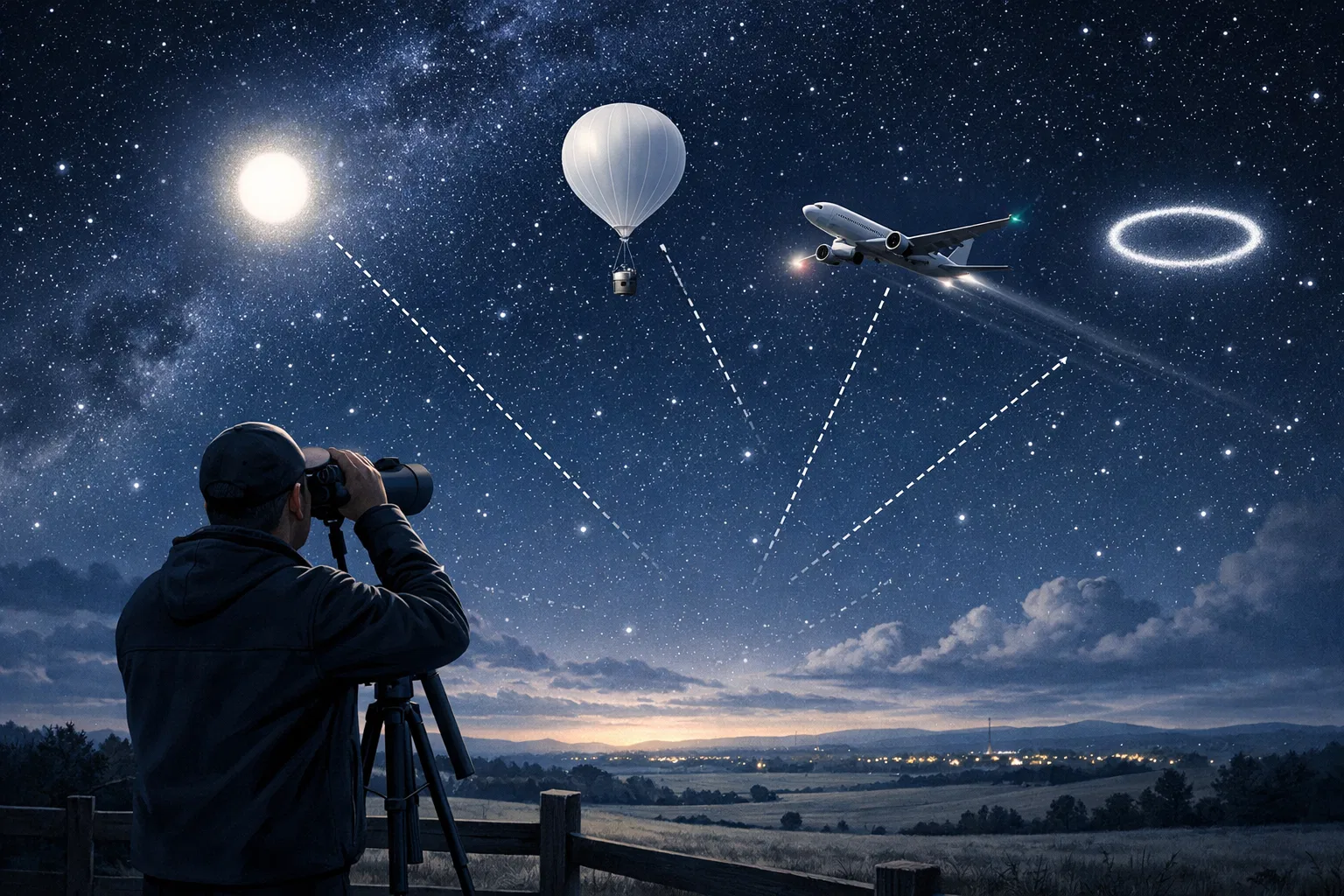
This hierarchy matters because human vision alone does not reliably provide distance, altitude or speed. A bright light with no visible background may appear to hover, race away or follow an observer even when it is a distant aircraft or astronomical object. A scientific investigation therefore tries to obtain several independent forms of measurement rather than relying on one impressive description. Modern research proposals for unidentified aerial phenomena emphasise synchronised cameras, triangulation, radar, radio receivers and environmental sensors precisely because corroborating instruments can distinguish real motion from optical or camera effects.[arXiv]arxiv.orgThe Scientific Investigation of Unidentified Aerial Phenomena (UAP) Using Multimodal Ground-Based ObservatoriesMay 29, 2023…
Multiple witnesses improve a case only when their testimony is genuinely independent. A crowd may establish that something attracted attention, but it does not automatically prove that everyone saw the same object or interpreted it accurately. People standing in different parts of a schoolyard, road or coastline can have different sightlines. Some may see the original stimulus; others may look up only after hearing excited descriptions from nearby witnesses.
Contemporary records consequently carry greater weight than recollections collected decades later. A school journal, air-traffic transcript or dated investigator’s notebook can reveal what was actually being claimed before documentaries, reunions and repeated media coverage reshaped the story.
How an investigation narrows the possibilities
Testing begins by converting the narrative into checkable details. “A silver disc flew impossibly fast” is difficult to evaluate. “At about 11 am, looking south-east from this point, a bright object crossed between these landmarks in approximately 20 seconds” can be compared with maps, wind direction, aircraft routes and the sky at that moment.
Investigators normally work through several competing explanations rather than choosing immediately between “alien craft” and “hoax”.
First, establish the chronology. The earliest reports are separated from later additions. Investigators ask when each witness first spoke publicly, whether notes survive and whether important details—such as a landing, military personnel or several objects—appear in contemporary material or only in retrospective accounts.
Second, reconstruct the viewing geometry. Buildings, trees, hills and coastlines help determine the direction of observation. If two known observation points and sightlines are available, triangulation may constrain an object’s position. Without a reliable distance, however, estimates of size and speed remain highly uncertain.
Third, check ordinary aerial activity. Flight paths, nearby aerodromes, helicopters, training exercises, balloons and drones can produce unfamiliar appearances. Moorabbin Airport is particularly relevant to reports from Melbourne’s south-east, including Westall, where contemporary accounts mentioned light aircraft around the observed object.[blogs.slv.vic.gov.au]blogs.slv.vic.gov.austrange lights in the sky the westall ufo event 1966Strange lights in the sky: The Westall UFO event, 19666 Apr 2024 — The Victorian Flying Saucer Research Society (later the Victorian UFO…
Fourth, reconstruct weather and the night sky. Cloud, wind, haze, temperature inversions and visibility affect how objects look. Investigators also calculate the positions of the Moon, bright planets, stars, meteors and satellites. Bureau of Meteorology stations record wind, cloud and visibility, while upper-air balloons provide information about atmospheric conditions at altitude.[Bureau of Meteorology]bom.gov.auBureau of MeteorologyAerological DiagramsAll Victorian Observations. Select a location to see its temperature, moisture and wind sounding…
Finally, test each explanation against all the important features. An explanation should account not merely for an object’s colour, but also its direction, duration, apparent behaviour and the surrounding circumstances. Where one theory explains only part of a complicated report, investigators must consider whether witnesses combined several ordinary stimuli into a single narrative.
Common Victorian explanations and observation errors
Aircraft seen in unfamiliar conditions
Aircraft are among the most frequent sources of unusual-light reports. Landing lights can remain almost stationary when an aircraft approaches an observer head-on, then appear to veer sharply as it turns. Navigation lights may suggest a triangular shape when the aircraft’s body is invisible against a dark sky. Sound may arrive late or be carried away by the wind, creating the impression of a silent object.
This is especially important around Melbourne, regional airports and Bass Strait routes. Investigators check scheduled traffic where records survive, but the absence of a matching commercial flight is not conclusive: private aircraft, military movements and flights outside controlled airspace may be poorly represented in accessible historical records.
Balloons, parachutes and drifting equipment
Weather and research balloons can appear metallic or brilliant in sunlight and behave in ways that seem unlike powered aircraft. Their apparent movement can change as they enter winds at different altitudes. After bursting, balloon material, parachutes and instrument packages may descend separately, making one event look like several objects.
The Bureau of Meteorology notes that weather balloons commonly rise into the upper atmosphere, expand and burst, after which their instruments descend to Earth. Depending on their condition and illumination, balloon remnants may look very different from the familiar round balloon imagined by a witness.[Bureau of Meteorology]bom.gov.auThe balloon may contain no gas or be partly inflated when it landsBureau of MeteorologyWeather balloons | The Bureau of…September 29, 2021 — A weather balloon can reach an altitude of 16–35 km in the…
Balloons have therefore played a central role in arguments about Westall. Researcher Keith Basterfield proposed that a balloon associated with the secret HIBAL atmospheric-sampling programme, together with its parachute and payload, might explain at least some observations. The hypothesis gains plausibility from the programme’s existence, the silvery appearance of its equipment and reports of aircraft in the area. It remains disputed because no released document has conclusively placed the required balloon at Westall at the required moment, and some witnesses describe motion that they believe a drifting system could not reproduce.[News.com.au]news.com.auDespite persistent public interest, the government has never provided an official explanation. A 2014 discovery of documents from a secre…
The correct verdict is therefore not “Westall was definitely a balloon”, but that the balloon theory is a serious conventional candidate whose documentary chain remains incomplete.
Planets, stars and atmospheric effects
Venus and other bright celestial objects are frequently mistaken for unusual aircraft, particularly near the horizon. Thin cloud, haze and the observer’s own eye movements can make a stationary light seem to change colour or move. The autokinetic effect—apparent motion of a small light against a featureless dark background—can make a star seem to dart or circle.
Atmospheric scintillation can also cause a bright point to flicker red, green or blue. Refraction near the horizon may distort its shape or apparent position. Investigators test such claims by calculating exactly which astronomical objects were visible from the reported location and whether their position matches the witness’s direction of view.
A mere match with a bright planet is not enough. The explanation weakens if the object crossed in front of nearby trees, cast measurable light, was observed from widely separated positions with consistent geometry or produced reliable radar returns. The strength lies in how many details the hypothesis explains, not in attaching a familiar label.
Meteors, satellites and re-entering debris
Brief lights moving rapidly across a large part of the sky often fit meteors. Longer, steady tracks may be satellites. Fragmenting space debris can produce several lights, colour changes and apparent formation movement. Witness estimates of duration are particularly important: a meteor usually lasts seconds, whereas aircraft or satellites remain visible much longer.
These events may generate clusters of reports across Victoria because one high-altitude phenomenon can be visible over a large area. Reports made from several towns are not necessarily independent encounters; they may be different views of the same distant event.
Camera and perspective effects
Modern videos introduce evidence but also new traps. Digital zoom removes visual context, autofocus makes lights swell and shrink, image stabilisation can create apparent movement, and internal reflections may place a ghost image opposite a bright light source. A small insect, bird or airborne particle close to a camera may appear to cross the sky at extraordinary speed.
Investigators therefore seek the original file rather than a compressed social-media copy. They examine frame rate, exposure, lens characteristics, metadata, camera movement and fixed reference points. Without a known distance, video alone rarely establishes an object’s true size or velocity.
Westall shows why witness numbers are not enough
Westall is stronger than an isolated light report because many students and some adults reported an unusual daylight event on 6 April 1966. Civilian investigators visited the area and interviewed witnesses, while school and press accounts preserved portions of the story. Reports of light aircraft around the object also offer a potentially checkable aviation connection.[blogs.slv.vic.gov.au]blogs.slv.vic.gov.austrange lights in the sky the westall ufo event 1966Strange lights in the sky: The Westall UFO event, 19666 Apr 2024 — The Victorian Flying Saucer Research Society (later the Victorian UFO…
Yet the case lacks the evidence that would now decide it. No authenticated close photograph, radar track or recovered object has emerged. The alleged ground traces were not preserved through a documented scientific chain of custody. No surviving official file conclusively identifies the stimulus. Even the number and shape of objects vary between accounts.
Investigators must therefore distinguish several propositions that are often merged together:
- A large number of people reacted to something unusual.
- Some witnesses saw an object they could not identify.
- The object performed manoeuvres beyond ordinary aircraft.
- The object was a non-human vehicle.
- Authorities deliberately concealed its origin.
The evidence for the first two propositions is considerably stronger than for the final three. Reports of secrecy or intimidation may be sincerely remembered, but they require independent documents before they can establish an organised cover-up. Conversely, the absence of an official explanation does not prove that nothing significant happened. It leaves the case unresolved at the level the surviving evidence permits.
The case also demonstrates why explanations may be composite. A balloon or airborne target could have produced the initial stimulus, while pursuing aircraft, excited crowd behaviour and later retelling added further apparent objects and manoeuvres. That possibility is less dramatic than a single extraordinary craft, but it often fits the way complex mass sightings develop.

Valentich: testing a UFO claim as an aviation accident
The disappearance of Frederick Valentich on 21 October 1978 is tested differently because it involved a missing aircraft and a real-time radio exchange with Melbourne Flight Service. The transcript is contemporary evidence, not merely a later witness recollection. Valentich reported an unidentified aircraft, bright lights, a metallic appearance and engine trouble before contact ceased over Bass Strait. The Department of Transport investigation could not determine the cause, and no confirmed wreckage of his Cessna was recovered.[abc.net.au]abc.net.audisappearance frederick valentich inspired kettering incidentdisappearance frederick valentich inspired kettering incident
That does not mean every interpretation is equally likely. Investigators ask whether the reported lights matched known astronomical objects, whether Valentich became spatially disorientated, whether the engine symptoms were consistent with a tightening spiral, and whether his descriptions changed as the situation deteriorated.
Night flying over dark water is a recognised setting for visual illusion and loss of orientation. The Australian Transport Safety Bureau describes spatial disorientation as a serious aviation hazard produced when visual and inner-ear information no longer gives a reliable sense of attitude or motion. Pilots operating without a clear horizon can misjudge a turn, climb or descent, sometimes without recognising what is happening.[ATSB]atsb.gov.auATSBAn overview of spatial disorientation as a factor in aviationATSBAn overview of spatial disorientation as a factor in aviation
A later sceptical reconstruction proposed that Valentich may have mistaken Venus, Mars, Mercury and Antares for an object while entering a descending spiral. This theory attempts to connect the lights, apparent orbiting motion, rough engine operation and disappearance within one aviation scenario. It remains a reconstruction rather than a demonstrated solution because there is no wreckage, flight-data recorder or radar track proving the aircraft’s final attitude and path.[Skeptical Inquirer]skepticalinquirer.orgOpen source on skepticalinquirer.org.
Valentich is consequently best classified as an unresolved fatal aviation disappearance with a plausible disorientation hypothesis—not as a confirmed UFO encounter and not as a fully solved accident.
How memory, media and missing records reshape cases
Human memory is reconstructive. Witnesses do not replay an event like a recording; they rebuild it from surviving impressions, later conversations and information learned afterwards. Experimental research on eyewitness testimony has repeatedly found that misleading post-event information can alter recalled details, while repetition can increase confidence in information that was not part of the original observation.[nih.gov]pmc.ncbi.nlm.nih.govPMCExperimental and meta-analytic evidence that sourcePMCExperimental and meta-analytic evidence that source
This does not imply that Victorian UFO witnesses are dishonest. A person can give a sincere, vivid and inaccurate account. The risk increases when:
- witnesses discuss the incident before giving separate statements;
- interviewers use leading questions;
- newspaper language supplies labels such as “disc” or “flying saucer”;
- documentaries repeatedly present one reconstruction;
- witnesses hear dramatic accounts from people who stood elsewhere;
- decades pass before a systematic interview is recorded.
Westall is particularly vulnerable to these effects because much of its best-known testimony was gathered long after 1966. Later interviews remain valuable, especially where they agree with contemporary material, but they cannot be treated as untouched records of the day.
Media coverage can also simplify uncertainty. A headline may turn “unidentified light” into “mysterious craft”, or present one investigator’s hypothesis as a conclusive solution. Anniversary reporting tends to privilege the most memorable witnesses and claims. A careful assessment returns to the earliest surviving records and marks later developments separately.
Missing records create another interpretive trap. The failure to locate a government file may mean that it was lost, destroyed, misfiled, never created or remains unidentified in an archive. It does not by itself establish deliberate suppression. Equally, archival survival is uneven: the National Archives confirms that the Royal Australian Air Force retained files on unusual aerial sightings, but those records vary in detail and were created chiefly for defence and national-security purposes rather than as comprehensive scientific studies.[naa]naa.gov.auflying saucers fact or fictionFlying saucers – fact or fiction?28 Feb 2018 — RAAF records of possible unidentified flying object (UFO) sightings have been retained…
Unresolved, weak or explained?
A useful final assessment avoids forcing every Victorian case into “true” or “false”.
Explained means a conventional cause matches the important evidence with few serious contradictions. A planet in the reported direction, an aircraft following the correct route or a documented balloon release may provide a strong identification.
Probably explained means one ordinary cause fits most of the account, but some records or details are missing. Many historical reports belong here because precise flight, weather or observer data no longer survive.
Unresolved means the available evidence does not support a reliable identification. This may describe a genuinely unusual observation, but it may also result from poor reporting. “Unresolved” is a statement about the limits of the evidence, not the origin of the object.
Weakly sourced applies when the story is known mainly through later retellings, anonymous claims or copied newspaper summaries. Such a report may be interesting local folklore but cannot carry the same evidential weight as a dated transcript, original photograph or independently documented multi-witness event.
Debunked should be reserved for claims in which the central evidence has been shown to be false, misrepresented or incompatible with the alleged event. Finding flaws in one detail does not automatically debunk every observation made during a complex incident.
The fairest reading of Victoria’s UFO record is therefore mixed. Many reports become ordinary once basic checks are performed. A smaller group remain open because the necessary information was never collected or has been lost. Westall retains historical importance as an unusually large witness event, while Valentich retains evidential weight because of the contemporary radio record and unresolved loss of an aircraft. Neither case, however, supplies the independent physical and instrumental evidence needed to establish an extraordinary vehicle. Their enduring lesson is not that investigation has failed, but that late, incomplete evidence sharply limits what any investigation can prove.
Amazon book picks
Further Reading
Books and field guides related to Unresolved, Mistaken or Explained How Can We Tell?. Use these as the next step if you want deeper reading beyond the article.
The Demon-Haunted World: Science as a Candle in the Dark
NEW YORK TIMES BESTSELLER • From the renowned astronomer and author of Cosmos comes a “powerful [and] stirring defense of informed ration...
The UFO Experience: A Scientific Inquiry
Cited by the New York Review of Books as "the best brief for visitation," this classic study presents an analysis of UFO reports and conc...
The UFO Handbook: A Guide to Investigating, Evaluating, and R...
An explanation of the usual reasons for confusing IFOs (identified flying objects) with UFOs and a survey of the tools used to investigat...
Bad Science
Ben Goldacre takes us on a journey through the bad science we are fed daily by hacks and quacks.
eBay marketplace picks
Marketplace Samples
Live-tested eBay searches with available results related to this page.
Selected fromUFO poster oneBay.co.uk.
Current eBay listing
VINTAGE UFO FLYING SAUCERS COMIC ADVERTISING A2 POSTER PRINT

Current eBay listing
I Want To Believe UFO Poster Giclée Fine Art Heavyweight Print

Endnotes
1.
Source: naa.gov.au
Title: flying saucers fact or fiction
Link:https://www.naa.gov.au/blog/flying-saucers-fact-or-fiction
Source snippet
Flying saucers – fact or fiction?28 Feb 2018 — RAAF records of possible unidentified flying object (UFO) sightings have been retained...
2.
Source: blogs.slv.vic.gov.au
Title: strange lights in the sky the westall ufo event 1966
Link:https://blogs.slv.vic.gov.au/our-stories/strange-lights-in-the-sky-the-westall-ufo-event-1966/
Source snippet
Strange lights in the sky: The Westall UFO event, 19666 Apr 2024 — The Victorian Flying Saucer Research Society (later the Victorian UFO...
3.
Source: arxiv.org
Link:https://arxiv.org/abs/2305.18566
Source snippet
The Scientific Investigation of Unidentified Aerial Phenomena (UAP) Using Multimodal Ground-Based ObservatoriesMay 29, 2023...
Published: May 29, 2023
4.
Source: bom.gov.au
Link:https://www.bom.gov.au/aviation/observations/aerological-diagrams/
Source snippet
Bureau of MeteorologyAerological DiagramsAll Victorian Observations. Select a location to see its temperature, moisture and wind sounding...
5.
Source: bom.gov.au
Link:https://www.bom.gov.au/climate/cdo/about/sites.shtml
Source snippet
Bureau of MeteorologyWhat is a Bureau station?17 May 2018 — Weather balloons are used at selected stations (most of which are airports) t...
Published: May 2018
6.
Source: bom.gov.au
Link:https://www.bom.gov.au/climate/data/stations/about-weather-station-data.shtml
Source snippet
Bureau of MeteorologyAbout Weather Station DataAt some stations the temperature and humidity of the upper atmosphere are also obtained by...
7.
Source: bom.gov.au
Title: The balloon may contain no gas or be partly inflated when it lands
Link:https://www.bom.gov.au/resources/learn-and-explore/radar-and-equipment-knowledge-centre/weather-balloons
Source snippet
Bureau of MeteorologyWeather balloons | The Bureau of...September 29, 2021 — A weather balloon can reach an altitude of 16–35 km in the...
Published: September 29, 2021
8.
Source: news.com.au
Link:https://www.news.com.au/technology/science/space/australias-roswell-calls-for-fresh-inquiry-into-60yearold-westall-ufo-mystery/news-story/888e54275c5ac3b815df508d1bfe8af2
Source snippet
Despite persistent public interest, the government has never provided an official explanation. A 2014 discovery of documents from a secre...
9.
Source: aviation-safety.net
Link:https://aviation-safety.net/wikibase/wiki.php?id=166155
10.
Source: atsb.gov.au
Title: ATSBAn overview of spatial disorientation as a factor in aviation
Link:https://www.atsb.gov.au/sites/default/files/media/29971/b20070063.pdf
11.
Source: atsb.gov.au
Title: ATSBAvoidable Accidents No. 7
Link:https://www.atsb.gov.au/sites/default/files/media/4475634/ar-2012-122.pdf
12.
Source: pmc.ncbi.nlm.nih.gov
Title: PMCExperimental and meta-analytic evidence that source
Link:https://pmc.ncbi.nlm.nih.gov/articles/PMC10492197/
13.
Source: link.springer.com
Link:https://link.springer.com/rwe/10.1007/978-3-030-93789
14.
Source: naa.gov.au
Title: ufo sightings weapons testing site woomera
Link:https://www.naa.gov.au/students-and-teachers/student-research-portal/learning-resource-themes/war/defence-equipment-and-weapons/ufo-sightings-weapons-testing-site-woomera
15.
Source: blogs.slv.vic.gov.au
Link:https://blogs.slv.vic.gov.au/such-was-life/page/13/
16.
Source: blogs.slv.vic.gov.au
Title: local history
Link:https://blogs.slv.vic.gov.au/terms/local-history/
17.
Source: blogs.slv.vic.gov.au
Link:https://blogs.slv.vic.gov.au/such-was-life/page/3/
18.
Source: blogs.slv.vic.gov.au
Link:https://blogs.slv.vic.gov.au/terms/unexplained/
19.
Source: blogs.slv.vic.gov.au
Link:https://blogs.slv.vic.gov.au/terms/paranormal/
20.
Source: blogs.slv.vic.gov.au
Title: slv.vic.gov.au Film
Link:https://blogs.slv.vic.gov.au/arts/film/page/4/
21.
Source: blogs.slv.vic.gov.au
Link:https://blogs.slv.vic.gov.au/such-was-life/page/26/
22.
Source: blogs.slv.vic.gov.au
Title: australian literature
Link:https://blogs.slv.vic.gov.au/terms/australian-literature/
23.
Source: blogs.slv.vic.gov.au
Link:https://blogs.slv.vic.gov.au/arts/page/30/
24.
Source: blogs.slv.vic.gov.au
Title: spooky stories
Link:https://blogs.slv.vic.gov.au/terms/spooky-stories/
25.
Source: blogs.slv.vic.gov.au
Link:https://blogs.slv.vic.gov.au/author/admin/page/4/
26.
Source: blogs.slv.vic.gov.au
Link:https://blogs.slv.vic.gov.au/2012/08/page/2/
27.
Source: blogs.slv.vic.gov.au
Link:https://blogs.slv.vic.gov.au/news/page/31/?page=1
28.
Source: blogs.slv.vic.gov.au
Link:https://blogs.slv.vic.gov.au/2018/page/5/
29.
Source: blogs.slv.vic.gov.au
Link:https://blogs.slv.vic.gov.au/arts/visual-arts/page/5/
30.
Source: atsb.gov.au
Link:https://www.atsb.gov.au/sites/default/files/media/760817/dark_night_take-off_accidents.pdf
31.
Source: atsb.gov.au
Link:https://www.atsb.gov.au/sites/default/files/investigation-reports/ao2011017.pdf
32.
Source: atsb.gov.au
Title: Special edition
Link:https://www.atsb.gov.au/sites/default/files/media/5774849/special_vf_86.pdf
33.
Source: atsb.gov.au
Link:https://www.atsb.gov.au/sites/default/files/2024-05/FAA-H-8083-3B%20Chapter%2010.pdf
34.
Source: atsb.gov.au
Link:https://www.atsb.gov.au/sites/default/files/investigation-reports/AO-2011-102%20Final.pdf
35.
Source: atsb.gov.au
Link:https://www.atsb.gov.au/sites/default/files/investigation-reports/ao2011043.pdf
36.
Source: atsb.gov.au
Title: AO2007009 001
Link:https://www.atsb.gov.au/sites/default/files/investigation-reports/AO2007009_001.pdf
37.
Source: atsb.gov.au
Title: aair200304282 001
Link:https://www.atsb.gov.au/sites/default/files/investigation-reports/aair200304282_001.pdf
38.
Source: bom.gov.au
Link:https://www.bom.gov.au/climate/data/acorn-sat/documents/ACORN-SAT_Observation_practices_WEB.pdf
39.
Source: bom.gov.au
Title: annual report 2024 25 group performance[1]
Link:https://www.bom.gov.au/sites/default/files/2025-10/annual-report-2024-25-group-performance%5B1%5D.pdf
40.
Source: bom.gov.au
Link:https://www.bom.gov.au/sites/default/files/2023-08/foi30-107-released-documents.pdf
41.
Source: bom.gov.au
Title: bureau of meteorology annual report 2023 24
Link:https://www.bom.gov.au/sites/default/files/2024-10/bureau-of-meteorology-annual-report-2023-24.pdf
42.
Source: bom.gov.au
Title: bureau of meteorology annual report 2024 25 full[1] 0
Link:https://www.bom.gov.au/sites/default/files/2025-10/bureau-of-meteorology-annual-report-2024-25-full%5B1%5D_0.pdf
43.
Source: bom.gov.au
Link:https://www.bom.gov.au/news-and-media/explore-our-new-rain-radar-and-map-viewer
44.
Source: abc.net.au
Title: disappearance frederick valentich inspired kettering incident
Link:https://www.abc.net.au/news/2016-07-07/disappearance-frederick-valentich-inspired-kettering-incident/7576428
45.
Source: skepticalinquirer.org
Link:https://skepticalinquirer.org/2013/11/the-valentich-disappearance-another-ufo-cold-case-solved/
46.
Source: Wikipedia
Title: Disappearance of Frederick Valentich
Link:https://en.wikipedia.org/wiki/Disappearance_of_Frederick_Valentich
47.
Source: abc.net.au
Title: westall ufo mystery witnesses want answers
Link:https://www.abc.net.au/news/2026-04-06/westall-ufo-mystery-witnesses-want-answers/106126614
48.
Source: abc.net.au
Title: accessing australia secret ufo files
Link:https://www.abc.net.au/news/2024-12-07/accessing-australia-secret-ufo-files/104673082
Additional References
49.
Source: youtube.com
Title: Melbourne UFO Mystery: 50 Years On | Studio 10
Link:https://www.youtube.com/watch?v=sPHVvg-dXOs
Source snippet
Australia’s Biggest UFO Cover-Up | The Westall Incident (1966)...
50.
Source: youtube.com
Title: Secrets of the UFOs | Full Documentary | 7NEWS Spotlight
Link:https://www.youtube.com/watch?v=sEczN_8Q380
Source snippet
Melbourne UFO Mystery: 50 Years On | Studio 10...
51.
Source: researchgate.net
Link:https://www.researchgate.net/publication/257464926_Are_Two_Interviews_Better_Than_One_Eyewitness_Memory_across_Repeated_Cognitive_Interviews
52.
Source: facebook.com
Link:https://www.facebook.com/abcnews.au/posts/a-ufo-sighting-in-far-north-queensland-set-off-an-international-hoax-but-it-came/1147146796766589/
53.
Source: linkedin.com
Link:https://www.linkedin.com/pulse/australias-forgotten-uap-record-now-part-disclosure-dr-andrew-btobc
54.
Source: nobaproject.com
Link:https://nobaproject.com/modules/eyewitness-testimony-and-memory-biases
55.
Source: facebook.com
Link:https://www.facebook.com/rnznewzealand/posts/it-remains-the-biggest-mass-sighting-of-a-ufo-in-australian-history/1420616840104260/
56.
Source: instagram.com
Link:https://www.instagram.com/p/DZrYgS2m2yT/?img_index=7
57.
Source: reddit.com
Link:https://www.reddit.com/r/UFOs/comments/1ged1e9/secret_file_detailing_truth_about_australias/
58.
Source: instagram.com
Link:https://www.instagram.com/reel/DOwxr_uCmDm/?hl=en