Within 1950 Venus Case
Why Venus Seemed to Chase the Canberra DC 3
Parallax and the autokinetic illusion can make a fixed planet appear to pace, climb with or evade a moving aircraft at night.
On this page
- How the crew judged the light's movement
- Parallax during turns and climbs
- The autokinetic illusion in a dark sky
Page outline Jump by section
Introduction
The most puzzling feature of the Canberra DC-3 sighting of 26 May 1950 was not that the crew saw a bright light, but that the light appeared to follow them. To experienced pilots, a planet should remain fixed relative to the horizon. Instead, the light seemed to keep pace with the aircraft, climb when the DC-3 climbed, and disappear when the crew tried to intercept it. These impressions made the object seem like another aircraft rather than a distant celestial body.[Garage Graphics History]garagegraphicshistory.blogspot.comflying saucer over australia 1950Garage Graphics HistoryFlying Saucers over Australia, 1950November 15, 2023…
Modern understanding of visual perception during night flying offers a straightforward explanation. A combination of parallax, the lack of distance cues over a dark landscape, and the autokinetic illusion can make a bright, isolated light appear to move intelligently even when it is effectively stationary. These effects explain why competent pilots could sincerely report that a distant light appeared to accompany their aircraft without requiring the light itself to have been moving.
How the crew judged the light’s movement
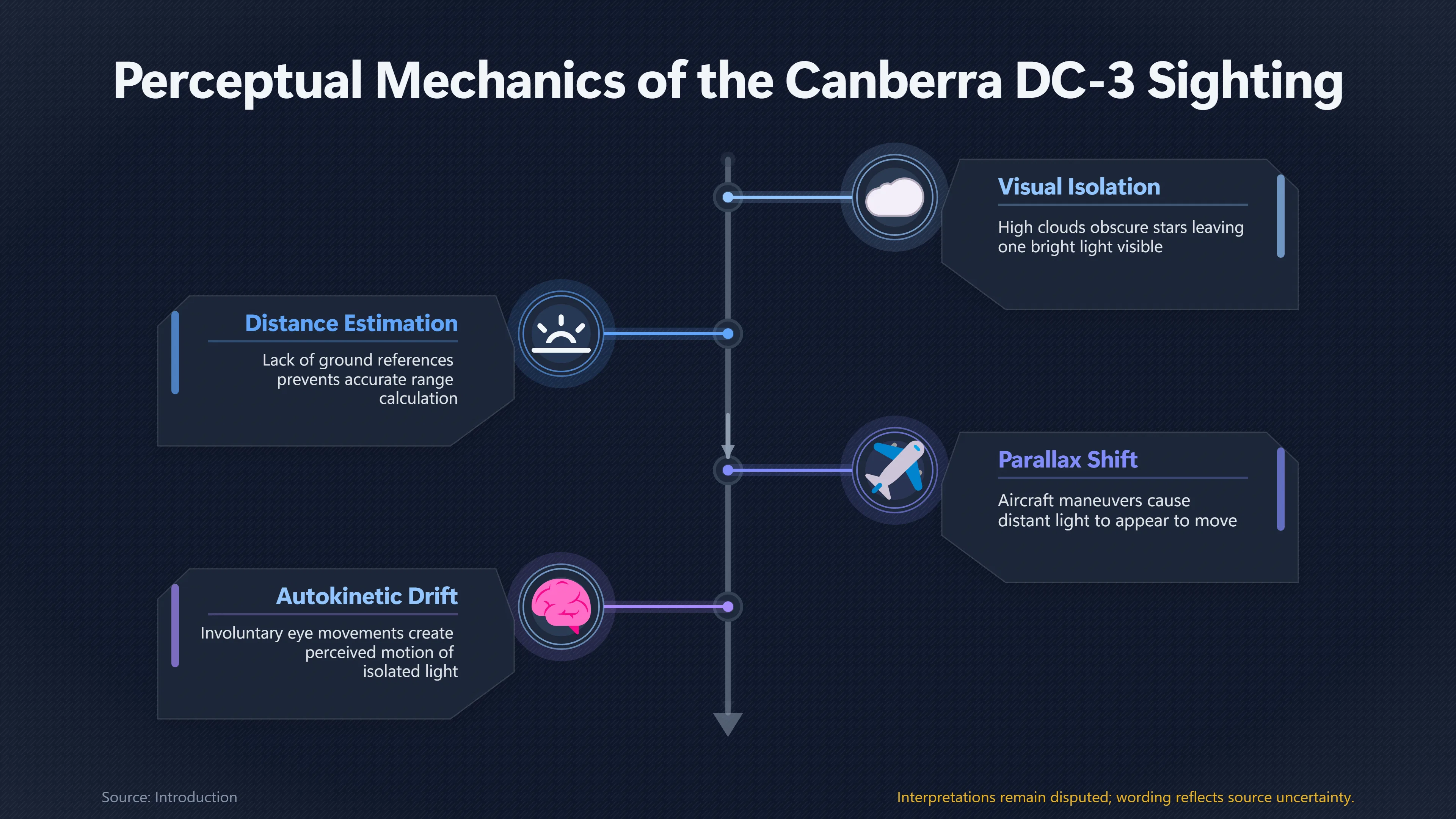
The crew were flying at night over country with very few visible ground references. High cloud obscured most stars, leaving one exceptionally bright light standing out against a largely featureless sky. Captain Gordon Savage later explained that, because nothing else was visible for comparison, it was impossible to estimate the light’s distance. He naturally compared it with the navigation lights of another aircraft rather than with a planet.[Garage Graphics History]garagegraphicshistory.blogspot.comflying saucer over australia 1950Garage Graphics HistoryFlying Saucers over Australia, 1950November 15, 2023…
That judgement affected every later observation. If the light was assumed to be a nearby aircraft, then changes in its apparent position suggested that it was manoeuvring. If, instead, it was many millions of kilometres away, those same apparent changes could be produced entirely by the movement of the observer.
This is a common problem in aviation. A single point of light provides almost no information about range. Without a visible outline, known size or surrounding landmarks, the brain has little evidence from which to judge whether the object is hundreds of metres away or astronomically distant.
Parallax during turns and climbs
Parallax is the apparent movement of an object caused by the observer changing position. Nearby objects appear to shift rapidly, while extremely distant objects shift so little that they can seem to accompany the observer.
During the Canberra incident, the DC-3 changed heading and altitude while the pilots repeatedly reassessed the light’s position. A planet close to the horizon can appear to slide relative to cloud layers or the aircraft’s windscreen as the aircraft banks or climbs. Because the cockpit itself is moving, the light may seem to respond to the aircraft’s manoeuvres even though it remains fixed in space.[Garage Graphics History]garagegraphicshistory.blogspot.comflying saucer over australia 1950Garage Graphics HistoryFlying Saucers over Australia, 1950November 15, 2023…
Several features of the report fit this mechanism:
- the light appeared to maintain a similar bearing for an extended period;
- it seemed to rise when the aircraft climbed;
- attempts to fly directly towards it failed to reduce the apparent distance;
- it appeared to move away rather than being overtaken.
These are classic consequences of trying to intercept an object that is effectively at an infinite distance. Since the aircraft cannot significantly change its viewing angle to a planet, the expected closing movement never occurs.
The same geometry often causes motorists to feel that the Moon is “following” their car. The underlying visual mechanism is identical, although it is usually more striking from an aircraft because the horizon, clouds and cockpit framing provide fewer stable references.
The autokinetic illusion in a dark sky
A second effect can make the impression even more convincing. The autokinetic illusion occurs when a person stares at a small, isolated light against a dark background. Tiny involuntary eye movements are interpreted by the brain as movement of the light itself, making it appear to drift, accelerate or change direction. This illusion has long been recognised in aviation medicine because it can mislead even experienced pilots during night operations.[ScienceDirect]sciencedirect.comScienceDirect Visual Illusions in Night FlyingVisual Illusions in Night Flying - ScienceDirect…
Several conditions during the Canberra flight would have favoured this illusion:
- a single exceptionally bright light;
- very few surrounding stars for comparison;
- prolonged visual attention from both pilots;
- a dark cockpit looking into an otherwise featureless sky.
The illusion does not produce identical perceived motion every moment. Instead, observers often report subtle wandering, pacing or evasive movement, exactly the sort of behaviour that encourages someone to interpret the light as another aircraft rather than as a celestial object.
Importantly, the illusion affects sincere observers. It is not evidence of poor eyesight or inexperience, but a well-documented characteristic of human visual perception under low-light conditions.
Why the light seemed to vanish
The crew also reported that the light faded into what appeared to be mist before reappearing. This observation is consistent with a bright planet viewed through thin cloud or varying atmospheric transparency near the horizon.
Venus is especially susceptible to this effect when it is rising. Thin cirrus cloud can weaken the light without completely obscuring it, producing the impression that the object has entered or emerged from a veil. Atmospheric turbulence near the horizon can also alter its brightness and apparent colour, contributing to reports of alternating white and reddish light.[Garage Graphics History]garagegraphicshistory.blogspot.comflying saucer over australia 1950Garage Graphics HistoryFlying Saucers over Australia, 1950November 15, 2023…
These changes would reinforce the impression of an intelligently controlled object, even though they arise naturally from viewing a bright astronomical object through an unstable atmosphere.
Why this mechanism matters for the Canberra case
The value of the Canberra incident lies in showing how several ordinary perceptual effects can combine into an extraordinary experience.
The pilots’ observations were genuine, detailed and made by experienced aircrew. What later changed was not the honesty of their testimony but the interpretation of what they had seen. Captain Savage ultimately accepted that Venus offered the best overall explanation once he learned that high cirrus cloud had hidden most of the stars while leaving the bright morning planet conspicuous near the eastern horizon.[Garage Graphics History]garagegraphicshistory.blogspot.comflying saucer over australia 1950Garage Graphics HistoryFlying Saucers over Australia, 1950November 15, 2023…
Not every contemporary astronomer agreed that every reported detail matched Venus perfectly, and some questioned whether the planet’s position fully accounted for the sighting. Nevertheless, the specific impression that the light was pacing the DC-3 is now one of the least mysterious aspects of the case. Modern knowledge of parallax, night-flight visual perception and the autokinetic illusion provides a coherent explanation for why a fixed celestial object could appear to climb, evade and accompany an aircraft without moving in the way the pilots perceived.[Garage Graphics History]garagegraphicshistory.blogspot.comflying saucer over australia 1950Garage Graphics HistoryFlying Saucers over Australia, 1950November 15, 2023…
Amazon book picks
Further Reading
Books and field guides related to Why Venus Seemed to Chase the Canberra DC 3. Use these as the next step if you want deeper reading beyond the article.
The Invisible Gorilla: How Our Intuitions Deceive Us
NEW YORK TIMES BESTSELLER • Our minds don’t work the way we think they do. Two renowned psychologists explain how and why our intuitions...
The Naked Pilot: The Human Factor in Aircraft Accidents
Investigations into the causes of aircraft accidents have for decades focused on what happened and who did it - very rarely Why? It is th...
Human Factors in Flight
The late Captain Frank H Hawkins FRAes, M Phil, was Human Factors Consultant to KLM, for whom he had flown for over 30 years as line capt...
Why We See What We Do Redux: A Wholly Empirical Theory of Vision
When we look at an object, do we see what's really there? In this follow-up to the highly provocative Why We See What We Do, D. Purves an...
eBay marketplace picks
Marketplace Samples
Live-tested eBay searches with available results related to this page.
Selected fromnight aviation poster oneBay.co.uk.
Endnotes
1.
Source: garagegraphicshistory.blogspot.com
Title: flying saucer over australia 1950
Link:https://garagegraphicshistory.blogspot.com/2023/11/flying-saucer-over-australia-1950.html?m=1
Source snippet
Garage Graphics HistoryFlying Saucers over Australia, 1950November 15, 2023...
Published: November 15, 2023
2.
Source: sciencedirect.com
Title: ScienceDirect Visual Illusions in Night Flying
Link:https://www.sciencedirect.com/science/article/abs/pii/0002939451900062
Source snippet
Visual Illusions in Night Flying - ScienceDirect...
3.
Source: youtube.com
Title: Spacial Disorientation
Link:https://www.youtube.com/watch?v=YatlPrTZUNs
Source snippet
Autokinetic Illusion...
4.
Source: youtube.com
Title: Autokinetic Illusion
Link:https://www.youtube.com/watch?v=DVakQSYL8SA
Source snippet
DANGERS of Spatial DISORIENTATION! Explained by CAPTAIN JOE...
Additional References
5.
Source: en.wikisource.org
Link:https://en.wikisource.org/wiki/Page%3ARuppelt_-_The_Report_on_Unidentified_Flying_Objects.djvu/111
Source snippet
wikisource.orgPage:Ruppelt - The Report on Unidentified Flying Objects.djvu/111 - Wikisource, the free online libraryPAGE:RUPPELT - THE R...
6.
Source: gutenberg.org
Title: The World of Flying Saucers, by Donald H
Link:https://www.gutenberg.org/files/66639/old/66639-h/66639-h.htm
Source snippet
Menzel and Lyle G. Boyd—A Project Gutenberg eBookOctober 31, 2021 — VENUS AS A MORNING STAR One of the “best” UFOs of the year 1950 appea...
Published: October 31, 2021
7.
Source: time.com
Title: The Press: The Saucer-Eyed Dragons
Link:https://time.com/archive/6607733/the-press-the-saucer-eyed-dragons//
Source snippet
April 17, 1950 — THE PRESS: THE SAUCER-EYED DRAGONS ADD TIME ON GOOGLE Show me more content from TIME on Google Search by TIME Apr 17, 19...
Published: April 17, 1950
8.
Source: project1947.com
Link:https://www.project1947.com/fig/trueaug1950.htm
Source snippet
PROJECT 1947 - Flight 117 and the Flying Saucer - TRUE MAGAZINE, August, 1950Image: TRUE Magazine, August, 1950 TRUE Magazine - August 19...
9.
Source: project1947.com
Link:https://www.project1947.com/articles/flying750.htm
Source snippet
July, 1950PROJECT 1947 * * * Image: FLYING Magazine July 1950 Cover FLYING Magazine - July, 1950 Image: FLYING Magazine, July 1950 Passen...
Published: July 1950
10.
Source: en.wikisource.org
Title: Chapter 7
Link:https://en.wikisource.org/wiki/The_Report_on_Unidentified_Flying_Objects/Chapter_7
Source snippet
Report on Unidentified Flying Objects/Chapter 7 - Wikisource, the free online libraryTHE REPORT ON UNIDENTIFIED FLYING OBJECTS/CHAPTER 7...
11.
Source: youtube.com
Title: DANGERS of Spatial DISORIENTATION! Explained by CAPTAIN JOE
Link:https://www.youtube.com/watch?v=ZxemflOo9W8
12.
Source: youtube.com
Title: Night Illusions (Private Pilot Lesson 15d)
Link:https://www.youtube.com/watch?v=y_HvgmQ3NJs
Source snippet
Aviation Visual Illusions...
13.
Source: sciencenews.org
Title: The Flying Saucer Mystery | Science News
Link:https://www.sciencenews.org/archive/flying-saucer-mystery
14.
Source: time.com
Title: science visitors from venus
Link:https://time.com/archive/6614002/science-visitors-from-venus/