Within South Australia UFOs
How Cold War Secrecy Shaped UFO Reports
Rocket ranges, nuclear sites and military secrecy made South Australia both a valuable observation zone and a breeding ground for uncertainty.
On this page
- Woomera, Maralinga and the prohibited area
- Why officials monitored unidentified objects
- Secret tests, surveillance fears and public uncertainty
Page outline Jump by section
Introduction
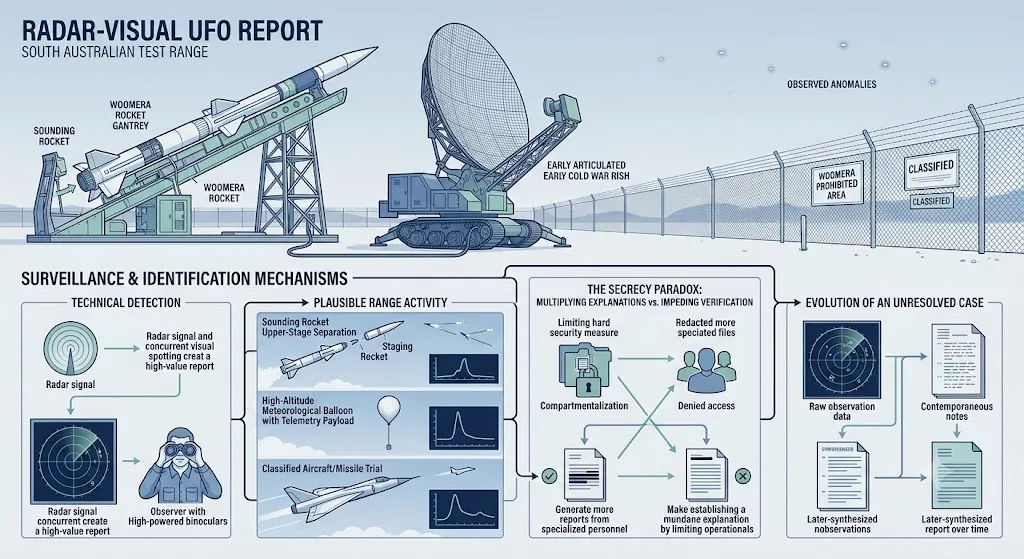
South Australia’s Cold War test ranges did not simply provide a dramatic backdrop for UFO reports. They helped create the reports, shape the official response and preserve the uncertainty around them. Woomera and Maralinga were places where rockets, missiles, high-altitude aircraft and nuclear-weapons experiments were conducted under strict security. They were also crowded with radar operators, engineers, security officers and military observers whose work depended on noticing anything unexpected in the sky.
That combination produced a paradox. Reports from trained personnel near sensitive installations could be more valuable than ordinary sightings, especially when instruments were involved. Yet the same installations generated unfamiliar objects, restricted information and misleading radar returns. Officials therefore had good reasons to investigate unidentified targets without assuming they were extraterrestrial. The lasting significance of the South Australian cases lies in this tension: some observations were genuinely unexplained, but secrecy made both verification and ordinary explanation unusually difficult.[naa.gov.au]naa.gov.auNational Archives of AustraliaUFO sightings at weapons testing site, WoomeraThis confidential two-page report details sightings on 15 Jul…
Woomera, Maralinga and the prohibited area
Woomera emerged from the Anglo-Australian Joint Project agreed in 1946. The prohibited area was declared in 1947, and the first military trial followed that December. It became the testing ground for a succession of guided weapons, rockets, aircraft systems and upper-atmosphere research programmes. The range was not merely an isolated launch pad: it was a vast instrumented environment containing tracking stations, radar, cameras, telemetry systems and specialised personnel spread across the South Australian interior.[defence.gov.au]defence.gov.auThe area was declared a Prohibited Area in 1947 and…Read more…
This infrastructure matters to UFO history because Woomera was designed to detect, measure and reconstruct aerial movement. A light or radar return seen there was more likely to be noticed than the same event over an ordinary rural district. Observers were routinely watching aircraft and test vehicles, sometimes with binoculars or tracking equipment. That increased the chances of obtaining technically detailed testimony, but it also placed witnesses in an unusually busy experimental airspace where unfamiliar hardware was part of normal operations.[dst.defence.gov.au]dst.defence.gov.auFire Across the Desert | DSTDefence Science and TechnologyWritten by Peter Morton and first published in 1989, the 600 page history book is now accessible … on 29 No…
Maralinga added another layer of sensitivity. Developed as a permanent British nuclear proving ground after a 1954 request, it hosted major atomic tests from 1956 and continued to be used for smaller weapons-component trials until 1963. Emu Field, farther north, had already hosted two atomic explosions in 1953. Woomera supported this wider programme through transport, communications, aviation and scientific facilities, tying the rocket range and nuclear sites into one interconnected defence landscape.[naa.gov.au]naa.gov.auNational Archives of AustraliaBritish nuclear tests at Maralinga | naa.gov.auAn official history of the tests by JL Symonds, was publishe…
The surviving 1960 report from near Wewak illustrates how closely UFO documentation could overlap with weapons work. Security officer J J A Hanlon recorded an unidentified object reported on 15 July near a nuclear-testing area about 24 kilometres from Maralinga Village. The document belonged to a Department of Supply file concerning the Weapons Research Establishment. Its importance is not that it proves an extraordinary craft was present, but that the sighting was treated as a security matter and entered the official system because of where it occurred.[National Archives of Australia]naa.gov.auNational Archives of AustraliaUFO sightings at weapons testing site, WoomeraThis confidential two-page report details sightings on 15 Jul…
The prohibited area’s scale also encouraged uncertainty. Today’s Woomera Prohibited Area covers more than 122,000 square kilometres, and its historical form was similarly immense. Test activities could occur far from the township and outside the knowledge of most local residents. An observer might see a flare, missile stage, research rocket, balloon or aircraft operation without having any realistic way to establish what it was.[Energy & Mining]energymining.sa.gov.auOpen source on sa.gov.au.

Why officials monitored unidentified objects
Cold War authorities did not need to believe in alien spacecraft to take an unidentified object seriously. Around Woomera or Maralinga, an unexplained radar return or visual target could indicate a foreign aircraft, unauthorised civilian intrusion, falling test debris, an off-course weapon, a meteorological balloon, equipment failure or a natural phenomenon capable of interfering with a trial.
The practical question was therefore not “Was this a flying saucer?” but “Did this object threaten security, safety or the validity of the test?” That distinction helps explain why reports moved through defence and intelligence channels. The Royal Australian Air Force developed standard procedures and forms for UFO reports, while departments responsible for weapons research retained records connected with sensitive sites. National Archives material shows that Australian authorities accumulated and assessed such reports during the Cold War, even though most did not lead to conclusions involving exotic technology.[naa.gov.au]naa.gov.auflying saucers fact or fictionflying saucers fact or fiction
Woomera’s surveillance equipment gave officials another reason to investigate. A radar contact during a weapons or aircraft trial could contaminate measurements, be mistaken for the vehicle under test or reveal an unexpected hazard. It might also raise fears of foreign observation. Britain and Australia had built Woomera partly in response to the strategic importance of long-range missiles after the Second World War, when knowledge of advanced weapons was treated as an intelligence prize.[Defence]defence.gov.auThe area was declared a Prohibited Area in 1947 and…Read more…
The celebrated Woomera radar-visual reports of the 1950s derive much of their reputation from this setting. Accounts describe trained personnel observing unusual objects while aircraft or range equipment were operating. The involvement of radar and experienced observers makes such cases harder to dismiss than an unsupported recollection from a casual witness. It does not, however, make the measurements infallible. Exact speeds and altitudes inferred from old radar plots depend on the equipment, tracking method, calibration and assumption that the return represented a solid object following the interpreted path.
Radar itself can produce misleading contacts. Temperature inversions and unusual humidity gradients can bend radar energy towards the ground, generating returns at false ranges or heights. This phenomenon, known as anomalous propagation, is well established and is especially relevant when assessing historical radar cases for which complete meteorological records, scope photographs and calibration data are unavailable.[noaa.gov]noaa.govanomalous propagationanomalous propagation
That explanation cannot automatically dispose of every Woomera event. A radar anomaly does not readily account for a simultaneous, clearly observed object unless the visual report was independent misidentification or the claimed correspondence was reconstructed afterwards. The problem is evidential: surviving summaries may preserve impressive figures while omitting the raw plots, weather profile, timing accuracy and chain of interpretation needed for a modern technical review. The range setting therefore strengthens the reason for taking the reports seriously while also multiplying the possible conventional causes.
Secret tests and unfamiliar skies
Woomera’s test programme placed objects in the sky that many people had never seen before. Guided missiles could change direction or separate into components. Sounding rockets climbed beyond the operating height of ordinary aircraft. Balloons carried scientific equipment, while aircraft flew tracking, photography and sampling missions. Exhaust trails could remain illuminated after sunset, and debris or parachute systems could appear to hover or descend in unusual ways.
Upper-atmosphere rocket research began at Woomera in 1957, including the British Skylark programme. Such launches were capable of producing striking high-altitude effects visible over long distances. The basic difficulty for witnesses was not irrationality but lack of information: observers outside the programme might accurately describe what they saw while being unable to identify its source.[AIAA Journal]arc.aiaa.orgAIAA JournalUpper Atmospheric Research at Woomera: the Austral…Sounding rocket programs for upper atmospheric research (UAR) commenced…
Nuclear testing created its own unusual aerial activity. Mushroom clouds reached great heights, aircraft were used for cloud sampling and monitoring, and balloons and instruments supported weapons trials. These were not UFO events in themselves, but they altered what could appear in the sky and normalised exceptional operations across the region. They also made officials less willing to disclose schedules, equipment or test results that could explain a public report.[National Museum of Australia]nma.gov.auNational Museum of AustraliaMaralinga18 Sept 2024 — On 27 September 1956 Britain conducted its first test at Maralinga. Britain conducted…
Secrecy could therefore preserve a mystery even when an ordinary defence explanation existed. A department might be unable to confirm that a missile, aircraft or classified instrument had been operating. It might issue a vague denial limited to one service while another agency conducted the activity. In other instances, records may never have been created, retained or transferred to archives. Later researchers are left comparing witness statements with incomplete administrative files.
This does not mean that every unexplained South Australian sighting was a secret test. The claim is often used too casually. A convincing test explanation should match the date, direction, duration, altitude and observed behaviour of the report. Without that correspondence, “classified aircraft” is no more demonstrated than an extraterrestrial interpretation. The ranges provide a strong category of possibilities, not a universal answer.
How secrecy shaped public uncertainty
The credibility problem surrounding Woomera and Maralinga was intensified by what later became known about government secrecy in the region. British atomic testing was conducted with limited public scrutiny, and the consequences for service personnel, local communities and Aboriginal people were not fully acknowledged at the time. Subsequent archival releases and the 1980s Royal Commission exposed serious weaknesses in safety arrangements, disclosure and official accountability.[service.gov.uk]assets.publishing.service.gov.ukUK Royal Commission into British Nuclear Tests in AustraliaUK Royal Commission into British Nuclear Tests in Australia
That history reasonably weakened public trust. Once authorities were shown to have withheld or minimised information about radioactive contamination and hazardous trials, later assurances about unexplained aerial events could appear less reliable. A mundane statement such as “no relevant activity occurred” carried less persuasive force in a region where major programmes had operated behind security barriers.
There is nevertheless an important difference between justified distrust and proof of an extraordinary claim. Evidence that governments concealed weapons information establishes that secrecy existed; it does not establish that officials concealed alien craft. The same records that reveal secrecy also show recognisable bureaucratic concerns: range safety, intelligence, weapons development, radiation monitoring and unauthorised observation. The strongest interpretation is that this environment created gaps in knowledge within which UFO stories could grow.
Media coverage added another distortion. “Flying saucer over atomic range” was inherently more newsworthy than “unidentified light investigated by a security officer”. The proximity of nuclear weapons encouraged speculation that the objects were monitoring human technology, a theme also popular in overseas UFO literature. Yet geographical association alone is weak evidence. Test sites employed more sky-watchers, more instruments and more reporting procedures than ordinary locations, so a higher number of recorded anomalies would be expected even without any unusual external interest.
The Maralinga record is a useful corrective. It confirms that an unidentified sighting occurred near a sensitive nuclear area and was documented by an official. It does not provide evidence that the object interacted with weapons, displayed impossible performance or was tracked by several independent systems. The location makes the report historically interesting, but the surviving evidence remains limited.[National Archives of Australia]naa.gov.auNational Archives of AustraliaUFO sightings at weapons testing site, WoomeraThis confidential two-page report details sightings on 15 Jul…
What the test-range connection really tells us
South Australia’s Cold War ranges produced better conditions for observing unusual aerial events than most parts of Australia. They concentrated technically trained witnesses, sophisticated instruments and frequent sky-watching in remote country. This is why Woomera’s radar and visual cases deserve a more careful hearing than poorly documented stories based only on later recollection.
The same environment, however, makes interpretation harder. Secret launches, research balloons, aircraft trials, missile debris, atmospheric effects and radar anomalies all belong on the list of plausible explanations. Restricted access prevented independent observation, while compartmentalised security meant that even officials receiving a UFO report might not know which tests were under way.
The cases are best divided into three broad levels:
- Historically significant but unresolved: reports involving trained observers, contemporaneous documentation or more than one detection method, where the surviving evidence is insufficient for a firm explanation.
- Potentially linked to range activity: sightings whose timing and behaviour resemble rockets, aircraft, balloons or other test equipment, but for which no exact operational match has been established.
- Weakly supported associations: stories treated as important mainly because they occurred near Woomera or Maralinga, without detailed records, instrument data or independent corroboration.
This framework avoids two opposite errors. It does not dismiss every witness as confused merely because conventional activity was common, and it does not treat an official file or military location as evidence of an unearthly craft. An object can be genuinely unidentified in the record while still being more likely to reflect incomplete information than unknown technology.
Cold War secrecy is therefore central to South Australia’s UFO history, but not because it confirms the most dramatic theories. It explains why unusual observations were taken seriously, why technically impressive cases emerged from the region and why some remain unresolved decades later. The ranges supplied both the watchers and many of the possible things they were watching. They also denied later investigators much of the operational detail needed to tell the difference.
Amazon book picks
Further Reading
Books and field guides related to How Cold War Secrecy Shaped UFO Reports. Use these as the next step if you want deeper reading beyond the article.
The Cold War
In 1950, when Joseph Stalin, Mao Zedong, Ho Chi Minh and Kim Il-Sung met in Moscow to discuss the future, they had reason to feel optimis...
The Bomb: A Life
Before the Bomb, there were simply 'bombs', lower case. But it was the twentieth century, one hundred years of almost incredible scientif...
Maralinga
Investigative journalist Frank Walker's Maralinga is a must - read true story of the abuse of our servicemen, scientists treating the Aus...
eBay marketplace picks
Marketplace Samples
Live-tested eBay searches with available results related to this page.
Selected fromCold War aviation poster oneBay.co.uk.

Endnotes
1.
Source: naa.gov.au
Link:https://www.naa.gov.au/students-and-teachers/student-research-portal/learning-resource-themes/war/defence-equipment-and-weapons/ufo-sightings-weapons-testing-site-woomera
Source snippet
National Archives of AustraliaUFO sightings at weapons testing site, WoomeraThis confidential two-page report details sightings on 15 Jul...
2.
Source: defence.gov.au
Link:https://www.defence.gov.au/bases-locations/sa/woomera/about
Source snippet
The area was declared a Prohibited Area in 1947 and...Read more...
3.
Source: dst.defence.gov.au
Title: Fire Across the Desert | DST
Link:https://www.dst.defence.gov.au/publication/fire-across-the-desert
Source snippet
Defence Science and TechnologyWritten by Peter Morton and first published in 1989, the 600 page history book is now accessible … on 29 No...
4.
Source: arc.aiaa.org
Link:https://arc.aiaa.org/doi/pdfplus/10.2514/6.IAC-05-E4.3.03
Source snippet
AIAA JournalUpper Atmospheric Research at Woomera: the Austral...Sounding rocket programs for upper atmospheric research (UAR) commenced...
5.
Source: airforce.gov.au
Title: Air Force Woomera Range Complex
Link:https://www.airforce.gov.au/about-us/bases/woomera-range-complex
Source snippet
Air ForceWoomera Range Complex - Royal Australian Air ForceThe Woomera Test Range includes: Woomera Prohibited Area, the large land mass...
6.
Source: naa.gov.au
Link:https://www.naa.gov.au/explore-collection/first-australians/other-resources-about-first-australians/british-nuclear-tests-maralinga
Source snippet
National Archives of AustraliaBritish nuclear tests at Maralinga | naa.gov.auAn official history of the tests by JL Symonds, was publishe...
7.
Source: nma.gov.au
Link:https://www.nma.gov.au/defining-moments/resources/maralinga
Source snippet
National Museum of AustraliaMaralinga18 Sept 2024 — On 27 September 1956 Britain conducted its first test at Maralinga. Britain conducted...
Published: September 1956
8.
Source: arpansa.gov.au
Title: british nuclear weapons testing
Link:https://www.arpansa.gov.au/understanding-radiation/sources-radiation/more-radiation-sources/british-nuclear-weapons-testing
9.
Source: naa.gov.au
Link:https://www.naa.gov.au/students-and-teachers/student-research-portal/learning-resource-themes/war/defence-equipment-and-weapons?page=1
10.
Source: energymining.sa.gov.au
Link:https://www.energymining.sa.gov.au/industry/energy-resources/licensing-and-land-access/land-access/woomera-prohibited-area
11.
Source: naa.gov.au
Title: flying saucers fact or fiction
Link:https://www.naa.gov.au/blog/flying-saucers-fact-or-fiction
12.
Source: noaa.gov
Title: anomalous propagation
Link:https://www.noaa.gov/jetstream/anomalous-propagation
13.
Source: assets.publishing.service.gov.uk
Title: UK Royal Commission into British Nuclear Tests in Australia
Link:https://assets.publishing.service.gov.uk/media/6616639156df202ca4ac051f/03000075No_redact-_public_domain.pdf
14.
Source: awm.gov.au
Link:https://www.awm.gov.au/collection/C2144666
15.
Source: naa.gov.au
Link:https://www.naa.gov.au/students-and-teachers/learning-resources/learning-resource-themes/war/defence-equipment-and-weapons/nuclear-bomb-test-maralinga
16.
Source: war.gov
Link:https://www.war.gov/medialink/ufo/061226/release_03/documents/CIA-UAP-010_REPORT_ON_CONVERSATIONS_WITH_SOVIET_SCIENTISTS_ON_SUBJECT_OF_UNIDENTIFIED_FLYING_OBJECTS_IS_THE_USSR.pdf
17.
Source: defence.gov.au
Link:https://www.defence.gov.au/bases-locations/sa/woomera/access/exclusion-periods
18.
Source: dst.defence.gov.au
Title: defence.gov.au Fire Across the Desert
Link:https://www.dst.defence.gov.au/news/2017/10/05/fire-across-desert-woomeras-history-book-digital-re-release
19.
Source: aph.gov.au
Link:https://www.aph.gov.au/Parliamentary_Business/Committees/Senate/Foreign_Affairs_Defence_and_Trade/Woomera2014/Report/~/media/Committees/Senate/committee/fadt_ctte/woomera_prohibited_area_2014/report/c03.pdf
20.
Source: parlinfo.aph.gov.au
Title: aph.gov.au Parl Info
Link:https://parlinfo.aph.gov.au/parlInfo/search/display/display.w3p%3Bquery%3DId%3A%22publications%2Ftabledpapers%2FHPP032016010929%22%3Bsrc1%3Dsm1
21.
Source: airpower.airforce.gov.au
Link:https://airpower.airforce.gov.au/sites/default/files/2021-03/SAAS01-A-Potential-Policy-for-Australian-Military-Space.pdf
22.
Source: sahistoryhub.history.sa.gov.au
Title: history.sa.gov.au Maralinga
Link:https://sahistoryhub.history.sa.gov.au/places/maralinga/
23.
Source: navyhistory.au
Title: the raaf and the ufos some of the story
Link:https://navyhistory.au/podcast/the-raaf-and-the-ufos-some-of-the-story/
24.
Source: Wikipedia
Title: Anomalous propagation
Link:https://en.wikipedia.org/wiki/Anomalous_propagation
25.
Source: facebook.com
Link:https://www.facebook.com/AustralianMillennials/photos/long-before-area-51-became-internet-folklore-australia-had-woomera-a-giant-milit/1408823361285739/
26.
Source: inria.hal.science
Link:https://inria.hal.science/hal-01526816v1/document
27.
Source: defencesa.com
Title: test and training areas
Link:https://defencesa.com/precincts/test-and-training-areas/
28.
Source: blackmistburntcountry.com.au
Link:https://blackmistburntcountry.com.au/index.php/resources/history/
Additional References
29.
Source: thetimes.com
Link:https://www.thetimes.com/world/australasia/article/us-australia-hypersonic-outback-dst772lx5
Source snippet
Woomera has a controversial history linked to British nuclear testing in the 1950s and 1960s, which caused radioactive contamination and...
30.
Source: youtube.com
Title: Maralinga: Australia’s Nuclear Dark Secret
Link:https://www.youtube.com/watch?v=vMOOTO4wAPU
Source snippet
This archival film footage in Rocket Range Australia documents the rocket research and military missile testing conducted at Woomera, Sou...
31.
Source: sbs.com.au
Link:https://www.sbs.com.au/news/article/australias-military-loses-its-ufo-x-files/bdnn5c5oz
32.
Source: royalsoc.org.au
Link:https://www.royalsoc.org.au/wp-content/uploads/2024/09/139_Brown.pdf
33.
Source: austlii.edu.au
Link:https://www.austlii.edu.au/au/journals/FlinJlLawRfm/1997/5.pdf
34.
Source: researchgate.net
Link:https://www.researchgate.net/profile/Joan-Bech/publication/252477725_Evaluation_of_atmospheric_anomalous_propagation_conditions_An_application_for_weather_radars/links/565caa0b08aeafc2aac7183b/Evaluation-of-atmospheric-anomalous-propagation-conditions-An-application-for-weather-radars.pdf
35.
Source: si.edu
Link:https://www.si.edu/object/siris_sil_398737
36.
Source: project1947.com
Link:https://www.project1947.com/kbcat/kbwoomera.htm
37.
Source: facebook.com
Link:https://www.facebook.com/ABCDarwin/posts/northern-territory-police-address-ufo-sightings-after-multiple-unusual-sightings/1368157208688792/
38.
Source: nuclear-justice.net
Link:https://nuclear-justice.net/article/hosokawa-try-2-word-paste-all/