Within National Archives
Why the RAAF Closed Its UFO Reporting System
The RAAF ended routine UFO investigations in 1994 after judging the reports a poor use of intelligence resources and little security risk.
On this page
- How unusual aerial sightings were assessed
- The security and workload case for withdrawal
- How closure shifted records into public archives
Page outline Jump by section
Introduction
The Royal Australian Air Force (RAAF) stopped routinely investigating UFO reports in 1994 because it concluded that the work no longer served a meaningful defence or intelligence purpose. After decades of examining what it called “unusual aerial sightings”, the Air Force judged that the overwhelming majority of reports could be explained by ordinary causes and that the small number remaining unresolved presented little or no threat to Australia’s security. Rather than signalling that the RAAF had solved every mystery, the decision reflected a change in priorities: scarce intelligence resources were better directed towards core defence tasks. This policy shift also reshaped Canberra’s role in Australia’s UFO history, as many historical files gradually moved from Defence custody into the National Archives, making them available for public research.[NAA]naa.gov.auNAAFlying saucers – fact or fiction? | naa.gov.auFebruary 28, 2018…
How unusual aerial sightings were assessed
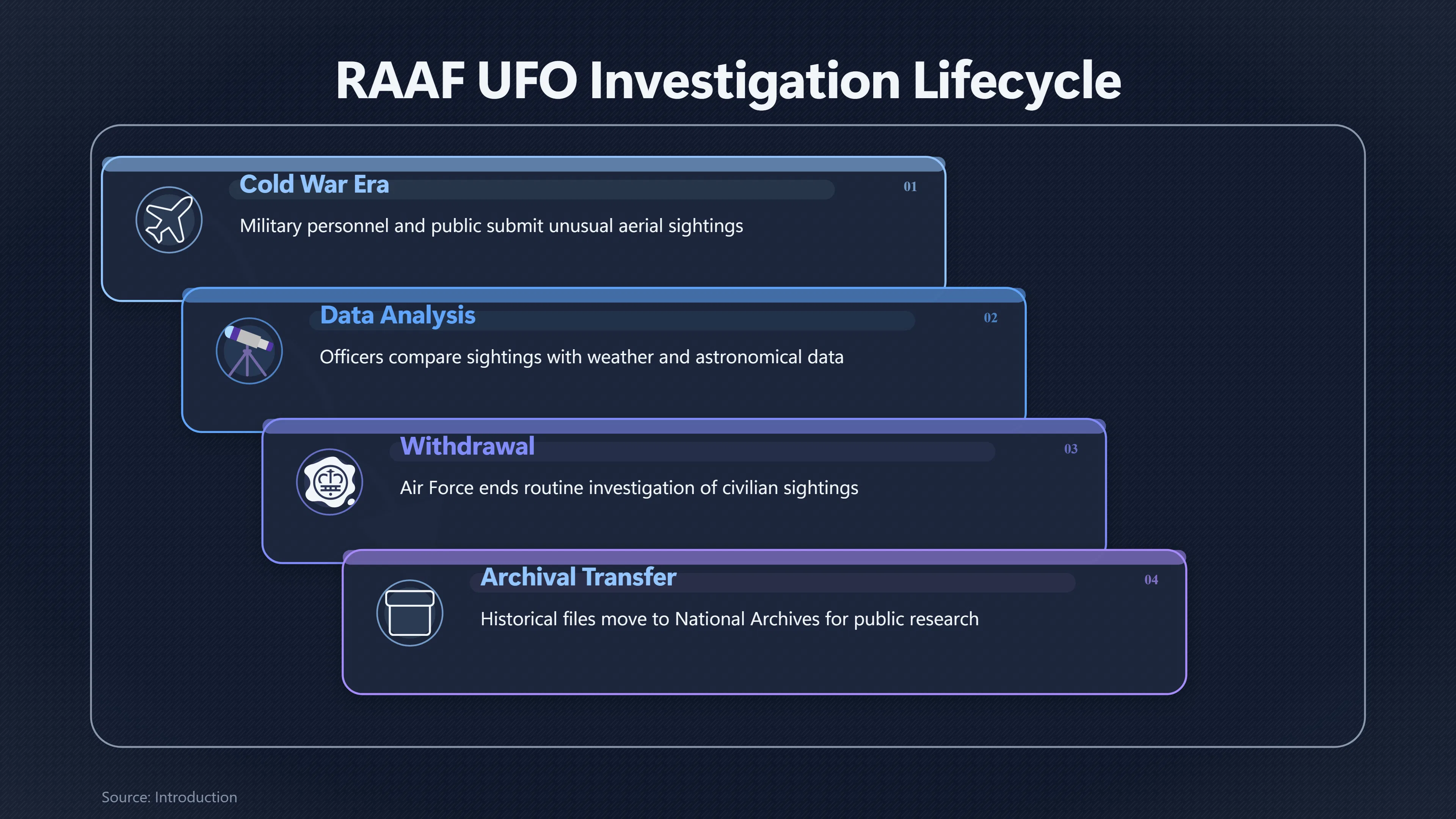
For much of the Cold War, the RAAF accepted reports of unusual aerial sightings from military personnel, pilots, police and members of the public. The purpose was broader than investigating claims of extraterrestrial spacecraft. Defence officials had to consider whether an unfamiliar object might represent an unidentified aircraft, missile activity, satellite debris, atmospheric phenomenon or another issue relevant to national security.
Investigations therefore focused on practical questions rather than speculation. Officers compared witness accounts with known aircraft movements, astronomical conditions, weather data and other available information. Many reports were attributed to planets, meteors, balloons, aircraft lighting, re-entering space debris or observational error. Others could not be conclusively identified because the evidence was incomplete, but being “unexplained” did not mean an extraordinary explanation had been established.[NAA]naa.gov.auNAAFlying saucers – fact or fiction? | naa.gov.auFebruary 28, 2018…
By the early 1990s, Defence considered decades of accumulated experience sufficient to judge the overall value of continuing the programme. Internal policy guidance stated that there was “no compelling reason” to continue committing Air Force resources to recording and attempting to explain unusual aerial sightings.[files.bluebookfiles.org]files.bluebookfiles.org1990.00 NARA NewZealandUFO AIR 1630 2 VolumeCopy /4.of 36February 10, 2026…
Why the RAAF decided to withdraw
The 1994 decision was driven primarily by governance and resource management rather than by a dramatic new discovery.
Several factors combined to support the policy change:
- Low intelligence value. Defence concluded that reports rarely produced information of military significance.
- Minimal security risk. The National Archives summarises the RAAF’s assessment that only around 3 per cent of reports remained unexplained and that these posed little or no threat to Australian security.
- Competing priorities. Intelligence staff were increasingly focused on conventional defence responsibilities rather than maintaining a specialist process for civilian UFO reports.
- Experience over several decades. After years of investigations, the Air Force believed that continued routine inquiry was unlikely to produce substantially different results.[naa.gov.au]naa.gov.auNAAFlying saucers – fact or fiction? | naa.gov.auFebruary 28, 2018…
Importantly, the decision was not presented as proof that every reported sighting had been explained. Instead, Defence judged that the remaining unresolved cases did not justify a permanent investigative programme. An unresolved report simply reflected insufficient evidence to reach a definite conclusion.
Former RAAF intelligence officer Brett Biddington has described the decision in practical terms: investigating civilian UFO reports was no longer regarded as part of the Air Force’s core business. This interpretation fits the broader trend within government agencies during the period, which increasingly measured programmes against operational priorities and available resources rather than public curiosity.[NAA]naa.gov.auNAAFlying saucers – fact or fiction? | naa.gov.auFebruary 28, 2018…
What changed after investigations ended
Ending routine investigations did not mean that Australia stopped responding to genuine aviation or defence incidents.
If an unidentified object creates an operational hazard—for example, an unknown aircraft entering controlled airspace or an event affecting flight safety—it is handled through normal military and civil aviation reporting systems rather than through a dedicated UFO programme. Modern Defence guidance emphasises aviation safety and airspace management instead of maintaining a separate category for public UFO reports.[Defence]defence.gov.auDefence Department of Defence FOI 116/22/23Defence Department of Defence FOI 116/22/23
Policy documents issued after the withdrawal instructed Defence personnel that the Australian Defence Force would no longer accept or investigate reports of unusual aerial sightings from the public. Instead, members of the public seeking to report such observations were directed towards civilian UFO organisations rather than Defence itself.[files.bluebookfiles.org]files.bluebookfiles.org1990.00 NARA NewZealandUFO AIR 1630 2 VolumeCopy /4.of 36February 10, 2026…
This distinction is important because it is sometimes misunderstood. The RAAF ended a specific administrative reporting system, not its responsibility to respond to genuine threats in Australian airspace. Unknown aircraft, aviation incidents and defence-related intrusions continue to be investigated under separate operational procedures.
How closure shifted records into public archives
The end of routine investigations transformed Canberra’s place in Australian UFO history.[youtube.com]youtube.comAustralian Military Aviation HistoryNew details emerge about RAAF interception in South China Sea | ABC News ABC News (Australia)…
While the reporting system operated, many files were active Defence records held within government offices in Canberra, particularly by Air Force intelligence. Once the programme ended and records became historically rather than operationally significant, increasing numbers were transferred to the National Archives of Australia under normal archival processes.[NAA]naa.gov.auNAAFlying saucers – fact or fiction? | naa.gov.auFebruary 28, 2018…
This change had two lasting consequences.
First, researchers and journalists gained much greater access to historical material. Instead of relying on rumours about secret government investigations, they could examine original correspondence, witness reports and administrative files.
Second, the archives helped place individual sightings in context. Rather than revealing a hidden official belief in extraterrestrial visitors, the surviving files largely document the everyday work of government officials assessing reports, corresponding with the public and deciding how much attention the subject deserved.
For the Australian Capital Territory, this administrative transition is why Canberra became associated with Australia’s documentary UFO history. The city’s importance lies less in local sightings than in its role as the place where national policy was formulated, records were managed and, ultimately, preserved.
What the policy does—and does not—mean
The RAAF’s withdrawal has often been interpreted in two opposite ways, neither of which reflects the documentary record.
One interpretation claims the Air Force stopped investigating because it had discovered nothing unusual. The official record supports the view that most reports had conventional explanations and the remainder posed no identifiable security concern, but it does not claim that every case was solved.[NAA]naa.gov.auNAAFlying saucers – fact or fiction? | naa.gov.auFebruary 28, 2018…
The opposite interpretation argues that the programme was closed to conceal extraordinary findings. Publicly available policy documents and archived files instead point to a far more routine explanation: Defence believed the programme consumed resources without delivering intelligence value, making it an administrative rather than conspiratorial decision.[files.bluebookfiles.org]files.bluebookfiles.org1990.00 NARA NewZealandUFO AIR 1630 2 VolumeCopy /4.of 36February 10, 2026…
Understanding that distinction helps explain why Canberra remains central to Australia’s UFO history. The enduring significance of the capital is not that it held definitive answers, but that it preserved the records showing how Australia’s defence establishment investigated unusual aerial reports, reassessed their value and eventually decided that routine UFO investigations no longer belonged within the RAAF’s mission.
Amazon book picks
Further Reading
Books and field guides related to Why the RAAF Closed Its UFO Reporting System. Use these as the next step if you want deeper reading beyond the article.
The UFO Experience: A Scientific Inquiry
Cited by the New York Review of Books as "the best brief for visitation," this classic study presents an analysis of UFO reports and conc...
UFOs and Government: A Historical Inquiry
Governments around the world have had to deal with the UFO phenomenon for a good part of a century. How and why they did so is the subjec...
The Report on Unidentified Flying Objects
Book Excerpt: ing can never be positively identified. It might have been a hallucination or it might have been some vehicle from outer sp...

eBay marketplace picks
Marketplace Samples
Live-tested eBay searches with available results related to this page.
Selected fromUFO poster oneBay.co.uk.

Current eBay listing
VINTAGE UFO FLYING SAUCERS COMIC ADVERTISING A2 POSTER PRINT



Current eBay listing
I Want To Believe UFO Poster Giclée Fine Art Heavyweight Print
Endnotes
1.
Source: naa.gov.au
Title: NAAFlying saucers – fact or fiction? | naa.gov.au
Link:https://www.naa.gov.au/blog/flying-saucers-fact-or-fiction
Source snippet
February 28, 2018...
Published: February 28, 2018
2.
Source: files.bluebookfiles.org
Title: 1990.00 NARA NewZealandUFO AIR 1630 2 Volume 2 1990
Link:https://files.bluebookfiles.org/pdfs/1990.00%20-%20NARA%20-%20NewZealandUFO%20-%20AIR-1630-2-Volume-2-1990-.pdf
Source snippet
Copy /4.of 36February 10, 2026...
Published: February 10, 2026
3.
Source: archives.gov
Link:https://www.archives.gov/research/topics/uaps/rg-collections
Source snippet
ecord Group or Collection | National ArchivesDecember 12, 2025 — RECORDS RELATED TO UNIDENTIFIED FLYING OBJECTS (UFOS) AND UNIDENTIFIED A...
Published: December 12, 2025
4.
Source: archives.gov
Link:https://www.archives.gov/research/topics/uaps/textual-and-microfilm
Source snippet
icrofilm | National ArchivesApril 24, 2025 — RECORDS RELATED TO UNIDENTIFIED FLYING OBJECTS (UFOS) AND UNIDENTIFIED ANOMALOUS PHENOMENA (...
Published: April 24, 2025
5.
Source: archives.gov
Title: Project BLUE BOOK
Link:https://www.archives.gov/research/military/air-force/ufos
6.
Source: everything.explained.today
Link:https://everything.explained.today/Australian_ufology/
7.
Source: defence.gov.au
Title: Defence Department of Defence FOI 116/22/23
Link:https://www.defence.gov.au/sites/default/files/2022-09/116_2223-documents.pdf
8.
Source: media.nationalarchives.gov.uk
Link:https://media.nationalarchives.gov.uk/index.php/ufo-files-national-archives/
9.
Source: nationalarchives.gov.uk
Title: UF O reports
Link:https://www.nationalarchives.gov.uk/explore-the-collection/explore-by-time-period/postwar/ufo-reports/
10.
Source: nationalarchives.gov.uk
Link:https://www.nationalarchives.gov.uk/help-with-your-research/research-guides/ufos/
Additional References
11.
Source: abc.net.au
Link:https://www.abc.net.au/listen/programs/expanse/uap-in-the-usa/104645762
Source snippet
04 Uncropped | UAP in the USA - ABC listenNovember 26, 2024 — And the ones that were unexplained was usually because there wasn’t enough...
Published: November 26, 2024
12.
Source: canberradaily.com.au
Link:https://canberradaily.com.au/the-truth-is-out-there-canberra/
Source snippet
The truth is out there, Canberra | Canberra DailyAugust 11, 2025 — Image: UFO pic 1 The National Archives of Australia in Canberra holds...
Published: August 11, 2025
13.
Source: abc.net.au
Link:https://www.abc.net.au/news/2024-12-07/accessing-australia-secret-ufo-files/104673082
Source snippet
There they are. The secretary leaves the room and Bill hurries to get to work, documenting what he can...
14.
Source: questions-statements.parliament.uk
Title: uk Written questions and answers
Link:https://questions-statements.parliament.uk/written-questions/detail/2024-12-05/18321/
Source snippet
questions and answers - Written questions, answers and statements - UK ParliamentDecember 11, 2024 — Written questions, answers and state...
Published: December 11, 2024
15.
Source: youtube.com
Link:https://www.youtube.com/watch?v=8yFIRaalq10
Source snippet
Australia's Chief of Air Force hasn't been briefed on UAP (UFOs)...Why?...
16.
Source: youtube.com
Title: Australia’s UFO Secrets Exposed with Ross Coulthart
Link:https://www.youtube.com/watch?v=hzoJPerhz-I
Source snippet
Inside the Australian UFO Archive: The Sea Fury, Maralinga, and the Valentich Mystery...
17.
Source: youtube.com
Title: In the 80s the RAAF held hundreds of files documenting UFO sightings
Link:https://www.youtube.com/watch?v=Rrou1Yl-hao
Source snippet
Australia’s UFO Secrets Exposed with Ross Coulthart...
18.
Source: youtube.com
Link:https://www.youtube.com/watch?v=dyBmXGRp43M
Source snippet
The UFOs of OZ | S01 EP04 - Bill Chalker...
19.
Source: youtube.com
Title: Australian Military Aviation History
Link:https://www.youtube.com/watch?v=MS7IgABDCrI
Source snippet
New details emerge about RAAF interception in South China Sea | ABC News ABC News (Australia)...
20.
Source: secretsdeclassified.af.mil
Link:https://www.secretsdeclassified.af.mil/Fact-Sheets/Display/Article/459832/project-blue-book/