Within Civilian Groups
How UFO Reports Changed Before Publication
Comparing original sighting forms with later magazine accounts shows how editing, selection and repetition could reshape a reported event.
On this page
- How investigators collected first hand accounts
- What editors shortened or emphasised
- How later retellings altered the evidence
Page outline Jump by section
Introduction
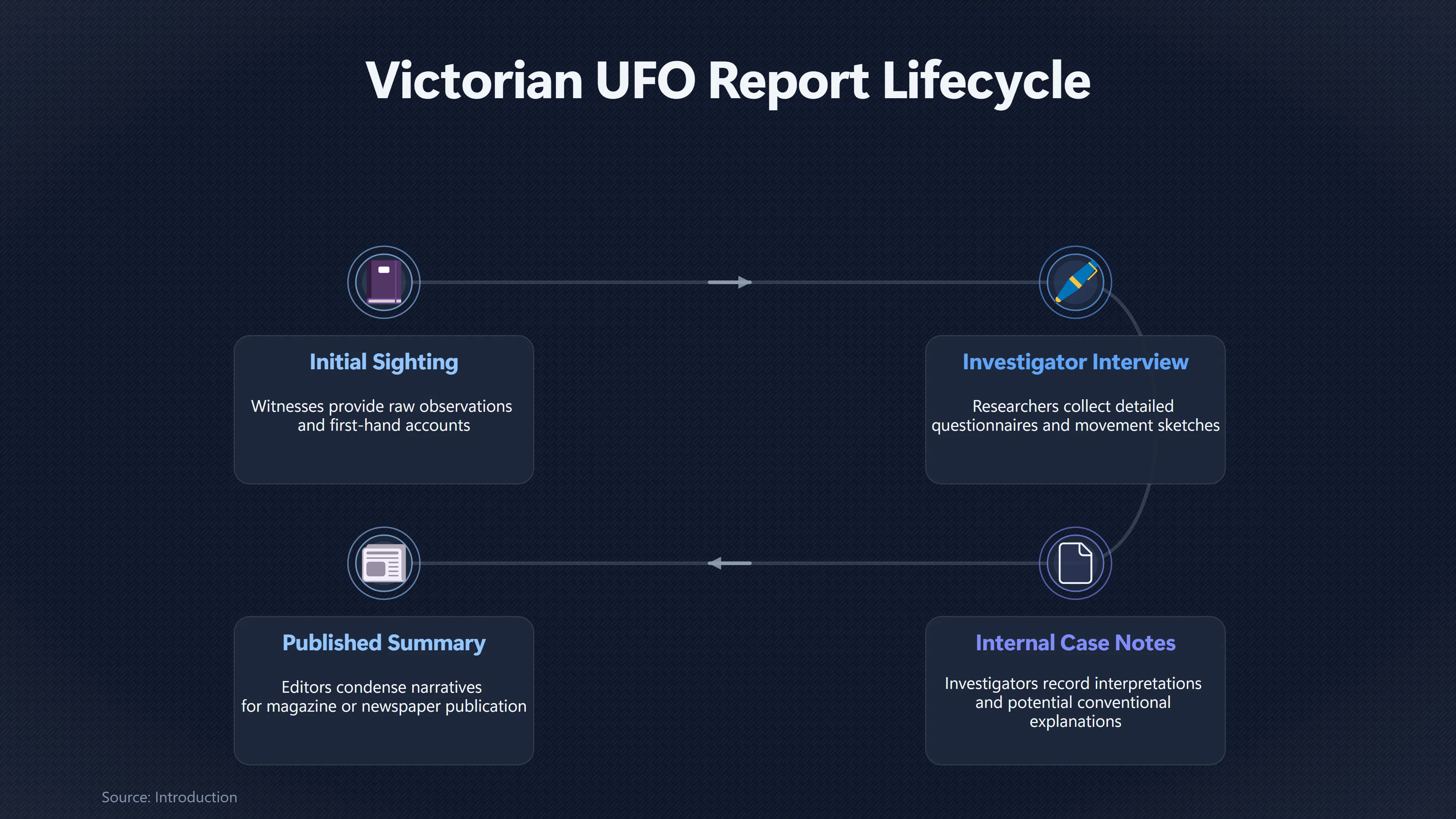
Most Victorian UFO reports did not pass directly from a witness to the public unchanged. Instead, they typically moved through several stages: an initial sighting report, an investigator’s interview or questionnaire, internal case notes, and finally a magazine article, newsletter or newspaper summary. Each stage involved choices about what to include, what to shorten and what to emphasise. Those editorial decisions do not necessarily imply deception, but they can substantially affect how later readers understand a case.
For anyone using Victoria’s civilian UFO archives, the distinction between an original witness statement and a published story is crucial. Contemporary forms often preserve uncertainty, conflicting recollections and mundane details that disappear from later accounts. Published versions, by contrast, were designed to be readable, memorable and sometimes persuasive. Understanding that process helps explain why some famous Victorian cases appear more dramatic in later retellings than in the earliest surviving records.[State Library Victoria Blogs]blogs.slv.vic.gov.auState Library Victoria BlogsStrange lights in the sky: The Westall UFO event, 19666 Apr 2024 — The Victorian Flying Saucer Research Socie…
How investigators collected first-hand accounts
Civilian investigators in Victoria generally tried to capture witness testimony as close to the event as possible. Organisations such as the Victorian Flying Saucer Research Society (later the Victorian UFO Research Society, or VUFORS) encouraged witnesses to write detailed statements, complete questionnaires and produce sketches showing an object’s apparent movement, shape and direction. Interviews frequently added observations about weather, lighting, nearby aircraft and the witness’s viewing position.[Internet Archive]archive.orgAustralian UFO Bulletin 1987 12 December djvu.txtFlying Saucer Research Society” and later that year was re-organised as the “Victorian Flying Saucer Research Society” with Mr. Peter E…
An original case file could therefore contain several distinct versions of the same event:
- the witness’s first handwritten account;
- answers to follow-up questions;
- an investigator’s interview notes;
- maps or sketches;
- correspondence with other investigators or government agencies;
- a final assessment prepared for publication.
These documents were created for different purposes. A questionnaire sought raw observations, while an investigator’s notes often included interpretation or attempts to identify conventional explanations. By the time a case reached a magazine, multiple layers of editing had already occurred.
Importantly, investigators themselves sometimes recognised uncertainty. Witnesses could disagree about colours, distances or timing even when observing the same event. Rather than treating every inconsistency as fatal, investigators often recorded several versions before deciding which details to highlight in print. That means the unpublished archive may preserve more complexity than the published article derived from it.
What editors shortened or emphasised
Space limitations strongly influenced Australian UFO magazines during the 1950s, 1960s and 1970s. Society newsletters relied on volunteer editors and limited printing budgets, making detailed transcripts impractical. As a result, editors routinely condensed lengthy interviews into short narratives.
Several kinds of information were commonly reduced:
- repeated expressions of uncertainty such as “I think” or “it seemed”;
- disagreements between multiple witnesses;
- background conversation unrelated to the sighting;
- unsuccessful attempts to identify the object;
- lengthy descriptions of weather or viewing conditions.
Conversely, certain elements naturally attracted editorial attention:
- unusual manoeuvres;
- apparently independent corroboration from multiple witnesses;
- sketches showing distinctive shapes;
- reports involving pilots, police officers or other witnesses perceived as especially reliable;
- claims that official authorities had investigated or declined to comment.
None of these editorial choices automatically invalidates the published account. However, they demonstrate that a magazine article should usually be understood as a summary rather than a complete primary source. Readers who only encounter the published version may assume that every surviving detail reflects the original testimony, when in reality many observations never appeared in print.
The Westall case shows how publication changed a story
The 1966 Westall sighting illustrates the process particularly well. The Victorian Flying Saucer Research Society interviewed witnesses soon after the incident, yet no comprehensive investigation was published at the time. Instead, fragments appeared through newspaper reports, school publications and society magazines, with additional witness testimony emerging decades later.[vic.gov.au]blogs.slv.vic.gov.auState Library Victoria BlogsStrange lights in the sky: The Westall UFO event, 19666 Apr 2024 — The Victorian Flying Saucer Research Socie…
One of the earliest detailed narratives came not from a formal investigation report but from a student account published in The Clayton Calendar, the Westall High School magazine. That account was later reproduced in the Australian Flying Saucer Review, allowing it to reach a much wider audience. During this transition, the school publication became part of the broader UFO literature rather than simply a local student record.[State Library Victoria Blogs]blogs.slv.vic.gov.auState Library Victoria BlogsStrange lights in the sky: The Westall UFO event, 19666 Apr 2024 — The Victorian Flying Saucer Research Socie…
Meanwhile, VFSRS investigators collected additional material that remained largely unpublished, including witness interviews, photographs and report forms. Later researchers revisiting these archival fragments found that some details widely repeated in documentaries and popular books either developed gradually over time or rested on memories recorded many years after the event.[blogspot.com]theozfiles.blogspot.comtheozfiles: "Westall '66the prehistory of its investigation…23 Apr 2026 — The brief bios show Judy Magee, Peter Norris and Paul Norman, copies of the VFSRS ma…
This does not prove that later witnesses were mistaken. Instead, it demonstrates that the published history of a case may represent only one stage in a much longer process of collecting, selecting and retelling evidence.
How repeated retellings altered the evidence
Once a UFO report entered magazines, books and documentaries, later authors often relied on earlier publications rather than returning to the original witness files. This created several predictable changes.
First, details became standardised. If one influential publication described an object as “disc-shaped” while the original witness had offered several possible comparisons, later writers frequently repeated only the simplified description.
Second, dramatic episodes tended to become central to the story. Less remarkable observations gradually disappeared, even if they had occupied considerable space in the original interview.
Third, later narratives sometimes merged independent recollections into a single seamless account. This makes the event easier to understand but can obscure genuine differences between witnesses.
Finally, memory itself changed over time. Witnesses interviewed decades later had often read books, watched documentaries or spoken with other participants. Modern recollections therefore reflect both the original experience and many years of discussion, making it difficult to separate fresh memory from later interpretation. The continuing evolution of Westall illustrates this challenge, with contemporary accounts, later interviews and retrospective documentaries sometimes differing in important details.[wikipedia.org]WikipediaWestall UFOThe Westall UFO was a reported UFO sighting in Australia that occurred on 6 April 1966 in Melbourne, Victoria.Read more…
Reading Victorian UFO publications critically
For historians, the most valuable approach is to compare every available layer of documentation rather than relying on a single published version.
Useful questions include:
- Was the article based on an original witness interview or another publication?
- Are quotations presented verbatim or paraphrased?
- Did multiple witnesses describe the same features independently?
- Which details appear only in much later retellings?
- Do unpublished notes reveal uncertainty omitted from the magazine version?
These questions do not assume that witnesses or investigators acted in bad faith. Rather, they recognise that every stage of publication involves selection and interpretation.
Within Victoria’s civilian UFO archives, the greatest historical value often lies not in the polished article but in the surviving report forms, correspondence and interview notes that reveal how the published narrative was assembled. Reading those materials alongside later magazine accounts provides a clearer picture of both what witnesses originally reported and how those reports gradually became some of Australia’s best-known UFO stories.

Amazon book picks
Further Reading
Books and field guides related to How UFO Reports Changed Before Publication. Use these as the next step if you want deeper reading beyond the article.
How UFOs Conquered the World: The History of a Modern Myth
"Cover[s] all the major themes of ufology, ranging from lights in the sky to crashed saucers, government cover-ups and alien abductions ....
The UFO Files: The Inside Story of Real-Life Sightings
'What does all this stuff about flying saucers amount to? What can it mean? What is the truth?' Winston Churchill, prime minister's perso...
The Seven Sins of Memory: How the Mind Forgets and Remembers
Rating: 3.5/5 from 5 Google Books ratings
A New York Times Notable Book: A psychologist's "gripping and thought-provoking" look at how and why our brains sometimes fail us (Steven...
eBay marketplace picks
Marketplace Samples
Live-tested eBay searches with available results related to this page.
Selected fromUFO poster oneBay.co.uk.


Current eBay listing
VINTAGE UFO FLYING SAUCERS COMIC ADVERTISING A2 POSTER PRINT
Current eBay listing
I Want To Believe UFO Poster Giclée Fine Art Heavyweight Print
Endnotes
1.
Source: archive.org
Link:https://archive.org/stream/AustralianUFOFiles/A703_554-1-30_Part%202_12055824_djvu.txt
Source snippet
Internet ArchiveFull text of "Australian UFO Files"Full text of "Australian UFO Files" publication in this form for sale to the public. P...
2.
Source: archive.org
Title: Australian UFO Bulletin 1987 12 December djvu.txt
Link:https://archive.org/stream/Australian_UFO_Bulletin_1987_12_December/Australian_UFO_Bulletin_1987_12_December_djvu.txt
Source snippet
Flying Saucer Research Society” and later that year was re-organised as the “Victorian Flying Saucer Research Society” with Mr. Peter E...
3.
Source: project1947.com
Link:https://www.project1947.com/kbcat/kbwestall.htm
Source snippet
Judith Magee, of the VFSRS says in “Australian Flying Saucer. Review” that the society encountered an “antagonistic attitude” when attemp...
4.
Source: Wikipedia
Title: Westall UFO
Link:https://en.wikipedia.org/wiki/Westall_UFO
Source snippet
The Westall UFO was a reported UFO sighting in Australia that occurred on 6 April 1966 in Melbourne, Victoria.Read more...
Published: April 1966
5.
Source: theozfiles.blogspot.com
Title: theozfiles: “Westall ‘66
Link:https://theozfiles.blogspot.com/2026/04/westall-66-prehistory-of-its.html
Source snippet
the prehistory of its investigation...23 Apr 2026 — The brief bios show Judy Magee, Peter Norris and Paul Norman, copies of the VFSRS ma...
6.
Source: Wikipedia
Title: List of reported UFO sightings
Link:https://en.wikipedia.org/wiki/List_of_reported_UFO_sightings
7.
Source: blogs.slv.vic.gov.au
Link:https://blogs.slv.vic.gov.au/our-stories/strange-lights-in-the-sky-the-westall-ufo-event-1966/
Source snippet
State Library Victoria BlogsStrange lights in the sky: The Westall UFO event, 19666 Apr 2024 — The Victorian Flying Saucer Research Socie...
Additional References
8.
Source: youtube.com
Title: The Disappearance of Frederick [Valentich]({{ ‘valentich/’ | relative_url }})
Link:https://www.youtube.com/watch?v=HVJr_YJgn1c
Source snippet
Westall UFO incident documentary 1966 Australia Australia’s Biggest UFO Cover-Up | The Westall Incident (1966) Project Unknown: Field Files...
9.
Source: youtube.com
Title: Schoolyard witnesses in mass UFO sighting demand answers | Australian Story
Link:https://www.youtube.com/watch?v=IhKyQkhOfoM
Source snippet
Australia’s Biggest UFO Cover-Up | The Westall Incident (1966)...
10.
Source: youtube.com
Link:https://www.youtube.com/watch?v=DZP-x4Ko_JI
Source snippet
OZ Encounters - UFO's In Australia (FULL DOCUMENTARY)...
11.
Source: youtube.com
Title: OZ Encounters
Link:https://www.youtube.com/watch?v=AAZNXPEaq0Q
Source snippet
Australia’s Biggest UFO Mystery | The Westall UFO Incident (1966)...
12.
Source: youtube.com
Link:https://www.youtube.com/watch?v=0vqsbptVgHU
Source snippet
The Disappearance of Frederick Valentich...
13.
Source: scribd.com
Link:https://www.scribd.com/document/646933318/Alien-Honeycomb
14.
Source: wolfdigitalmedia.com
Link:https://wolfdigitalmedia.com/ufo/jamesmcdonaldarchive.htm
15.
Source: facebook.com
Link:https://www.facebook.com/groups/370084973101188/posts/4766127860163522/
16.
Source: facebook.com
Link:https://www.facebook.com/groups/1453182688334610/posts/4478966252422890/
17.
Source: skeptics.com.au
Link:https://www.skeptics.com.au/wp-content/uploads/magazine/The%20Skeptic%20Volume%208%20%281988%29%20No%201.pdf