Within Explanations
Can Sightlines Reveal Where a UFO Was?
Maps, landmarks and viewing angles can narrow an object's position, but size and speed remain uncertain when distance is unknown.
On this page
- Turning witness directions into mapped lines of sight
- When triangulation can constrain an object's position
- Why uncertain distance distorts size and speed
Page outline Jump by section
Introduction
Sightlines are one of the most practical tools for testing Victorian UFO reports because they turn a witness’s description into something that can be checked against the real landscape. Instead of asking only what someone thought they saw, investigators ask where they were standing, which direction they were facing, what landmarks were visible, and whether hills, buildings or trees would have blocked or framed the view. This approach cannot identify every unknown object, but it often narrows the range of plausible explanations by reconstructing the geometry of the sighting. It is especially valuable in Victoria, where reports range from dense suburban areas around Melbourne to open farmland, mountain ranges and long stretches of coastline. Contemporary UFO investigations, including those based on archived Australian reports, consistently rely on reconstructing observation geometry before considering more unusual explanations.[naa]naa.gov.aunaa Flying saucers – fact or fiction? | naa.gov.auFlying saucers – fact or fiction? | naa.gov.auFebruary 28, 2018…
Can Sightlines Reveal Where a UFO Was?
A witness may accurately remember seeing an unusual object while still being mistaken about its distance, height or speed. Human vision estimates direction much more reliably than distance when there are few visual references.
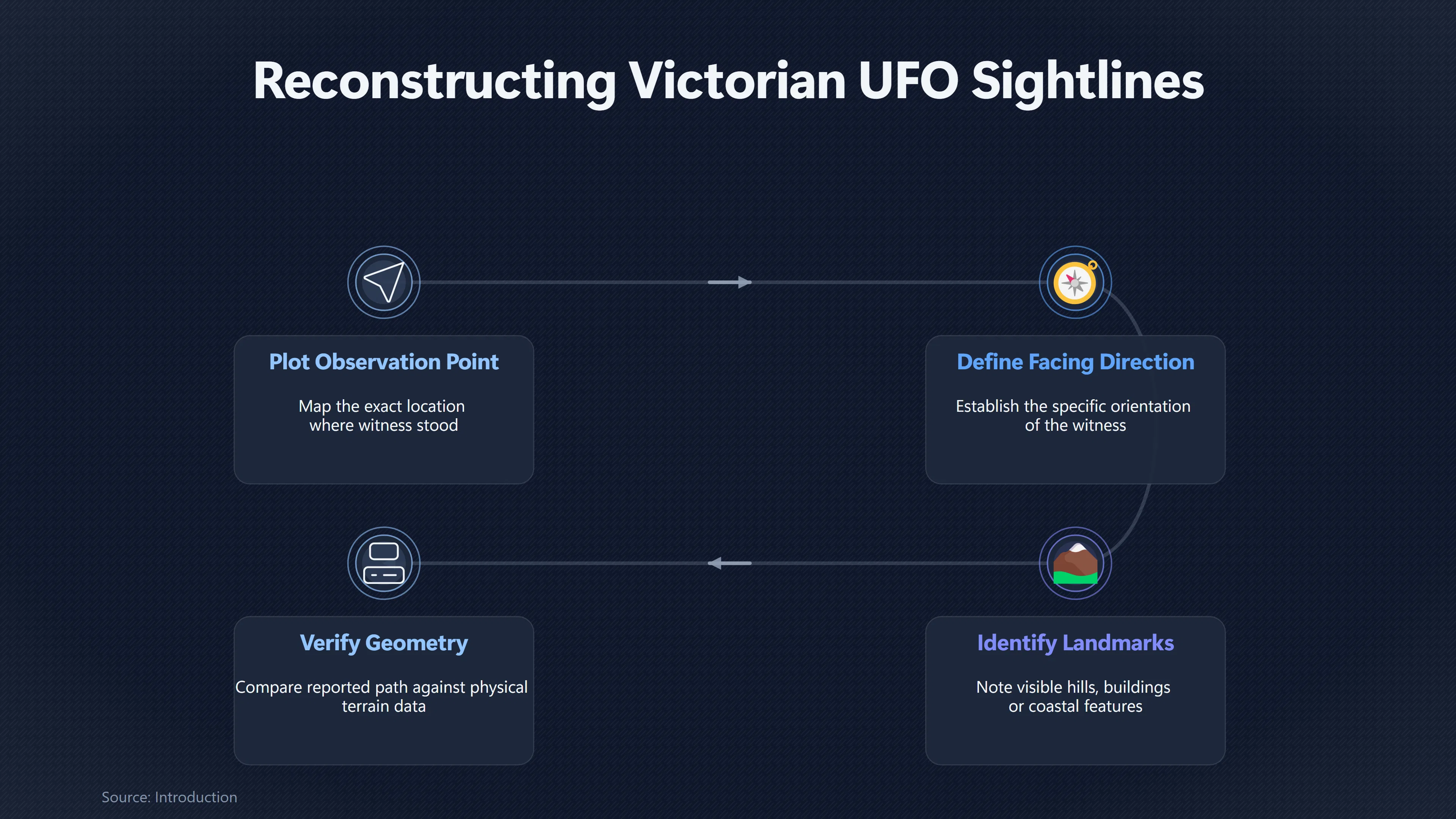
Investigators therefore begin by plotting the observation point on a map. They then reconstruct the witness’s line of sight using details such as:
- the road, beach, hill or building where the witness stood;
- the direction they faced;
- prominent landmarks that appeared beneath or beside the object;
- the object’s apparent elevation above the horizon;
- whether the object disappeared behind terrain, trees or buildings.
These details create a line extending from the observer into the landscape. The line alone does not reveal the object’s distance, but it defines where it could have appeared from that location. If several independent witnesses provide usable sightlines, those lines can be compared to see whether they intersect in a realistic area or instead describe incompatible positions.
In many historical Victorian cases, this reconstruction is more informative than descriptions such as “hovering overhead” or “moving incredibly fast”, because mapped directions can be tested against aircraft routes, astronomical objects, weather conditions and local geography.[naa]naa.gov.aunaa Flying saucers – fact or fiction? | naa.gov.auFlying saucers – fact or fiction? | naa.gov.auFebruary 28, 2018…
Turning Witness Directions into Mapped Lines of Sight
Victoria provides many fixed reference points that help investigators convert memories into measurable geometry.
For example, a witness might report that an object:
- crossed above the Dandenong Ranges from a particular suburban street;
- appeared over Port Phillip Bay while viewed from the foreshore;
- disappeared behind a known ridgeline in the Grampians;
- emerged from behind a recognisable hill near Ballarat or Bendigo.
Each landmark fixes part of the viewing geometry. Digital elevation models, topographic maps and modern satellite imagery allow investigators to estimate which parts of the sky would actually have been visible from the reported location.
This can immediately rule out some claims. If a witness recalled an object descending behind a ridge that would have hidden the horizon from that viewpoint, the reconstruction may show the remembered path is physically impossible. Alternatively, the reconstruction may demonstrate that the reported movement aligns closely with an aircraft following a known approach corridor or a bright astronomical object setting behind distant terrain.
The same method is useful even decades after an event because roads, hills and coastlines usually change far less than human memory.
When Triangulation Can Constrain an Object’s Position
A single sightline cannot determine distance. An object could lie almost anywhere along that viewing direction.
The situation improves when multiple independent witnesses observed the same event from different locations.
Each witness contributes another line of sight. If those lines converge within a relatively small area, investigators can estimate:
- an approximate location;
- a minimum altitude;
- possible flight path;
- whether different witnesses were probably observing the same object.
If the lines fail to converge, several explanations become more likely:
- different witnesses were watching different objects;
- memories changed before formal interviews;
- estimated directions were inaccurate;
- later retellings combined separate events into one narrative.
Modern scientific proposals for investigating unidentified aerial phenomena similarly emphasise simultaneous observations from multiple locations because triangulation provides an objective estimate of distance instead of relying on visual impressions alone.[arXiv]arxiv.orgarXiv The New Science of Unidentified Aerospace-Undersea Phenomena (UAPThe New Science of Unidentified Aerospace-Undersea Phenomena (UAP)January 27, 2025…
Why Uncertain Distance Distorts Size and Speed
Distance is the largest unknown in most eyewitness reports.
An object appearing the size of a thumbnail at arm’s length could represent:
- a nearby bird;
- a drone;
- a balloon;
- an aircraft many kilometres away.
Without knowing the distance, investigators cannot reliably calculate either its physical size or its true speed.
This is why dramatic descriptions such as “it accelerated instantly” often become less certain after geometric reconstruction. A distant aircraft changing direction slightly can appear to move rapidly against the background sky, while a nearby insect passing close to the observer can seem enormous and extraordinarily fast.
Similarly, an object apparently hovering over a landmark may actually be far beyond it. From one viewpoint the alignment appears exact, but moving only a short distance sideways can reveal that the object and landmark were separated by many kilometres.
Because of this uncertainty, experienced investigators avoid estimating extraordinary speeds until they have constrained the object’s position using independent evidence.
Why Sightlines Matter in Victorian Cases
Well-known Victorian incidents illustrate why sightline analysis is valuable even when it cannot produce a definitive answer.
For example, discussions of the 1966 Westall incident frequently depend on reconstructing where students, teachers and nearby residents stood, which direction they looked, and how reported movements related to nearby open ground and surrounding landmarks. Competing explanations—including unusual aircraft, research balloons and genuinely unidentified objects—cannot be fairly compared without first establishing what parts of the landscape each witness could actually see. Later reconstructions have therefore focused heavily on maps, school grounds and the surrounding terrain rather than witness testimony alone.[naa]naa.gov.aunaa Flying saucers – fact or fiction? | naa.gov.auFlying saucers – fact or fiction? | naa.gov.auFebruary 28, 2018…
The same principle applies across Victoria. Whether a report comes from Melbourne’s suburbs, rural Gippsland or the Bass Strait coastline, reliable geometry provides a firmer basis for investigation than descriptions of appearance alone.
What Sightlines Can—and Cannot—Prove
Sightline reconstruction is a powerful filtering tool rather than proof of any particular explanation.
It can:
- eliminate physically impossible descriptions;
- identify where multiple witnesses genuinely agreed;
- test whether terrain matched the reported observation;
- support comparisons with aircraft, balloons or astronomical objects;
- estimate possible positions when several independent observations exist.
It cannot:
- determine distance from a single observation;
- prove an object’s identity by itself;
- recover details that witnesses never recorded;
- compensate for memories altered by later discussion or media coverage.
For this reason, sightlines are most valuable when combined with other evidence such as photographs, weather records, aviation data, contemporary notes and independent witness accounts. Used together, these sources often strengthen ordinary explanations, while in a smaller number of cases they simply show that the available evidence is insufficient to identify the object with confidence.[naa]naa.gov.aunaa Flying saucers – fact or fiction? | naa.gov.auFlying saucers – fact or fiction? | naa.gov.auFebruary 28, 2018…
Amazon book picks
Further Reading
Books and field guides related to Can Sightlines Reveal Where a UFO Was?. Use these as the next step if you want deeper reading beyond the article.
The UFO Handbook: A Guide to Investigating, Evaluating, and R...
An explanation of the usual reasons for confusing IFOs (identified flying objects) with UFOs and a survey of the tools used to investigat...
The UFO Experience: A Scientific Inquiry
Cited by the New York Review of Books as "the best brief for visitation," this classic study presents an analysis of UFO reports and conc...
How to Lie with Maps
An updated edition of the "humorous, informative and perceptive" guide to how maps can lead us astray ( Toronto Globe and Mail). An insta...
NightWatch: A Practical Guide to Viewing the Universe
A practical guide to viewing the universe.
eBay marketplace picks
Marketplace Samples
Live-tested eBay searches with available results related to this page.
Selected fromUFO poster oneBay.co.uk.
Current eBay listing
VINTAGE UFO FLYING SAUCERS COMIC ADVERTISING A2 POSTER PRINT

Current eBay listing
I Want To Believe UFO Poster Giclée Fine Art Heavyweight Print

Endnotes
1.
Source: naa.gov.au
Title: naa Flying saucers – fact or fiction? | naa.gov.au
Link:https://www.naa.gov.au/blog/flying-saucers-fact-or-fiction
Source snippet
Flying saucers – fact or fiction? | naa.gov.auFebruary 28, 2018...
Published: February 28, 2018
2.
Source: nationalarchives.gov.uk
Title: National Archives UFOs
Link:https://www.nationalarchives.gov.uk/help-with-your-research/research-guides/ufos/
Source snippet
National ArchivesUFOs - The National Archives...
3.
Source: arxiv.org
Title: arXiv The New Science of Unidentified Aerospace-Undersea Phenomena (UAP)
Link:https://arxiv.org/abs/2502.06794
Source snippet
The New Science of Unidentified Aerospace-Undersea Phenomena (UAP)January 27, 2025...
Published: January 27, 2025
4.
Source: blogs.slv.vic.gov.au
Title: strange lights in the sky the westall ufo event 1966
Link:https://blogs.slv.vic.gov.au/our-stories/strange-lights-in-the-sky-the-westall-ufo-event-1966/
5.
Source: media.nationalarchives.gov.uk
Title: nationalarchives.gov.uk The Cold War and UFOs | The National Archives
Link:https://media.nationalarchives.gov.uk/index.php/cold-war-ufos/
6.
Source: media.nationalarchives.gov.uk
Link:https://media.nationalarchives.gov.uk/index.php/ufo-files-national-archives/
7.
Source: media.nationalarchives.gov.uk
Link:https://media.nationalarchives.gov.uk/index.php/the-truth-is-in-here-ufos-at-the-national-archives/
8.
Source: nationalarchives.gov.uk
Title: UF O reports
Link:https://www.nationalarchives.gov.uk/explore-the-collection/explore-by-time-period/postwar/ufo-reports/
Additional References
9.
Source: news.com.au
Link:https://www.news.com.au/technology/science/space/australias-roswell-calls-for-fresh-inquiry-into-60yearold-westall-ufo-mystery/news-story/888e54275c5ac3b815df508d1bfe8af2
Source snippet
A 2014 discovery of documents from a secret US-Australian radiation-testing initiative, the HIBAL project, fueled speculation that the ob...
10.
Source: legalclarity.org
Title: navy uap key encounters hearings and disclosure
Link:https://legalclarity.org/navy-uap-key-encounters-hearings-and-disclosure/
Source snippet
Navy UAP: Key Encounters, Hearings, and Disclosure - LegalClarityJuly 2, 2026 — CASE RESOLUTIONS AND OFFICIAL FINDINGS AARO has published...
Published: July 2, 2026
11.
Source: youtube.com
Link:https://www.youtube.com/watch?v=ZqSHlmpBbIY
Source snippet
This curated selection features investigative analyses and documentary case studies of landmark Victorian UFO incidents—including the Wes...
12.
Source: contactproject.org
Title: The Contact Project
Link:https://contactproject.org/
Source snippet
Clear blue skies, clear signalsJuly 19, 2026 — * * * TWO METHODS, TWO SETS OF RESULTS This is the most important structural feature of Pa...
Published: July 19, 2026
13.
Source: archives.gov
Link:https://www.archives.gov/research/topics/uaps/moving-images-and-sound
14.
Source: archives.gov
Link:https://www.archives.gov/research/topics/uaps/rg-collections
15.
Source: archives.gov
Link:https://www.archives.gov/research/topics/uaps/textual-and-microfilm
16.
Source: uapledger.com
Title: Analytic Fa
Link:https://uapledger.com/documents/release-3-dow-uap-d077
Source snippet
DOW-UAP-D077: AARO Unresolved Case Analysis Update: Western United States Event · UAP LedgerJune 12, 2026 — the phenomena as “silent.” Th...
Published: June 12, 2026
17.
Source: youtube.com
Title: Westall 60 Years On: Australia’s Most Famous UFO Sighting
Link:https://www.youtube.com/watch?v=JBgdkpzbuRU
Source snippet
Oz Encounters: UFO's In Australia (1997) VHS Capture...
18.
Source: ufouap.net
Title: Speed ca
Link:https://www.ufouap.net/en/explainers/parallax-in-uap-videos
Source snippet
Parallax in UAP Videos: Why Objects Seem Fast | Global UFO ArchiveJuly 11, 2026 — Evidence / Updated 2026-07-11 / 7 min read PARALLAX IN...
Published: July 11, 2026