Within South Australia UFOs
Why Outback Lights Can Look Like UFOs
Meteors, aircraft, planets, headlights and atmospheric refraction can all look extraordinary across South Australia's open horizons.
On this page
- Distance and motion on open roads
- Meteors, aircraft, planets and headlights
- How atmospheric refraction distorts light
Page outline Jump by section
Introduction
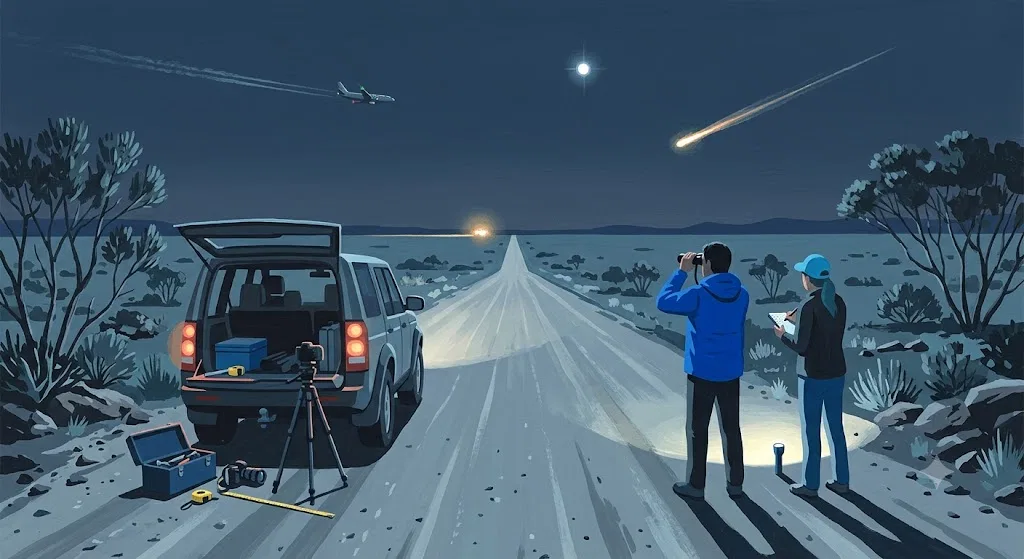
South Australia’s outback can make ordinary lights look anything but ordinary. On long, dark roads, a bright point may seem to hover, pursue a vehicle, change colour or accelerate without warning. The most likely explanations are usually meteors, aircraft, bright planets, distant headlights and atmospheric refraction rather than unusual craft. What makes these sightings persuasive is not necessarily the light itself, but the lack of reliable clues about its distance, size, height and speed.
This matters when assessing South Australian UFO reports because the state combines exceptionally open horizons with sparse ground lighting, long viewing distances and strong temperature differences near the surface. A witness may describe what they saw accurately while drawing the wrong conclusion about where it was or how it moved. The best investigation therefore begins with geometry, weather, astronomy and traffic—not with assumptions that the witness imagined the event or encountered something exotic.
Why distance and motion become unreliable
A light normally gains meaning from its surroundings. Buildings, trees and nearby terrain provide scale; overlapping objects reveal which thing is closer; and a visible horizon helps the brain judge height and movement. Much of inland South Australia removes those reference points. At night, the land may disappear almost completely, leaving a single light against a dark sky.
This is not merely a problem for inexperienced observers. Aviation authorities treat night-time visual illusions as a serious safety issue. The Australian Transport Safety Bureau describes autokinesis, in which a person staring at an isolated light in darkness perceives it as moving because tiny involuntary eye movements are mistakenly attributed to the light. The apparent movement can be convincing enough for a pilot to interpret a stationary source as another aircraft.[ATSB]atsb.gov.auFAA H 8083 3B Chapter 10NIGHT VISIONMay 3, 2024 — On a clear night, distant stationary lights can be mis- taken for stars or other aircraft. Even the norther…
The same loss of visual context also makes distance extremely difficult to estimate. A small, bright light nearby and a powerful light many kilometres away can produce a similar image on the retina. Without knowing the distance, a witness cannot reliably calculate the source’s size or speed. A light that appears to race alongside a car may instead be almost stationary on a distant horizon, with the vehicle’s own movement changing the viewing angle.
Road geometry strengthens the illusion. A distant light may be hidden and revealed repeatedly as the road rises, dips or bends. From inside a moving vehicle, those changes can look like abrupt climbs, descents or sideways turns. A source can also appear to maintain the same relative position for many minutes, creating the impression that it is following the observer. These effects help explain why outback reports often contain dramatic apparent motion but few usable measurements.
The problem is well demonstrated by aviation guidance. The US Federal Aviation Administration warns that roads and moving trains can be mistaken for runway lighting, while bright lights surrounded by otherwise dark terrain can distort judgements of distance. Australian accident investigations likewise show that even trained pilots can misjudge the position of lights when flying over featureless, unlit country.[faa.gov]faa.gov12 afh ch11Airplane Flying Handbook (3C) Chapter 11September 24, 2021 — At night, the Ground Lighting Illusions Lights along a straight path, suc…
Meteors, aircraft, planets and headlights
No single ordinary explanation fits every South Australian outback sighting. The useful question is which explanation best matches the light’s duration, direction, colour, apparent behaviour and relationship to the horizon.
Meteors and fireballs are strong candidates for brief, fast events. Meteors occur on ordinary clear nights as well as during named meteor showers, and particularly bright examples can cross a large part of the sky, fragment or leave a glowing train.[NASA Science]science.nasa.govScience Meteor ShowersNASA ScienceMeteor ShowersFebruary 14, 2025 — 30 Apr 2025 — Several meteors per hour can usually be seen on any clear night. When there a… A witness may describe a brilliant object as descending towards nearby ground even when it is tens of kilometres high and visible across a much wider region. Perspective can also make a meteor travelling roughly towards the observer appear slower than one crossing the line of sight.
Meteors are less convincing explanations for lights reported to hover or remain visible for many minutes. They are best considered when the observation involves a rapid streak, sudden flare, fragmentation or abrupt disappearance. Reports from multiple towns at nearly the same time also favour a high-altitude fireball over a nearby object.
Aircraft can appear surprisingly strange when viewed head-on. A powerful landing light may remain almost fixed in the sky as the aircraft approaches, then seem to dart sideways when the aircraft turns and its navigation lights become visible. Changes in cloud, haze or aircraft attitude can make the light brighten, fade or vanish. At long range, engine noise may be inaudible or may arrive well after the aircraft has been noticed.
An aircraft’s apparent movement is especially difficult to interpret when the observer is also travelling. A distant plane crossing at a shallow angle can seem to match a car’s speed, while a turn may be perceived as an impossible acceleration. South Australian UFO investigators have repeatedly found that apparently anomalous dots or lights were compatible with ordinary aircraft; the state’s large defence and aviation areas add further possibilities, although secrecy should not be used as a catch-all explanation without supporting flight information.[ABC News]abc.net.auOpen source on abc.net.au.
Venus and other bright celestial objects provide a better explanation for lights that remain in approximately the same part of the sky for a long period. Venus can be exceptionally conspicuous near the horizon and is frequently mistaken for an aircraft or unusual light. When viewed through unstable air, it may twinkle, change colour or appear to pulse. Autokinesis can then supply apparent movement even though the planet itself is effectively stationary during a short observation.[Sky & Telescope]skyandtelescope.orgSky & Telescope Why Are There So Many UFOs?Sky & Telescope Why Are There So Many UFOs?
A useful test is whether the light maintains a consistent relationship to the stars while the observer stops moving and watches from a fixed position. Astronomy software can also reconstruct the sky for the precise date, time and location. A vague statement that “it was probably Venus” is not enough; the planet must actually have been visible in the reported direction and at the appropriate elevation.
Vehicle headlights are among the most important explanations on open roads. A car beyond the visible horizon can send light through or above layers of air that bend it towards a distant observer. The source may therefore be visible even though the vehicle and the road are not. Because only the bright, distorted image is seen, the light can appear suspended above the ground.
Headlights also change naturally from white to yellow or red as their angle, distance and atmospheric path vary. Hills, road bends, passing traffic and temporary obstructions can make them split, merge, blink or disappear. An observer who turns around or leaves the main road may believe the light has reacted intelligently when the apparent response is actually produced by changing sightlines.
How refraction turns distant lights into hovering objects
Atmospheric refraction occurs because light changes direction as it passes through air layers of different density. Temperature is a major influence on that density. The Bureau of Meteorology defines a mirage as an optical illusion produced by the bending of light in the atmosphere.[Bureau of Meteorology]bom.gov.auOpen source on bom.gov.au.
In the outback, the air close to the ground can be much hotter or colder than the air above it. During a temperature inversion, cooler dense air may sit beneath warmer air. Light from a distant vehicle, building or other ground source can curve through this layered atmosphere and reach an observer who would normally be below the direct line of sight.
A strong version of this process produces a superior mirage, sometimes called a Fata Morgana. The Bureau explains that an inversion can act like a refracting lens, making a distant source appear higher than its true position and sometimes stretching, duplicating or inverting its image.[The Bureau of Meteorology]media.bom.gov.auOpen source on bom.gov.au. For a small light at night, those distortions need not resemble a recognisable mirage. They may simply create a fuzzy luminous patch that seems to hover above the horizon.
Australian physiologist Jack Pettigrew tested this explanation while investigating Min Min-type lights. In an outback experiment, observers saw the light of a vehicle positioned roughly ten kilometres away appear above the horizon under suitable atmospheric conditions. A pronounced mirage of distant terrain was visible the following morning, supporting the interpretation that the same layered air had refracted the vehicle light. Pettigrew argued that at least a substantial class of reported outback lights could be explained as distant headlights or other artificial sources seen through a superior mirage.[ABC News]abc.net.auABC News Mystery of the Min Min lights explained — ABC Science ArchiveABC News Mystery of the Min Min lights explained — ABC Science Archive
The mechanism is highly relevant to South Australia even though the best-known Min Min tradition is associated with Queensland. The South Australian interior and Nullarbor margin provide the same essential ingredients: low horizons, long lines of sight, isolated roads and strong near-ground temperature gradients. Former South Australian Bureau of Meteorology regional director Allan Brunt applied atmospheric refraction to the celebrated 1988 Nullarbor encounter, arguing that a distant light could have appeared elevated and distorted because its rays were bent downwards towards the observers.[The Skeptic]skeptic.org.ukfrom the archives the 1988 nullarbor ufo mystery solvedfrom the archives the 1988 nullarbor ufo mystery solved
Refraction does not mean that every strange outback light has been solved. The precise atmospheric profile at the time of an old sighting is rarely available, and some witness descriptions include details that cannot be tested decades later. Nor does a laboratory or field demonstration prove that the same mechanism caused a particular event. It does, however, establish something crucial: a ground-based light below the normal horizon can genuinely appear as an isolated, moving-looking object in the sky.
What makes an ordinary explanation convincing?
A credible explanation should account for the observation as a whole rather than simply name a familiar object. Investigators should compare the reported time and direction with astronomical positions, meteor records, aircraft routes, road alignments and weather conditions. The strongest identifications produce several independent matches.
For example, a planetary explanation becomes stronger when the light was seen in the correct direction for Venus, remained visible for a long period and disappeared as cloud covered that part of the sky. A meteor explanation gains weight when reports from separate places describe the same short-lived trajectory. A refracted-headlight explanation is persuasive when the light stays near the road horizon, changes as traffic approaches or recedes, and occurs during calm conditions favourable to a temperature inversion.
Stopping the vehicle is particularly useful. If an apparently pursuing light continues moving in relation to the landscape, the source may truly be mobile. If it steadies or changes behaviour once the observer stops, motion parallax or road geometry becomes more likely. Viewing through binoculars can reveal aircraft navigation lights, while photographs that include stars or identifiable terrain provide much better evidence than tightly zoomed images of an isolated glow.
The date, time and exact location matter more than an elaborate verbal description. Investigators need the compass direction, angular height above the horizon, duration, weather, observer movement and any available landmarks. Even an honest and attentive witness cannot recover those details accurately long after the event.
This is why the best ordinary explanations should not be treated as dismissals. South Australia’s open country creates powerful and sometimes hazardous visual illusions, documented in meteorology and aviation as well as UFO investigation. Many outback lights remain technically “unidentified” because the necessary information was never recorded, not because every normal possibility was eliminated. The appropriate conclusion is often narrower: the report may describe a genuinely striking experience, while the available evidence still favours a distant or familiar light seen under unusually deceptive conditions.
Amazon book picks
Further Reading
Books and field guides related to Why Outback Lights Can Look Like UFOs. Use these as the next step if you want deeper reading beyond the article.
The UFO Experience: A Scientific Inquiry
Cited by the New York Review of Books as "the best brief for visitation," this classic study presents an analysis of UFO reports and conc...
The Demon-Haunted World
NEW YORK TIMES BESTSELLER • From the renowned astronomer and author of Cosmos comes a “powerful [and] stirring defense of informed ration...
eBay marketplace picks
Marketplace Samples
Live-tested eBay searches with available results related to this page.
Selected fromUFO poster oneBay.co.uk.
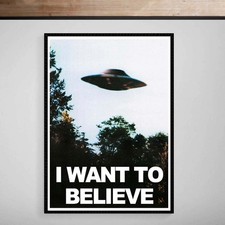
Current eBay listing
I Want To Believe UFO Poster Giclée Fine Art Heavyweight Print
Current eBay listing
VINTAGE UFO FLYING SAUCERS COMIC ADVERTISING A2 POSTER PRINT
Endnotes
1.
Source: atsb.gov.au
Link:https://www.atsb.gov.au/sites/default/files/media/29971/b20070063.pdf
Source snippet
ions of poor visual cues, such as night operations or instrument meteorological conditions (IMC).Read more...
2.
Source: faa.gov
Title: 12 afh ch11
Link:https://www.faa.gov/sites/faa.gov/files/regulations_policies/handbooks_manuals/aviation/airplane_handbook/12_afh_ch11.pdf
Source snippet
Airplane Flying Handbook (3C) Chapter 11September 24, 2021 — At night, the Ground Lighting Illusions Lights along a straight path, suc...
Published: September 24, 2021
3.
Source: atsb.gov.au
Title: ATSBAvoidable Accidents No
Link:https://www.atsb.gov.au/sites/default/files/media/4475634/ar-2012-122.pdf
Source snippet
7 - Visual flight at night accidents17 Dec 2013 — That is, the visual appearance of the runway lights must be cross-checked against the a...
4.
Source: atsb.gov.au
Link:https://www.atsb.gov.au/sites/default/files/investigation-reports/ao2011043.pdf
Source snippet
Controlled flight into terrain, Piper Saratoga PA-32R-301T...26 Apr 2012 — A pilot flying a night visual approach may misinterpret...
5.
Source: science.nasa.gov
Title: Science Meteor Showers
Link:https://science.nasa.gov/solar-system/meteors-meteorites/meteor-showers/
Source snippet
NASA ScienceMeteor ShowersFebruary 14, 2025 — 30 Apr 2025 — Several meteors per hour can usually be seen on any clear night. When there a...
Published: February 14, 2025
6.
Source: ntrs.nasa.gov
Link:https://ntrs.nasa.gov/api/citations/20200000049/downloads/20200000049.pdf
Source snippet
NASA Technical Reports ServerA Meteoroid Handbook for Aerospace Engineers and...by A Moorhead · 2019 · Cited by 7 — [Witnesses]({{ 'witnesses-b8ac9c/' | relative_url }}) observed a...
7.
Source: faa.gov
Link:https://www.faa.gov/sites/faa.gov/files/21_phak_glossary.pdf
8.
Source: ares.jsc.nasa.gov
Title: how to find meteorites
Link:https://ares.jsc.nasa.gov/meteorite-falls/how-to-find-meteorites/
9.
Source: ntrs.nasa.gov
Link:https://ntrs.nasa.gov/api/citations/19670006112/downloads/19670006112.pdf
10.
Source: apod.nasa.gov
Title: apod search
Link:https://apod.nasa.gov/cgi-bin/apod/apod_search?tquery=Meteor
11.
Source: jpl.nasa.gov
Title: small asteroid to safely pass close to earth sunday
Link:https://www.jpl.nasa.gov/news/small-asteroid-to-safely-pass-close-to-earth-sunday/
12.
Source: science.gsfc.nasa.gov
Link:https://science.gsfc.nasa.gov/sed/content/uploadFiles/publication_files/Jenniskens2012.pdf
13.
Source: nasa.gov
Link:https://www.nasa.gov/meteoroid-environment-office/lunar-impact-monitoring/videos/
14.
Source: nasa.gov
Link:https://www.nasa.gov/wp-content/uploads/2015/12/pdco-neoreport030825.pdf
15.
Source: nasa.gov
Link:https://www.nasa.gov/wp-content/uploads/static/history/ap11ann/apollo11_log/log.htm
16.
Source: faa.gov
Link:https://www.faa.gov/pilots/safety/pilotsafetybrochures/media/spatiald_visillus.pdf
17.
Source: faa.gov
Link:https://www.faa.gov/sites/faa.gov/files/regulations_policies/handbooks_manuals/aviation/phak/19_phak_ch17.pdf
18.
Source: faa.gov
Link:https://www.faa.gov/sites/faa.gov/files/2022-01/NovDec2015.pdf
19.
Source: faa.gov
Link:https://www.faa.gov/about/office_org/headquarters_offices/avs/offices/aam/cami/library/online_libraries/aerospace_medicine/media/77004299.pdf
20.
Source: faa.gov
Title: pilot handbook
Link:https://www.faa.gov/sites/faa.gov/files/pilots/pilot_handbook.pdf
21.
Source: faa.gov
Title: PHA K Table of Contents Chapter 1
Link:https://www.faa.gov/sites/faa.gov/files/02_phak_toc.pdf
22.
Source: faa.gov
Title: 2019 11 07 ACS WG Interim Recommendation Report Powered Lift Handbook
Link:https://www.faa.gov/regulations_policies/rulemaking/committees/documents/media/2019-11-07%20ACS%20WG%20Interim%20Recommendation%20Report%20-%20Powered-Lift%20Handbook.pdf
23.
Source: faa.gov
Link:https://www.faa.gov/sites/faa.gov/files/data_research/research/med_humanfacs/oamtechreports/AM79-25.pdf
24.
Source: atsb.gov.au
Title: FAA H 8083 3B Chapter 10
Link:https://www.atsb.gov.au/sites/default/files/2024-05/FAA-H-8083-3B%20Chapter%2010.pdf
Source snippet
NIGHT VISIONMay 3, 2024 — On a clear night, distant stationary lights can be mis- taken for stars or other aircraft. Even the norther...
Published: May 3, 2024
25.
Source: abc.net.au
Link:https://www.abc.net.au/news/2018-02-23/curious-adelaide-ufo-sightings-across-australia/9466950
26.
Source: naa.gov.au
Link:https://www.naa.gov.au/blog/flying-saucers-fact-or-fiction
27.
Source: skyandtelescope.org
Title: Sky & Telescope Why Are There So Many UFOs?
Link:https://skyandtelescope.org/stargazing-and-observing/my-favorite-ufos/
28.
Source: bom.gov.au
Link:https://www.bom.gov.au/glossary
29.
Source: media.bom.gov.au
Link:https://media.bom.gov.au/social/blog/292/mirrors-in-the-sky-demystifying-the-legend-of-the-flying-dutchman
30.
Source: abc.net.au
Title: ABC News Mystery of the Min Min lights explained — ABC Science Archive
Link:https://www.abc.net.au/science/archive/articles/2003/03/28/818193.htm?site=northqld&topic=enviro
31.
Source: skeptic.org.uk
Title: from the archives the 1988 nullarbor ufo mystery solved
Link:https://www.skeptic.org.uk/1989/12/from-the-archives-the-1988-nullarbor-ufo-mystery-solved/
32.
Source: bom.gov.au
Title: Observations for Nullarbor
Link:https://www.bom.gov.au/places/sa/nullarbor/observations/nullarbor/
33.
Source: bom.gov.au
Title: Observations for Nullarbor
Link:https://www.bom.gov.au/places/sa/yalata/observations/nullarbor/
34.
Source: bom.gov.au
Title: Observations for Nullarbor
Link:https://www.bom.gov.au/places/sa/bice/observations/nullarbor/
35.
Source: bom.gov.au
Title: Observations for Nullarbor
Link:https://www.bom.gov.au/places/sa/7NXX/observations/nullarbor/
36.
Source: bom.gov.au
Title: iridescent rainbow cloud shines in 2026 australian weather calendar
Link:https://www.bom.gov.au/news-and-media/iridescent-rainbow-cloud-shines-in-2026-australian-weather-calendar
37.
Source: media.bom.gov.au
Title: bom.gov.au Explainer: what are halos?
Link:https://media.bom.gov.au/social/blog/1917/explainer-what-are-halos/%F0%9F%98%8A
38.
Source: media.bom.gov.au
Title: bom.gov.au Clouds: your questions answered
Link:https://media.bom.gov.au/social/blog/1344/clouds-your-questions-answered/
39.
Source: bom.gov.au
Link:https://www.bom.gov.au/resources/learn-and-explore/climate-knowledge-centre/climate-factors/subtropical-ridge
40.
Source: bom.gov.au
Link:https://www.bom.gov.au/resources/learn-and-explore/climate-knowledge-centre/climate-factors/easterly-troughs
41.
Source: atsb.gov.au
Title: Special edition
Link:https://www.atsb.gov.au/sites/default/files/media/5774849/special_vf_86.pdf
42.
Source: atsb.gov.au
Link:https://www.atsb.gov.au/sites/default/files/media/760817/dark_night_take-off_accidents.pdf
43.
Source: atsb.gov.au
Title: Night vision goggles
Link:https://www.atsb.gov.au/sites/default/files/media/36432/Night_vision_goggles.pdf
44.
Source: atsb.gov.au
Link:https://www.atsb.gov.au/sites/default/files/media/1543486/ar2009033.pdf
45.
Source: atsb.gov.au
Link:https://www.atsb.gov.au/sites/default/files/media/5774734/asd_37_mar_64.pdf
46.
Source: atsb.gov.au
Title: asd 111 80
Link:https://www.atsb.gov.au/sites/default/files/media/5774807/asd_111_80.pdf
47.
Source: parks.sa.gov.au
Link:https://www.parks.sa.gov.au/parks/nullarbor-national-park
48.
Source: trove.nla.gov.au
Link:https://trove.nla.gov.au/newspaper/article/101971256
Additional References
49.
Source: youtube.com
Title: Min Min Lights: Mysterious Lights in the Australian Outback
Link:https://www.youtube.com/watch?v=NwiMQm3wk1I
Source snippet
The Mysterious Min Min Light Haunting the Australian Outback No One Can Explain...
50.
Source: youtube.com
Title: The Mysterious Min Min Light Haunting the Australian Outback No One Can Explain
Link:https://www.youtube.com/watch?v=9jZ1g7IUm_s
Source snippet
PPGS Lesson 14.2 | Aeromedical: Illusions...
51.
Source: instagram.com
Link:https://www.instagram.com/reel/DXOUvU4Eohk/
52.
Source: facebook.com
Link:https://www.facebook.com/TheNTNews/posts/can-neither-confirm-or-deny-northern-territory-police-have-received-multiple-ufo/1505194630956170/
53.
Source: facebook.com
Link:https://www.facebook.com/South.Pacific.Post/posts/tidbitsnames-the-buka-wayour-scribes-final-tidbit-from-his-buka-adventure-was-a-/1438886698255742/
54.
Source: instagram.com
Link:https://www.instagram.com/reel/DO8W9zzD5MY/?hl=en
55.
Source: facebook.com
Link:https://www.facebook.com/10newsplus/posts/did-you-happen-to-see-this-mysterious-ufo-an-expert-reveals-what-the-unusual-sig/122169729686899199/
56.
Source: instagram.com
Link:https://www.instagram.com/reel/Da4abyaS05o/
57.
Source: fliphtml5.com
Link:https://fliphtml5.com/fwspv/tojk/Illustrated_Encyclopedia_of_the_Universe_%28DK%29/
58.
Source: merriam-webster.com
Link:https://www.merriam-webster.com/dictionary/jack