Within Kimba Encounter
Could a Two Second Glimpse Create Kimba's Figure?
Speed, darkness and a two-second viewing window could explain why a bright shape was interpreted as a suspended person.
On this page
- What the witnesses could see at road speed
- How low light affects shape and distance
- Which reported details are most vulnerable to error
Page outline Jump by section
Introduction
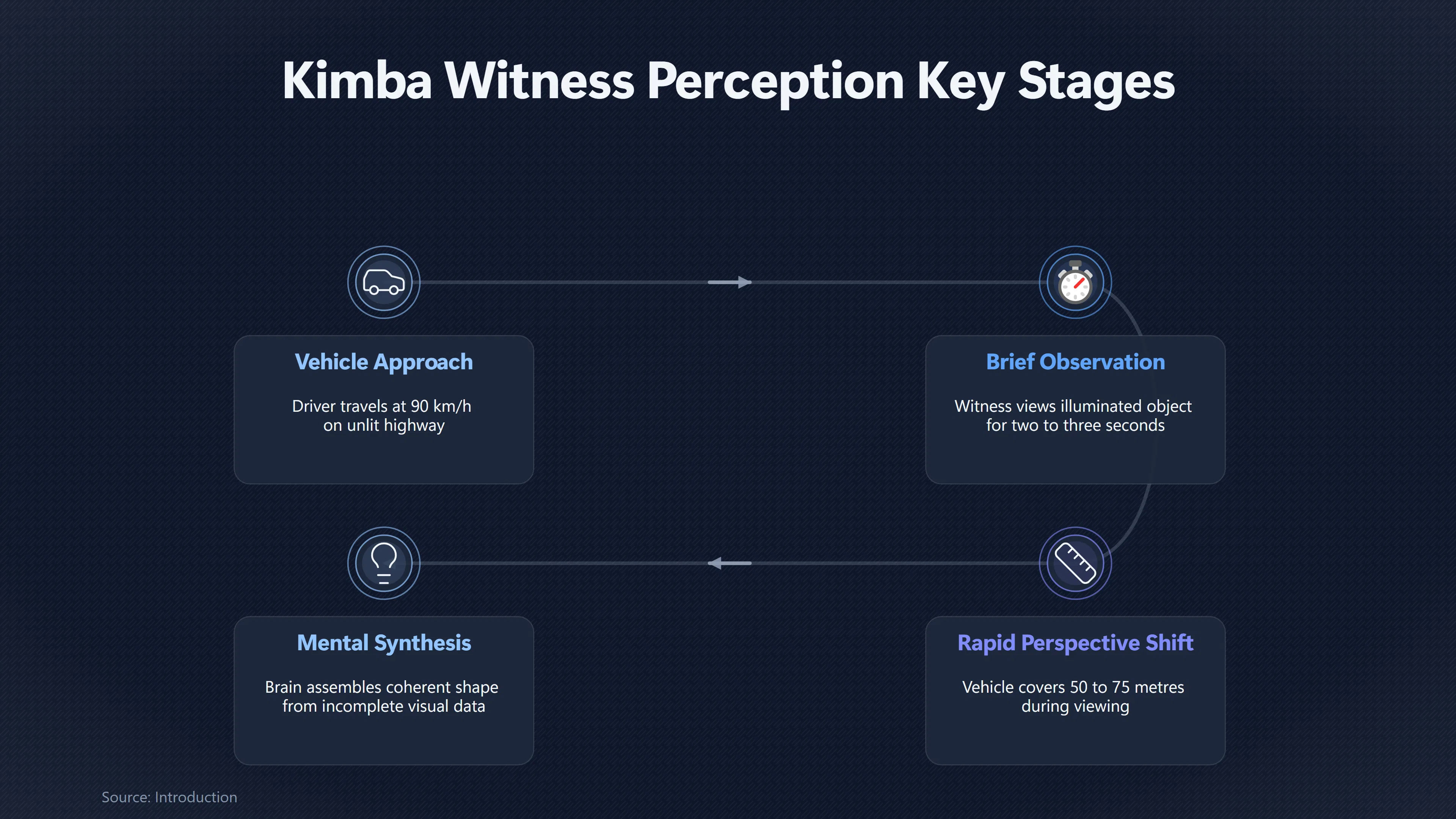
Yes. The conditions under which the principal Kimba witness made his observation provide one of the strongest conventional reasons for caution when interpreting the sighting. According to the witness’s own account, he was driving at about 90 kilometres per hour on an unlit rural highway and viewed the illuminated object for only two or three seconds as his vehicle passed. Those circumstances are well known to reduce the accuracy of judging shape, distance and detail at night, especially when an unexpected light suddenly appears beside the road.[PubMed]pubmed.ncbi.nlm.nih.govStandard measures of visual acuity do not predict drivers' recognition performance under day or night conditions - PubMed…
This does not mean the witnesses imagined the event. Multiple motorists independently reported an unusual orange rectangular light in approximately the same location. The question is narrower: could a genuine roadside light have been misinterpreted as containing a suspended human figure because of the limits of human perception during a brief night-time drive? On the available evidence, that is a plausible explanation for some of the reported details, particularly the figure itself.
What the witnesses could see at road speed
The Kimba case differs from many prolonged observation reports because the key visual information was gathered almost entirely while the witnesses remained in moving vehicles.
Travelling at roughly 90 km/h, a car covers about 25 metres every second. During a viewing period of only two or three seconds, the witness would have travelled approximately 50 to 75 metres while simultaneously steering, monitoring the road and attempting to identify an unexpected bright object beside it. That constantly changing viewpoint makes it difficult to build a stable mental picture of an unfamiliar scene.
Modern vision research shows that drivers are generally capable of detecting unexpected lights at night, but recognising exactly what those lights represent is much more difficult. Recognition performance declines substantially in low-light conditions because reduced contrast makes object identification less reliable than daytime viewing.[PubMed]pubmed.ncbi.nlm.nih.govStandard measures of visual acuity do not predict drivers' recognition performance under day or night conditions - PubMed…
The Kimba testimony itself reflects these limitations. The principal driver described a sharply defined white figure suspended within an orange doorway-like glow, while his passenger—who looked only after being directed towards the scene—reported seeing an orange illuminated shape and a white “blob” rather than a clearly recognisable person. Another motorist saw a tall illuminated doorway with a figure-like shape, whereas a separate witness reported only the orange rectangle. The consistency lies mainly in the presence of the orange light, not in the finer details.
How low light affects shape and distance
Night-time vision relies far less on colour and fine detail than daytime vision. In dim conditions the visual system becomes better at detecting bright objects than accurately identifying their structure.
Several well-established effects are relevant to the Kimba observations:
- Reduced contrast sensitivity. Bright and dark regions remain visible, but edges become less distinct, making silhouettes easier to misinterpret.[PubMed]pubmed.ncbi.nlm.nih.govStandard measures of visual acuity do not predict drivers' recognition performance under day or night conditions - PubMed…
- Compressed depth cues. Darkness removes familiar visual references, making it harder to judge whether a light is close, distant, elevated or attached to another object.[PMC]pmc.ncbi.nlm.nih.govOpen source on nih.gov.
- Changing viewing angle. As a vehicle passes a roadside object, perspective alters rapidly, encouraging the brain to assemble a coherent shape from incomplete information.
- Expectation and pattern recognition. Human observers naturally interpret ambiguous visual information as meaningful forms, particularly human figures. Experimental work on night driving has shown that motorists often see illuminated objects without correctly identifying what they are until it is too late, or misjudge where they are located relative to the road.[Sage Journals]journals.sagepub.comSage JournalsThe Influence of Driver Expectation when Recognizing Lighted Targets at Nighttime - Jeffrey W. Muttart, Swaroop Dinakar, Gre…
These mechanisms do not require hallucination or faulty eyesight. They are ordinary features of visual perception under demanding conditions.
Which reported details are most vulnerable to error
Not every part of the Kimba report is equally susceptible to perceptual distortion.
The existence of an orange light is comparatively robust. Independent motorists reported a bright rectangular glow in roughly the same location, suggesting that some genuine illuminated phenomenon was present.
The precise appearance of the white figure is much less secure. Several factors increase the likelihood of error:
- The observation lasted only seconds.
- The witness was concentrating primarily on driving.
- The object appeared unexpectedly.
- The figure was seen within or against a bright illuminated background, reducing contrast.
- Other witnesses did not describe the figure in the same way.
The passenger’s description is especially informative. Instead of confirming a detailed humanoid form, she recalled only a pale white mass associated with the orange light. That difference suggests that the more elaborate description may have depended on the exact viewing angle and the driver’s immediate interpretation rather than on a clearly observable object.
Similarly, estimates that the figure appeared to float above the ground should be treated cautiously. Judging vertical position in darkness without nearby reference points is notoriously difficult, especially from a moving vehicle.[PMC]pmc.ncbi.nlm.nih.govOpen source on nih.gov.
Does this explain the whole Kimba encounter?
Probably not by itself.
Night-time perception provides a convincing mechanism for why witnesses might disagree about whether the illuminated object contained a person, a white blob or simply a bright interior. It offers a stronger explanation for the reported figure than for the initial orange rectangular light itself.
That distinction is important when assessing the Kimba encounter. The perceptual evidence suggests that the interpretation of the scene is more uncertain than the existence of an unusual illuminated source. The brief viewing time, darkness and driving conditions weaken confidence in the reported humanoid details without necessarily dismissing the underlying observation.
Within the broader Kimba case, this is why sceptical analyses often focus less on whether something unusual was present beside the road and more on whether the most striking element—the apparently suspended human figure—could have emerged from normal visual processing during a fleeting night-time glimpse. The available evidence cannot resolve that question definitively, but the known limits of night driving perception make it a credible and evidence-based possibility.
Amazon book picks
Further Reading
Books and field guides related to Could a Two Second Glimpse Create Kimba's Figure?. Use these as the next step if you want deeper reading beyond the article.
The Demon-Haunted World
NEW YORK TIMES BESTSELLER • From the renowned astronomer and author of Cosmos comes a “powerful [and] stirring defense of informed ration...
The UFO Experience: A Scientific Inquiry
Cited by the New York Review of Books as "the best brief for visitation," this classic study presents an analysis of UFO reports and conc...
Mistakes Were Made (but Not by Me)
Why is it so hard to say "I made a mistake"-and really believe it? When we make mistakes, cling to outdated attitudes, or mistreat other...
Visual Intelligence
A unique, illustrated popular study reveals the way the human eye acts on the visual world not just to represent but to create the things...
eBay marketplace picks
Marketplace Samples
Live-tested eBay searches with available results related to this page.
Selected fromUFO poster oneBay.co.uk.
Current eBay listing
I Want To Believe UFO Poster Giclée Fine Art Heavyweight Print
Current eBay listing
VINTAGE UFO FLYING SAUCERS COMIC ADVERTISING A2 POSTER PRINT
Endnotes
1.
Source: pubmed.ncbi.nlm.nih.gov
Link:https://pubmed.ncbi.nlm.nih.gov/16127335/
Source snippet
Standard measures of visual acuity do not predict drivers' recognition performance under day or night conditions - PubMed...
2.
Source: pmc.ncbi.nlm.nih.gov
Link:https://pmc.ncbi.nlm.nih.gov/articles/PMC7141062/
3.
Source: journals.sagepub.com
Link:https://journals.sagepub.com/doi/10.1177/1541931213601111
Source snippet
Sage JournalsThe Influence of Driver Expectation when Recognizing Lighted Targets at Nighttime - Jeffrey W. Muttart, Swaroop Dinakar, Gre...
4.
Source: pmc.ncbi.nlm.nih.gov
Title: The main research quest
Link:https://pmc.ncbi.nlm.nih.gov/articles/PMC9136390/
Source snippet
Driver Perception: Combining Eye-Tracking and Automated Road Scene Perception - PMCSeptember 29, 2020 — RESEARCH OBJECTIVE We aimed to ga...
Published: September 29, 2020
5.
Source: journals.sagepub.com
Link:https://journals.sagepub.com/doi/pdf/10.1177/1541931213601111
Source snippet
Muttart, Swaroop Dinakar, Gregory Vandenberg, Michael Yosko, 2016September 15, 2016 — First published online September 15, 2016 Request p...
Published: September 15, 2016
6.
Source: pmc.ncbi.nlm.nih.gov
Link:https://pmc.ncbi.nlm.nih.gov/articles/PMC4350319/
Source snippet
Previous research has shown that visual target detection is affected by age. In addition, light conditions also infl...
7.
Source: pmc.ncbi.nlm.nih.gov
Link:https://pmc.ncbi.nlm.nih.gov/articles/PMC2742770/
Source snippet
Author manuscript; available in PMC: 2009 Sep 14. Published in final edited form as: Psychol Sci. 2009 Apr;20(4):464–472. doi: 10.1111/j...
Additional References
8.
Source: sciencedirect.com
Link:https://www.sciencedirect.com/science/article/abs/pii/S0022437515000134
Source snippet
JOURNAL OF SAFETY RESEARCH Volume 53, June 2015, Pages 31-37 DRIVERS' JUDGMENTS OF THE EFFECT OF HEADLIGHT GLARE ON THEIR AB...
Published: June 2015
9.
Source: sciencedirect.com
Title: Data from two additional participants were eliminated due to technical di
Link:https://www.sciencedirect.com/science/article/pii/S0022437515000134
Source snippet
Drivers' judgments of the effect of headlight glare on their ability to see pedestrians at night - ScienceDirectPARTICIPANTS Twenty one u...
10.
Source: abc.net.au
Link:https://www.abc.net.au/news/2018-02-23/curious-adelaide-ufo-sightings-across-australia/9466950
Source snippet
NIGHTMARE ON THE NULLARBOR Image: A newspaper report from Sydney's The Daily Mirror on a UFO incident. The Daily Mirror r...
11.
Source: journal.com.ph
Title: According to the witness there were no external portholes or marking
Link:https://journal.com.ph/bizarre-ufo-encounters-along-the-roads-of-[south-australia
Source snippet
Bizarre UFO Encounters Along The Roads Of South Australia | Journal OnlineJune 3, 2021 — He would describe it as a “three metre diameter...
Published: June 3, 2021
12.
Source: research.aston.ac.uk
Link:https://research.aston.ac.uk/en/publications/night-driving-effects-of-glare-from-vehicle-headlights-on-motion-/
Source snippet
Anderson *, Ian E. Holliday * Optometry * Aston Research Centre for Health in Ageing * College of Health a...
13.
Source: inkl.com
Title: close encounters shedding light on south australia s x files
Link:https://www.inkl.com/news/close-encounters-shedding-light-on-south-australia-s-x-files
Source snippet
Close encounters: Shedding light on South Australia's…Reports made the front pages of newspapers of strange objects sighted from Eyre Pen...
14.
Source: ufos-scientificresearch.blogspot.com
Title: Case two: Four people in three separate vehicles, trave
Link:https://ufos-scientificresearch.blogspot.com/2016/09/
Source snippet
Unidentified Anomalous Phenomena - scientific research: September 2016The magnetic field of both vehicles was similar, suggesting that th...
15.
Source: sciencedirect.com
Title: Discomfort glare influences covert visual attention
Link:https://www.sciencedirect.com/science/article/pii/S0001691826009947
Source snippet
ACTA PSYCHOLOGICA Date: August 2026 Article: 107193 Volume: Volume 268 PUBLISHED BY: ELSEVIER DISCOMFORT GLARE INFLUENCES CO...
Published: August 2026
16.
Source: ufos-scientificresearch.blogspot.com
Title: My answer, is that it was one that happene
Link:https://ufos-scientificresearch.blogspot.com/2013/06/kimba-south-australia-very-intriguing.html
Source snippet
Unidentified Anomalous Phenomena - scientific research: Kimba, South Australia - a very intriguing caseJune 4, 2013 — TUESDAY, JUNE 4, 20...
Published: June 4, 2013
17.
Source: ufos-scientificresearch.blogspot.com
Title: Unidentified Anomalous Phenomena
Link:https://ufos-scientificresearch.blogspot.com/2015/09/ufos-anfractuous-phenomenon-part-2.html
Source snippet
scientific research: UFOs: An anfractuous phenomenon - part 2September 25, 2016 — Let’s take a look at a few Australian case examples, an...
Published: September 25, 2016