Within Outback Lights
Meteor, Aircraft or Planet: Which Best Fits?
Duration, direction, colour and movement offer practical clues for deciding whether an outback light was a meteor, aircraft or bright planet.
On this page
- Clues that favour a meteor or fireball
- Clues that favour aircraft or distant traffic
- How astronomy and flight records can test a report
Page outline Jump by section
Introduction
Most unexplained lights reported in South Australia’s outback can be narrowed to a small number of ordinary causes if the witness description is examined carefully. The most useful clues are not whether the light looked unusual, but how long it lasted, how it moved, whether it stayed close to the horizon, and whether other evidence such as astronomy or flight records matches the timing. A light that appears mysterious in isolation may fit the well-known behaviour of a meteor, a distant aircraft or a bright planet once those details are compared.
This practical approach is especially valuable in South Australia, where long sightlines, sparse lighting and featureless horizons make distance and speed difficult to judge. Rather than assuming a single explanation for every report, investigators compare the observed characteristics against known astronomical and aviation phenomena before deciding whether a sighting remains unexplained.
Meteor, Aircraft or Planet: Which Best Fits?
The quickest way to distinguish common night-time lights is to compare a few observable features.
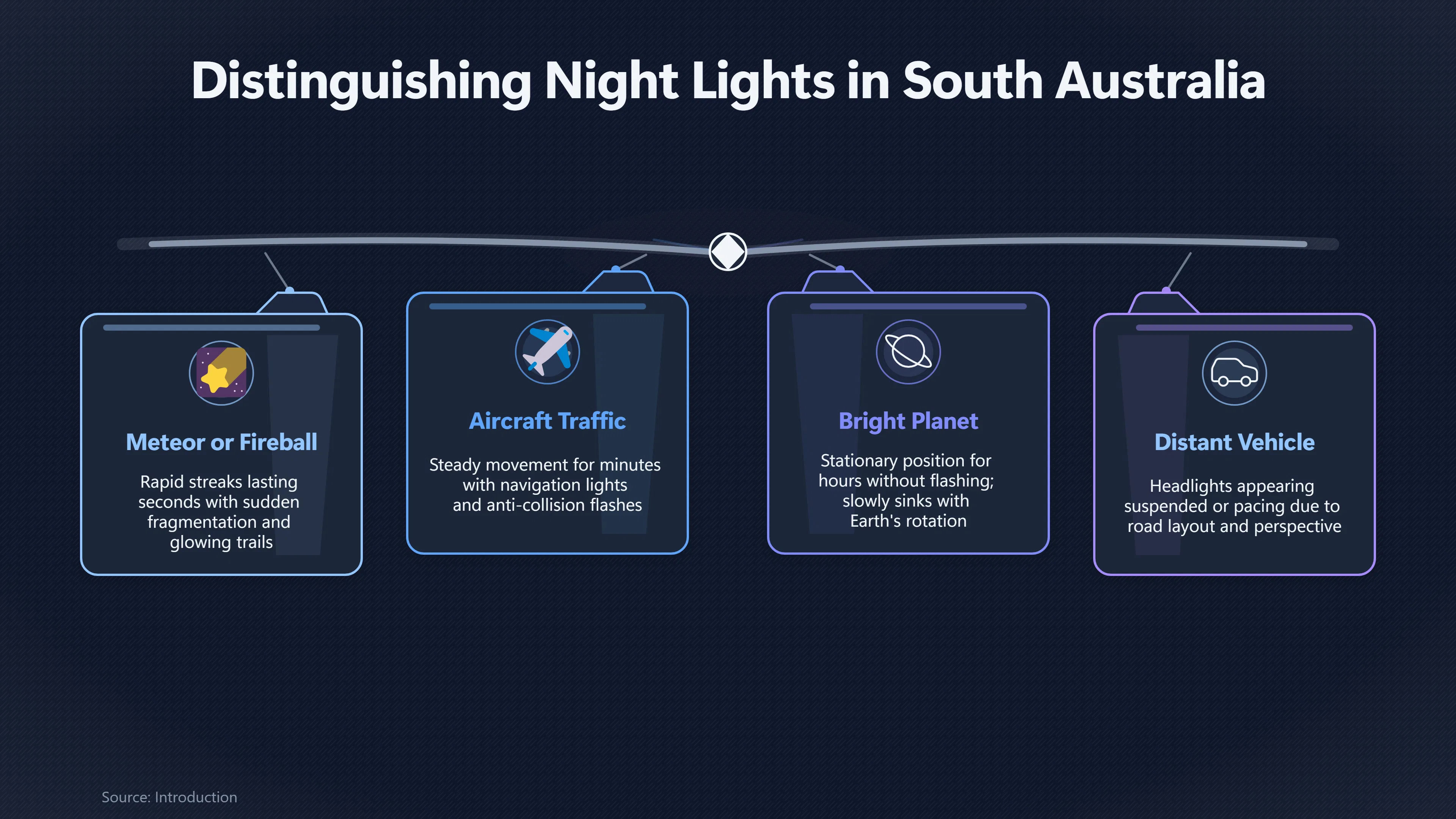
FeatureMeteor or fireballAircraftBright planetTypical durationSecondsMinutes or longerHoursMotionRapid streak or plungeSteady movement across the skyAppears stationaryBrightnessCan brighten suddenly and fragmentUsually steady with navigation lightsConstant, without flashingColourWhite, green, blue or orange possibleWhite landing lights plus red/green navigation lightsUsually white or pale yellowPositionCan cross any part of the skyOften follows predictable routesFixed relative to the starsEnd of eventStops abruptlyContinues beyond viewSlowly sets with Earth’s rotation
No single feature is decisive. A reliable identification comes from the combination of duration, direction, brightness and movement.
Clues That Favour a Meteor or Fireball
A meteor is usually the easiest ordinary explanation to recognise because it behaves differently from almost every aircraft.
Strong indicators include:
- A bright streak lasting only a few seconds.
- Rapid movement across a large section of sky.
- Sudden brightening before fading.
- Fragmentation into multiple glowing pieces.
- A glowing trail that lingers briefly after the main object disappears.
- Multiple reports over a wide geographical area at roughly the same time.
Many witnesses believe a fireball landed nearby because it appears to descend towards the horizon. In reality, perspective is deceptive. Bright fireballs typically burn tens of kilometres above Earth and may be visible across hundreds of kilometres. The apparent landing point often lies far beyond where an observer expects.[NASA Science]science.nasa.govScience Meteors and Meteorites: ExplorationNASA ScienceMeteors and Meteorites: Exploration - NASA ScienceNovember 5, 2024…
Colour alone is not a reliable guide. Green, blue and orange fireballs are well documented and result from both the meteoroid’s composition and atmospheric effects rather than indicating anything unusual.[NASA Jet Propulsion Laboratory (JPL)]jpl.nasa.govNASA Jet Propulsion Laboratory (JPL)Meteor Likely Cause of Southwest U.S. Light Show | NASA Jet Propulsion Laboratory (JPL)September 15…
Another useful clue is timing. If numerous observers across South Australia and neighbouring states reported a brilliant light within the same minute, a fireball becomes much more likely than an isolated aircraft.
Clues That Favour Aircraft or Distant Traffic
Aircraft produce some of the most persistent UFO reports because their appearance changes dramatically with viewing angle.
Several characteristics point towards an aircraft rather than an astronomical object:
- The light remains visible for many minutes.
- It follows a smooth, continuous path.
- White landing lights appear exceptionally bright when the aircraft is approaching almost directly towards the observer.
- Red and green navigation lights become easier to recognise as the aircraft changes direction.
- Flashing anti-collision lights repeat at regular intervals.
- The light slowly changes position instead of making sudden high-speed movements.
In inland South Australia, long straight roads can also produce convincing illusions. Distant vehicle headlights may seem suspended above the horizon, disappear behind gentle rises and then reappear unexpectedly. From inside a moving vehicle this can create the impression that the light is pacing or following the observer even though both vehicles are simply travelling on different roads.
Temperature inversions, which are common over inland Australia during calm nights, may also refract light and make distant aircraft or vehicle lights appear higher, brighter or distorted than expected.
When a Bright Planet Is the Better Match
Venus is responsible for many reports of apparently stationary bright objects, especially shortly after sunset or before sunrise.
A planet becomes the strongest explanation when:
- The light remains in almost exactly the same place for an hour or more.
- It neither flashes nor crosses the sky.
- It slowly sinks towards the horizon over the course of the evening.
- Multiple people from different locations see it in approximately the same direction.
- The observation matches the known position of Venus or Jupiter.
Atmospheric turbulence close to the horizon can make planets appear to shimmer, pulse or change colour. Red, orange, white and even bluish flashes can occur as the atmosphere bends different wavelengths of light by slightly different amounts. These effects are strongest when the planet is low above the horizon and can give the misleading impression that the object is changing shape or behaviour.
Because there are few reference points in the outback, a bright planet may also appear unusually close or surprisingly large even though it is simply the brightest object in the evening sky.
How Astronomy and Flight Records Can Test a Report
Once a witness account has been collected, independent records provide the best way to test competing explanations.
Useful checks include:
- Astronomy software or planetarium applications to establish whether Venus, Jupiter or another bright object occupied the reported position.
- Meteor shower calendars and fireball reporting networks to determine whether other observers recorded a bright meteor at the same time.
- Historical weather observations to assess cloud cover, visibility and atmospheric conditions.
- Flight-tracking records and published air routes to identify commercial aircraft operating in the relevant area.
- Air traffic information where available for larger aircraft movements.
These comparisons do not automatically prove what was seen, but they can eliminate possibilities. If a bright object remained motionless in the western sky for two hours while Venus occupied exactly that position, the astronomical explanation becomes much stronger. Likewise, if a reported “fast-moving craft” coincides with a documented fireball seen across several states, the meteor explanation is considerably strengthened.[nasa.gov]science.nasa.govScience Meteors and Meteorites: ExplorationNASA ScienceMeteors and Meteorites: Exploration - NASA ScienceNovember 5, 2024…
Applying the Checklist to South Australian UFO Reports
Many historical South Australian UFO reports contain enough observational detail to narrow the field of explanations even decades later. Duration is often the most valuable clue.
A report describing a brilliant object that crossed half the sky in three seconds before disappearing strongly favours a meteor. A light observed steadily for twenty minutes while apparently hovering above the horizon is more consistent with an aircraft approaching on a shallow bearing or a bright planet seen under unusual atmospheric conditions. Reports of lights “following” vehicles become less persuasive when road layout, viewing angle and the observer’s own motion are considered together.
This approach does not dismiss witnesses. Instead, it recognises that honest observations can still produce mistaken interpretations when viewed across South Australia’s dark, open landscapes. Careful comparison with astronomy, aviation and environmental conditions often explains reports that initially seemed extraordinary while allowing the small number of genuinely unresolved cases to be assessed on their own merits.
Amazon book picks
Further Reading
Books and field guides related to Meteor, Aircraft or Planet Which Best Fits?. Use these as the next step if you want deeper reading beyond the article.
Turn Left at Orion
With over 100,000 copies sold since first publication, this is one of the most popular astronomy books of all time. It is a unique guideb...
The Demon-Haunted World
NEW YORK TIMES BESTSELLER • From the renowned astronomer and author of Cosmos comes a “powerful [and] stirring defense of informed ration...
eBay marketplace picks
Marketplace Samples
Live-tested eBay searches with available results related to this page.
Selected frommeteor art print oneBay.co.uk.

Endnotes
1.
Source: science.nasa.gov
Title: Science Meteors and Meteorites: Exploration
Link:https://science.nasa.gov/solar-system/meteors-meteorites/exploration/
Source snippet
NASA ScienceMeteors and Meteorites: Exploration - NASA ScienceNovember 5, 2024...
Published: November 5, 2024
2.
Source: cneos.jpl.nasa.gov
Link:https://cneos.jpl.nasa.gov/fireballs/intro.html
Source snippet
Introduction Map/Data Lightcurves Operational Notes INTRODUCTION Image: Fireball from the Perseid shower as seen from the Space Station o...
3.
Source: jpl.nasa.gov
Link:https://www.jpl.nasa.gov/news/meteor-likely-cause-of-southwest-us-light-show/
Source snippet
NASA Jet Propulsion Laboratory (JPL)Meteor Likely Cause of Southwest U.S. Light Show | NASA Jet Propulsion Laboratory (JPL)September 15...
4.
Source: science.nasa.gov
Title: Science Meteors and Meteorites: Facts
Link:https://science.nasa.gov/solar-system/meteors-meteorites/facts/
Source snippet
We call the objects that creates this brilliant effect by different names, depending on where it...
5.
Source: nasa.gov
Title: It’s Fireball Season!
Link:https://www.nasa.gov/blogs/watch-the-skies/2026/03/26/its-fireball-season-answering-your-meteor-questions/
Source snippet
Answering Your Meteor Questions - NASAMarch 26, 2026 — WATCH THE SKIES Image Janet Sudnik March 26, 2026 5:18PM CATEGORIES Marshall Space...
Published: March 26, 2026
6.
Source: science.nasa.gov
Title: But we call the same objects by different names, depending on where they are
Link:https://science.nasa.gov/solar-system/meteors-meteorites/
Source snippet
and Meteorites - NASA ScienceFebruary 2, 2026 — METEORS AND METEORITES Meteors and meteorites are often called “shooting stars” — bright...
Published: February 2, 2026
7.
Source: science.nasa.gov
Title: It also
Link:https://science.nasa.gov/solar-system/meteors-meteorites/quadrantids/
Source snippet
NASA ScienceApril 3, 2025 — Meteor Showers QUADRANTIDS METEOR SHOWER An image of an etching of an astronomical chart showing Bootes the P...
Published: April 3, 2025
8.
Source: nasa.gov
Title: interesting fact of the month 2021
Link:https://www.nasa.gov/space-science-and-astrobiology-at-ames/interesting-fact-of-the-month-current/interesting-fact-of-the-month-2021/
Source snippet
What in the world is a fireball? According to the American Meteor Society, a fireball is another term for a...
9.
Source: science.nasa.gov
Title: looking for lightning finding fireballs 149381
Link:https://science.nasa.gov/earth/earth-observatory/looking-for-lightning-finding-fireballs-149381/
Source snippet
for Lightning, Finding Fireballs - NASA ScienceJanuary 27, 2022 — Earth Observatory 5 min read LOOKING FOR LIGHTNING, FINDING FIREBALLS I...
Published: January 27, 2022
10.
Source: jpl.nasa.gov
Title: instruments image fireball over bering sea
Link:https://www.jpl.nasa.gov/news/nasa-instruments-image-fireball-over-bering-sea/
Source snippet
NASA Jet Propulsion Laboratory (JPL)March 22, 2019 —.2 min read NASA INSTRUMENTS IMAGE FIRE...
Published: March 22, 2019
11.
Source: sma.nasa.gov
Link:https://sma.nasa.gov/news/articles/newsitem/2017/07/11/it-s-a-bird-it-s-a-plane-it-s-a-fireball
12.
Source: cneos.jpl.nasa.gov
Link:https://cneos.jpl.nasa.gov/fireballs/
Source snippet
Introduction Map/Data Lightcurves Operational Notes FIREBALL AND BOLIDE DATA The following fireball data are derived from U.S. Government...
Additional References
13.
Source: youtube.com
Title: How to Tell if it is an Aircraft, Satellite, or Meteor in Your Night Time-lapses
Link:https://www.youtube.com/watch?v=sRQzJQdxLFg
Source snippet
How to Identify Stars, Planets, and Satellites in the Night Sky...
14.
Source: youtube.com
Title: How to Identify Stars, Planets, and Satellites in the Night Sky
Link:https://www.youtube.com/watch?v=MwGoy4azFrM
Source snippet
What's That In The Sky? How To Identify That Flash of Light You Just Saw...
15.
Source: youtube.com
Title: What’s That In The Sky? How To Identify That Flash of Light You Just Saw
Link:https://www.youtube.com/watch?v=VDWSgtf23N8
Source snippet
Was that flash a meteor or something man-made?...
16.
Source: youtube.com
Title: Was that flash a meteor or something man-made?
Link:https://www.youtube.com/watch?v=tH4FqZzWHSE
Source snippet
Are you REALLY capturing SHOOTING STARS? How to identify what you're really seeing...
17.
Source: youtube.com
Link:https://www.youtube.com/watch?v=7aG8XL_a_BA