Within Flying Ark
What Inspired Parramatta's Flying Ark Vision?
Balloons, airship schemes and unresolved flight problems gave Birmingham a ready-made technological language for imagining an aerial vessel.
On this page
- Ballooning in colonial New South Wales
- Australian flying machine schemes before 1868
- Why an enclosed aerial vessel seemed plausible
Page outline Jump by section
Introduction
Frederick William Birmingham’s 1868 vision of a “flying ark” is easiest to understand when placed alongside the flight culture of Victorian New South Wales rather than the later language of UFOs. By the time Birmingham described an enclosed aerial vessel carrying him into a pilot’s compartment, colonial Australians had already spent decades reading about balloons, experimental flying machines and ambitious airship proposals. Newspapers, public exhibitions and engineering discussions had made controlled flight seem an attainable—if still unrealised—technological goal.[State Library of New South Wales]sl.nsw.gov.auOpen source on nsw.gov.au.
This context matters because Birmingham did not describe an impossible magical object. Instead, he imagined what looked like an engineered vehicle designed to solve a recognised nineteenth-century problem: how human beings might travel safely through the air before the invention of the aeroplane. His account therefore reflects a distinctive blend of Victorian engineering optimism, religious symbolism and speculative aviation, rather than evidence that colonial New South Wales experienced a modern-style UFO encounter.
Ballooning made flight seem imaginable
Colonial audiences already expected humans to fly
Long before powered aircraft existed, people in New South Wales had become familiar with the idea of aerial travel through newspaper reports and public demonstrations. International developments were widely reprinted in colonial newspapers, including descriptions of balloon ascents in Europe and proposals for mechanically powered flying machines.
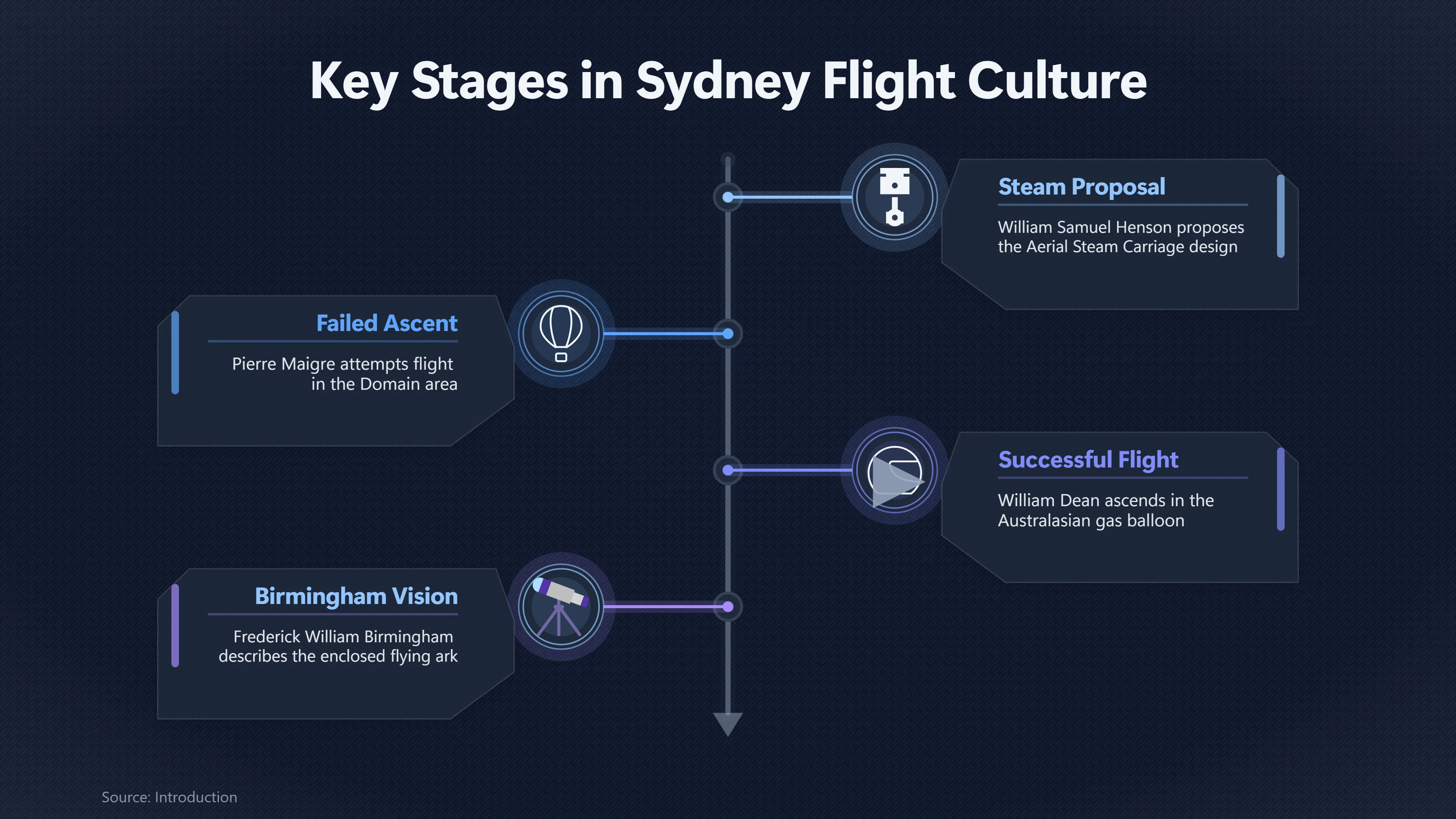
One influential example arrived in 1843, when Sydney readers learned about William Samuel Henson’s proposed Aerial Steam Carriage, an ambitious design for a steam-powered aircraft. Although the machine never flew, it introduced colonial readers to the possibility that engineering—not myth—might eventually conquer the air.[State Library of New South Wales]sl.nsw.gov.auOpen source on nsw.gov.au.
Public ballooning reinforced that message. Balloon ascents became major attractions because they showed that people could genuinely leave the ground, even if they had little control over where they landed. Successes and spectacular failures alike demonstrated that flight belonged to the world of experimental science rather than pure fantasy.
Sydney’s balloon experiments attracted enormous attention
Before Birmingham’s 1868 vision, Sydney had already witnessed several highly publicised balloon attempts:
- French aeronaut Pierre Maigre’s failed ascent in the Domain in 1856 drew thousands of spectators before ending in disorder when the balloon would not fly.
- William Dean successfully ascended in the gas balloon The Australasian in 1858, proving that sustained human flight in Australia was possible, even without powered navigation.
- Later balloon exhibitions throughout the 1860s and 1870s continued to attract large crowds despite frequent accidents and dramatic mishaps.[nsw.gov.au]sl.nsw.gov.auOpen source on nsw.gov.au.
These events created a public culture in which aerial vehicles were exciting, experimental and imperfect. Flight itself was no longer unimaginable; the remaining challenge was controlling it.
Australian flying-machine schemes before 1868
The most important local influence was not a balloon but an Australian-designed airship.[airshipsonline.com]airshipsonline.comAustralian Airship SchemeIntroduction 2. The Document 3. The Proposed Routes 4. The Airship Proposal In July 1924, the Airship Guarantee Company sent a detailed p…
Sydney physician and inventor Dr William Bland spent years developing his “Atmotic Ship”, first publicised in 1851. His design combined a hydrogen-filled elongated balloon with steam-powered propellers intended to provide steering and propulsion rather than simply drifting with the wind. Models and detailed drawings were displayed internationally at London’s Crystal Palace and in Paris, demonstrating that colonial New South Wales was contributing ideas to global debates about aviation.[nsw.gov.au]sl.nsw.gov.auOpen source on nsw.gov.au.
Although Bland never built a full-sized machine, the proposal was widely discussed. More importantly, it framed aerial navigation as an engineering problem awaiting a practical solution rather than an impossible dream.
For someone like Birmingham—an engineer and surveyor accustomed to technical drawing and mechanical thinking—that distinction mattered. His imagination was already operating within a society where inventors openly proposed navigable aerial craft decades before powered flight became reality.
Some researchers have even noted that Bland died in 1868, the same year as Birmingham’s vision, although there is no evidence that this coincidence directly influenced Birmingham’s experience. Bill Chalker has suggested only that the wider atmosphere of contemporary aeronautical experimentation may have helped shape how Birmingham interpreted his vision, not that Bland’s design served as its blueprint.[The Oz Files]theozfiles.blogspot.comdid frederick william birmingham buildThe Oz Filestheozfiles: Did Frederick William Birmingham build a flying machine based on his bizarre 1868 UFO "vision" in Parramatta, NSW…

Why an enclosed aerial vessel seemed plausible
One striking feature of Birmingham’s account is that the “ark” was described as an enclosed machine with substantial walls and an internal pilot’s area rather than an open platform or balloon basket.
From a modern perspective this resembles later aircraft interiors, but within the Victorian context it reflected contemporary engineering expectations. Designers increasingly imagined future flying machines as vehicles containing engines, steering systems and protected working spaces. The concept of a pilot operating machinery inside a purpose-built structure already existed in speculative aviation literature, even though no practical aircraft yet embodied it.[State Library of New South Wales]sl.nsw.gov.auOpen source on nsw.gov.au.
Equally significant is what Birmingham did not describe. He did not present a seamless metallic disc or an inexplicable object beyond human technology. Instead, he believed he had been shown engineering principles that could eventually be understood and reproduced.
That emphasis places his experience much closer to Victorian invention than to twentieth-century UFO narratives.
Technology and revelation were not opposites
Modern readers often separate scientific invention from religious experience, but many Victorians did not.
Birmingham interpreted the figure accompanying him as a spirit rather than an extraterrestrial visitor. The aerial machine itself became part of a larger revelation in which technical knowledge and divine purpose could coexist. Receiving practical information through a supernatural vision was therefore consistent with wider nineteenth-century religious culture, particularly among people who believed scientific discovery revealed God’s design rather than challenged it.[Parramatta History and Heritage]historyandheritage.cityofparramatta.nsw.gov.auOpen source on nsw.gov.au.
This helps explain why Birmingham reportedly attempted to develop or sketch a flying machine afterwards. He appears to have believed he had received genuine engineering insight through an extraordinary spiritual experience, not that he had merely witnessed an unexplained object.
What this means for New South Wales UFO history
Understanding Victorian flight culture changes how Birmingham’s account fits into the history of unusual aerial experiences in New South Wales.
Rather than standing as an isolated anticipation of modern flying-saucer reports, the Parramatta vision occupies a transitional space between three nineteenth-century traditions:
- public fascination with balloons and experimental aviation;
- colonial confidence that engineering would eventually master flight;
- religious visions interpreted through contemporary technological ideas.
This does not prove that Birmingham fabricated his experience, nor does it confirm that he encountered an unknown craft. Instead, it shows why his description naturally adopted the language of the most advanced flight concepts available in 1868. His “flying ark” reflected a society already imagining controlled aerial navigation decades before aeroplanes became reality, making the vision historically distinctive while also firmly rooted in the technological imagination of Victorian New South Wales.
Amazon book picks
Further Reading
Books and field guides related to What Inspired Parramatta's Flying Ark Vision?. Use these as the next step if you want deeper reading beyond the article.
Falling Upwards: How We Took to the Air
Documents the experiences of the pioneers of human flight to offer insight into the character qualities that inspired their ambitions and...
The Aeronauts: Travels in the Air
The True Story Behind the Major Motion Picture — and one of the greatest daredevil stories in the history of aviation In 1862, ambitious...
The Victorian Internet
First published 1998. Subjects: Telegraphie, Telekommunikationsnetz, Telegraph, History, Telecommunication, history.
eBay marketplace picks
Marketplace Samples
Live-tested eBay searches with available results related to this page.
Selected fromaviation poster oneBay.co.uk.


Endnotes
1.
Source: sl.nsw.gov.au
Link:https://www.sl.nsw.gov.au/stories/dreamers-experimenters-and-balloonists
2.
Source: historyandheritage.cityofparramatta.nsw.gov.au
Link:https://historyandheritage.cityofparramatta.nsw.gov.au/blog/2014/01/09/frederick-william-birmingham
3.
Source: www2.sl.nsw.gov.au
Title: Dreamers, experimenters and balloonists
Link:https://www2.sl.nsw.gov.au/archive/discover_collections/history_nation/aviation/dreamers/index.html
4.
Source: upload.wikimedia.org
Title: Commons Journal and proceedings of the Royal Society of New South Wales
Link:https://upload.wikimedia.org/wikipedia/commons/2/28/Journal_and_proceedings_of_the_Royal_Society_of_New_South_Wales_%28IA_journa135124034042002roya%29.pdf
Source snippet
Wikimedia CommonsJournal and proceedings of the Royal Society of New South Wales...
5.
Source: www2.sl.nsw.gov.au
Title: Bland’s atmotic ship
Link:https://www2.sl.nsw.gov.au/archive/discover_collections/history_nation/aviation/dreamers/atmotic.html
6.
Source: www2.sl.nsw.gov.au
Link:https://www2.sl.nsw.gov.au/archive/curio/exhibit/1320/storiesfb98.html?from_collection=2&page=17
7.
Source: strathfield.nsw.gov.au
Title: nsw.gov.au Up, Up and Away! Strathfield Council
Link:https://www.strathfield.nsw.gov.au/Council/Local-Studies-Blog/Up-Up-and-Away
8.
Source: manning.collections.slsa.sa.gov.au
Title: slsa.sa.gov.au Adelaide
Link:https://manning.collections.slsa.sa.gov.au/adelaide/entertai/misc.htm
9.
Source: sl.nsw.gov.au
Link:https://www.sl.nsw.gov.au/collection-items/balloon-ascent-mr-gale-domain-sydney
10.
Source: theozfiles.blogspot.com
Title: did frederick william birmingham build
Link:https://theozfiles.blogspot.com/2013/11/did-frederick-william-birmingham-build.html
Source snippet
The Oz Filestheozfiles: Did Frederick William Birmingham build a flying machine based on his bizarre 1868 UFO "vision" in Parramatta, NSW...
11.
Source: airshipsonline.com
Title: Australian Airship Scheme
Link:https://airshipsonline.com/airships/australian-airship-scheme/
Source snippet
Introduction 2. The Document 3. The Proposed Routes 4. The Airship Proposal In July 1924, the Airship Guarantee Company sent a detailed p...
Published: July 1924
12.
Source: theozfiles.blogspot.com
Title: the 1868 ufo vision of frederick
Link:https://theozfiles.blogspot.com/2023/12/the-1868-ufo-vision-of-frederick.html
13.
Source: garagegraphicshistory.blogspot.com
Title: ufo encounter parramatta park australia
Link:https://garagegraphicshistory.blogspot.com/2023/11/ufo-encounter-parramatta-park-australia.html
14.
Source: theozfiles.blogspot.com
Title: theozfiles: The Old and the New
Link:https://theozfiles.blogspot.com/2018/07/the-old-and-new.html
15.
Source: australianhistoricaluforeports.blogspot.com
Link:https://australianhistoricaluforeports.blogspot.com/2015/
16.
Source: theozfiles.blogspot.com
Title: theozfiles: The Search for Historical UFO reports in Australia
Link:https://theozfiles.blogspot.com/2015/12/the-search-for-historical-ufo-reports.html
Additional References
17.
Source: cambridge.org
Link:https://www.cambridge.org/core/journals/polar-record/article/dreams-of-flight-in-the-nineteenthcentury-arctic-imagination/5172760AFF6A025D590544BE8E6DFE09
Source snippet
March 23, 2026 — BALLOONS AND THE SEARCH FOR FRANKLIN Rather than representing a fantasy of a disembodied and objective aerial perspectiv...
Published: March 23, 2026
18.
Source: youtube.com
Title: The Power to Fly: The History and Development of the Flying Machine
Link:https://www.youtube.com/watch?v=qLK-YDcrt2g
Source snippet
The Incredible Balloon Flight of James Glaisher, 1862...
19.
Source: youtube.com
Title: Conquest of the Air: History of Aviation Documentary
Link:https://www.youtube.com/watch?v=Vu79CpgnfSI
Source snippet
The Incredible History of Aviation - From Balloons to Jet Engines...
20.
Source: youtube.com
Link:https://www.youtube.com/watch?v=aAcZifHtblo
Source snippet
Conquest of the Air: History of Aviation Documentary...
21.
Source: abc.net.au
Link:https://www.abc.net.au/news/2018-12-30/australia-nearly-had-an-airship-service-to-london-until-tragedy/10630846
22.
Source: sciencedirect.com
Link:https://www.sciencedirect.com/science/article/abs/pii/S0160932721000089
23.
Source: cambridge.org
Link:https://www.cambridge.org/core/books/abs/victorian-writing-about-risk/groundless-optimism-regression-in-the-service-of-the-ego-england-and-empire-in-victorian-ballooning-memoirs/C0A418D8CA1569236F243961B0944A3F
24.
Source: cambridge.org
Link:https://www.cambridge.org/core/services/aop-cambridge-core/content/view/C0A418D8CA1569236F243961B0944A3F/9780511484797c3_p74-98_CBO.pdf/groundless-optimism-regression-in-the-service-of-the-ego-england-and-empire-in-victorian-ballooning-memoirs.pdf
25.
Source: youtube.com
Title: Lawrence Hargrave
Link:https://www.youtube.com/watch?v=Lb2R75KP8yo
Source snippet
The Power to Fly: The History and Development of the Flying Machine...
26.
Source: makingscience.royalsociety.org
Link:https://makingscience.royalsociety.org/items/hs_19_205/minutes-of-the-balloon-committee-of-the-british-association-by-william-henry-sykes