Within Remote Skies
When Aircraft Lights Look Like Hovering UFOs
Head-on aircraft, landing lights and unfamiliar flight paths can produce bright, silent-looking objects that seem to hover or disappear.
On this page
- Why head on aircraft appear stationary
- How landing lights create sudden appearances
- Which aviation records can confirm a sighting
Page outline Jump by section
Introduction
Many Northern Territory UFO reports begin with a bright light that appears to hover silently above the landscape before suddenly moving away or disappearing. One of the most common explanations is not an unusual craft at all, but an ordinary aircraft viewed under unusual conditions. The Territory’s immense distances, dark skies and unfamiliar flight paths allow aircraft to remain visible from tens of kilometres away while offering very few clues about their true position, speed or direction. A head-on aircraft can appear almost motionless, while powerful landing lights may seem to switch on suddenly in an otherwise empty sky. These effects are well understood in aviation and visual perception, yet they continue to feature in sincere UFO reports because they are genuinely counter-intuitive to observers on the ground.[ATSB]atsb.gov.auRunway excursion involving Boeing 737, VH-VUI, at Darwin Airport, Northern Territory, on 6 December 2016 | ATSBMay 15, 2019…
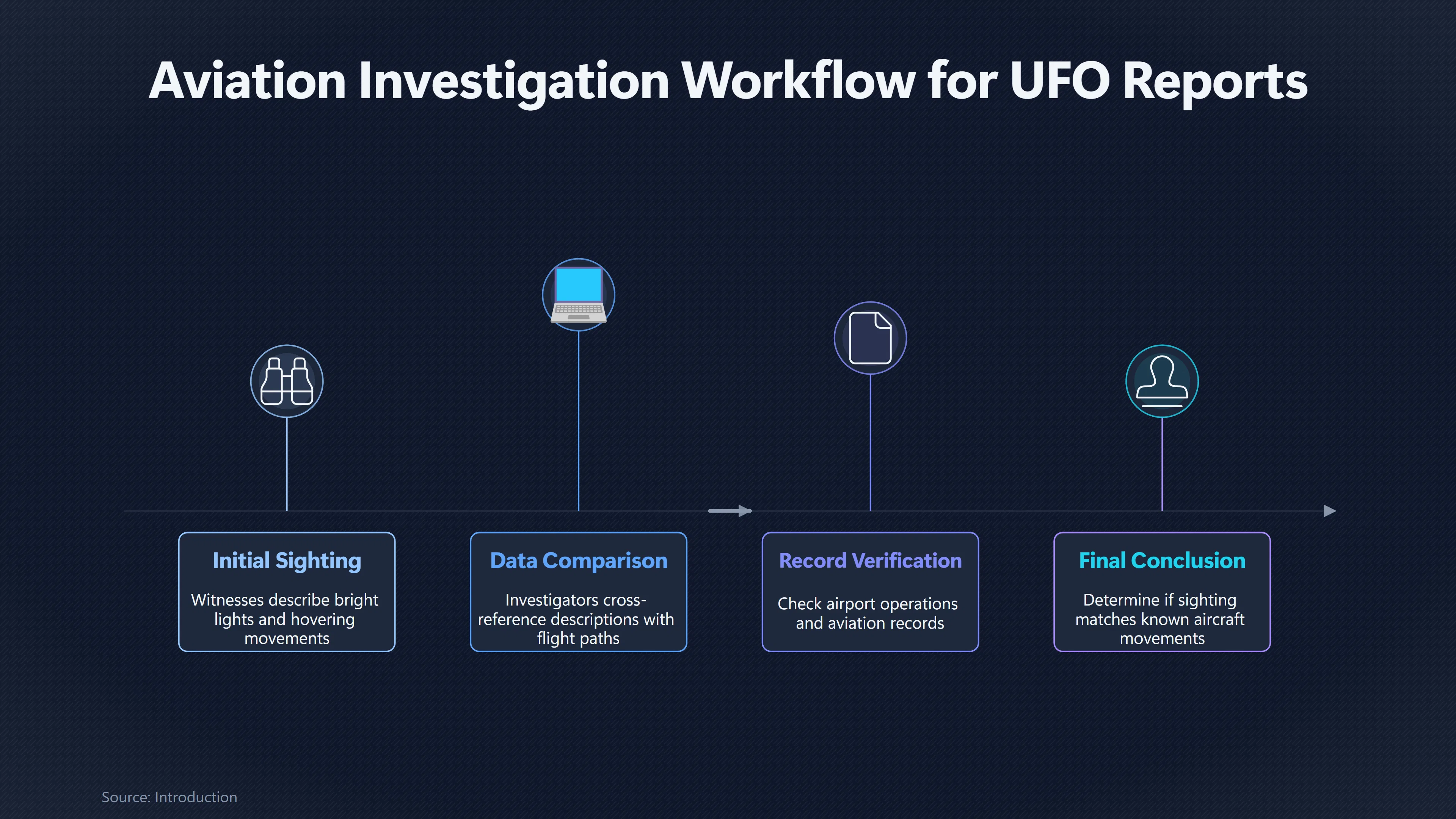
This does not mean every unexplained sighting can automatically be identified as an aircraft. Instead, it explains why investigators examining Northern Territory reports routinely compare witness descriptions with flight paths, airport operations and aviation records before considering more unusual possibilities.
Why head-on aircraft appear stationary
One of the easiest ways for an aircraft to resemble a hovering UFO is to fly almost directly towards the observer.
Human vision judges movement mainly by changes in an object’s position against the background. An aircraft crossing from left to right steadily changes its apparent position and is easily recognised as moving. An aircraft approaching almost directly towards an observer behaves differently. Although it may be travelling at hundreds of kilometres per hour, its position in the sky changes only very slowly because most of its motion is along the observer’s line of sight rather than across it.
The result can be surprising:
- the light appears fixed in one place for several minutes;
- there is little or no obvious engine noise because of the great distance;
- the object seems unusually bright as its landing lights face the observer;
- when the aircraft finally turns, it appears to accelerate sideways or vanish.
These descriptions closely match many reports of “hovering” UFOs that later prove consistent with normal aircraft movements. Aviation researchers have long recognised that darkness and the absence of visual references make judging distance and motion extremely unreliable.[ATSB]atsb.gov.auATSBATSB TRANSPORT SAFETY REPORTATSBATSB TRANSPORT SAFETY REPORT
In the Northern Territory this effect is enhanced by exceptionally long sightlines across open country. Someone standing near Alice Springs, Tennant Creek or on remote pastoral land may see an aircraft while it is still many tens of kilometres from its destination.
How landing lights create sudden appearances
Aircraft landing lights are designed to be extremely bright so that crews can see ahead during take-off and landing while making the aircraft highly visible to other traffic.
Seen head-on at night, these lights can dominate everything else. The aircraft’s fuselage and navigation lights may remain invisible while only two brilliant white lights are seen. Because surrounding terrain is dark, the lights can appear detached from any obvious aircraft structure.
Several effects commonly follow:
- Sudden appearance. A distant aircraft turns onto an approach path, bringing its landing lights directly towards the observer.
- Extreme brightness. Landing lights can outshine stars and planets while still belonging to an aircraft many kilometres away.
- Sudden disappearance. The aircraft turns away, descends below terrain, enters cloud or the crew switches landing lights off after departure or once no longer required.
- Apparent shape changes. Atmospheric haze, dust or heat shimmer may blur or spread bright lights, making a single aircraft appear larger or oddly shaped.
To an observer unfamiliar with local aviation routes, the sequence can look remarkably mysterious despite following normal flight procedures.
Why this happens so often in the Northern Territory
The Territory contains long aviation routes linking Darwin, Alice Springs, Katherine, Tennant Creek, Yulara and numerous smaller communities. Medical evacuation flights, charter operators, freight aircraft, defence movements and regular airline services all operate across areas where there are few towns or artificial lights.
That creates several conditions favourable to mistaken identification:
- observers often do not expect aircraft over apparently empty country;
- flights may follow routes invisible from the ground rather than roads;
- aircraft can remain visible for unusually long periods because there are few hills or buildings blocking the view;
- low background lighting increases the contrast of bright landing lights.
Military aviation can add another layer of uncertainty. Northern Australia hosts regular defence exercises and training activity, while Darwin is served by both civilian and military aviation. Unfamiliar aircraft types, unusual operating hours or formations may therefore appear unexpected without implying anything extraordinary.
Why silence does not rule out an aircraft
Many witnesses regard the lack of engine noise as evidence that an object cannot be an aircraft. At long distances, however, sound behaves very differently from light.
An aircraft’s lights may be visible long before its engines become audible. Wind direction, temperature layers and atmospheric conditions can carry or suppress sound over considerable distances. In some situations the aircraft may turn away before engine noise reaches the observer at all.
This combination—a brilliant light with little or no sound—is entirely consistent with distant aircraft operations and is frequently reported during night approaches.
Which aviation records can confirm a sighting
Many apparent UFO sightings can be checked against independent aviation information.
Useful sources include:
- commercial flight tracking services that record most airline and many general aviation flights;
- Airservices Australia airspace information and published flight procedures;
- airport arrival and departure records where available;
- Notices to Airmen (NOTAMs), which describe temporary aviation activities;
- where relevant, defence exercise announcements, although some military flights are not publicly trackable.
Not every aircraft will appear on public tracking websites. Some military, government or low-level operations may have limited public visibility, and historical records become harder to verify as time passes. Even so, comparing a sighting with known flight movements is usually one of the first investigative steps because it often explains reports involving apparently stationary or unusually bright lights.
What aviation research says about visual misidentification
The aviation industry treats night-time visual illusions as a serious operational safety issue rather than an unusual curiosity. Investigations into accidents and incidents repeatedly show that even experienced pilots can misjudge position, height and movement when flying over dark terrain with few visual references. The same limits of human perception affect observers watching from the ground.[ATSB]atsb.gov.auRunway excursion involving Boeing 737, VH-VUI, at Darwin Airport, Northern Territory, on 6 December 2016 | ATSBMay 15, 2019…
A Northern Territory example illustrates the importance of these visual conditions. During an Australian Transport Safety Bureau investigation into a night landing at Darwin Airport, investigators highlighted how reduced ambient lighting, the absence of runway centreline lighting and heavy rain reduced reliable visual cues available to the flight crew. Although this was an aviation safety investigation rather than a UFO case, it demonstrates how darkness and isolated lighting can mislead even trained professionals.[ATSB]atsb.gov.auRunway excursion involving Boeing 737, VH-VUI, at Darwin Airport, Northern Territory, on 6 December 2016 | ATSBMay 15, 2019…
For UFO investigators, the lesson is straightforward: a witness may provide an entirely honest description of what they saw while still misjudging the object’s distance, speed or behaviour.
Why aircraft remain one of the strongest first explanations
Within the wider pattern of Northern Territory UFO reports, night aircraft provide one of the most common conventional explanations for lights that appear to hover, suddenly brighten or disappear without warning. The combination of long-distance viewing, powerful landing lights, unfamiliar flight paths and sparse visual references creates conditions in which ordinary aircraft can produce genuinely unusual impressions.
That does not automatically resolve every report. Some sightings remain poorly documented or lack sufficient information for a confident identification. However, when investigators can match the reported time, direction and appearance with known aircraft movements, the case usually becomes considerably stronger as an example of how normal aviation can generate convincing UFO observations under the unique viewing conditions of the Northern Territory.
Amazon book picks
Further Reading
Books and field guides related to When Aircraft Lights Look Like Hovering UFOs. Use these as the next step if you want deeper reading beyond the article.
The UFO Handbook: A Guide to Investigating, Evaluating, and R...
An explanation of the usual reasons for confusing IFOs (identified flying objects) with UFOs and a survey of the tools used to investigat...
The Pilot's Handbook of Aeronautical Knowledge
Pilot's Handbook of Aeronautical Knowledge, an official Federal Aviation Administration (FAA) Handbook; provides basic knowledge that is...
Stick and Rudder: An Explanation of the Art of Flying
In the early 1940's, Wolfgang Langewiesche wrote a series of articles in Air Facts analyzing the various aspects of piloting techniques....
Weather Flying
Weather Flying is regarded in the industry as the bible of weather flying. Robert Buck, a general aviation and commercial pilot with tens...
eBay marketplace picks
Marketplace Samples
Live-tested eBay searches with available results related to this page.
Selected fromairplane model oneBay.co.uk.

Endnotes
1.
Source: atsb.gov.au
Link:https://www.atsb.gov.au/investigations/ao
Source snippet
Runway excursion involving Boeing 737, VH-VUI, at Darwin Airport, Northern Territory, on 6 December 2016 | ATSBMay 15, 2019...
Published: May 15, 2019
2.
Source: atsb.gov.au
Title: ATSBDark Night Take-off Accidents in Australia | ATSB
Link:https://www.atsb.gov.au/publications/research-and-analysis-report/2022/aviation/dark-night-take-accidents-australia
Source snippet
A primary factor in 15 of these accidents was considered to be som...
3.
Source: atsb.gov.au
Title: ATSBATSB TRANSPORT SAFETY REPORT
Link:https://www.atsb.gov.au/sites/default/files/media/24554/AO2007009_001.pdf
4.
Source: atsb.gov.au
Link:https://www.atsb.gov.au/taxonomy/term/294?page=0
Source snippet
It is an exemplar image of the lights on the night the incident took place...
5.
Source: atsb.gov.au
Link:https://www.atsb.gov.au/investigations/ao
Source snippet
Runway excursion involving Raytheon B200, VH-MVP, Lord Howe Island Airport, New South Wales, on 18 February 2022 | ATSBMay 24, 2023 — FIN...
Published: May 24, 2023
6.
Source: atsb.gov.au
Title: taking off in the darkness
Link:https://www.atsb.gov.au/media/news-items/2013/taking-off-in-the-darkness
Source snippet
June 13, 2013 — An incident where a passenger jet took off at night without the crew noticing that the runway lights were off has ill...
Published: June 13, 2013
7.
Source: atsb.gov.au
Title: A primary factor in 15 of these accidents was considered to be some form o
Link:https://www.atsb.gov.au/publications/1995/dark-night-take-off-accidents-in-australia
Source snippet
Dark Night Take-off Accidents in Australia | ATSBApril 21, 1995 — Between January 1979 and May 1993, 35 aircraft accidents occurred in Au...
Published: April 21, 1995
8.
Source: atsb.gov.au
Link:https://www.atsb.gov.au/node?page=911
Source snippet
Moreover, unaided night visual approaches may be as difficult as instrument approaches. There are substantial difficulties with judgi...
9.
Source: skybrary.aero
Link:https://skybrary.aero/index.php/articles/visual-illusions
Source snippet
Visual Illusions | SKYbrary Aviation Safety* Autokinesis: When flying at night, if a pilot stares at a stationary light in the distance f...
Additional References
10.
Source: ufouap.net
Title: Aircraft Lights Mistaken for UFOs: Night Guide | Global UFO Archive
Link:https://www.ufouap.net/en/explainers/aircraft-lights-mistaken-for-ufos
Source snippet
July 16, 2026 — Skywatching / Updated 2026-07-16 / 7 min read AIRCRAFT LIGHTS MISTAKEN FOR UFOS: A NIGHT IDENTIFICATION GUIDE An aircraft...
Published: July 16, 2026
11.
Source: airservicesaustralia.com
Title: Go-arounds and other ‘unusual’ activity
Link:https://www.airservicesaustralia.com/about-us/our-services/how-air-traffic-control-works/unusual-activities-on-the-ground-and-in-the-air/
Source snippet
AirservicesIt can be difficult for passengers or the public to have an accurate picture or understanding of an incident or activity and A...
12.
Source: australianflying.com.au
Title: Sun Glare caused Runway Misalignment: ATSB
Link:https://www.australianflying.com.au/latest/sun-glare-caused-runway-misalignment-atsb
Source snippet
(Google Earth annotated by the ATSB) The pilot of VH-NWI performed a low-level S-turn before going around. (Google Eart...
13.
Source: youtube.com
Title: Chapter 17 Aeromedical Factors | PHAK | AGPIAL Audio/Video Book
Link:https://www.youtube.com/watch?v=n1UYc615ZTQ
Source snippet
Night Illusions (Private Pilot Lesson 15d) Cyndy Hollman · 45K views...
14.
Source: airservicesaustralia.com
Title: In-flight emergencies
Link:https://www.airservicesaustralia.com/about-us/our-services/how-air-traffic-control-works/in-flight-emergencies/
Source snippet
Many light aircraft operate outside of controlled airspace...
15.
Source: youtube.com
Title: The Illusions of Night Flying
Link:https://www.youtube.com/watch?v=irVrDSfP5Ww
Source snippet
Chapter 17 Aeromedical Factors | PHAK | AGPIAL Audio/Video Book...
16.
Source: youtube.com
Title: Part 107 Night Training (full course)
Link:https://www.youtube.com/watch?v=f_YfFRxOr9o
Source snippet
Night Illusions (Private Pilot Lesson 15d)...
17.
Source: youtube.com
Title: PPGS Lesson 14.2 | Aeromedical: Illusions
Link:https://www.youtube.com/watch?v=ZBPmFaqECdM
Source snippet
Part 107 Night Training (full course)...
18.
Source: youtube.com
Title: Night Illusions (Private Pilot Lesson 15d)
Link:https://www.youtube.com/watch?v=y_HvgmQ3NJs
Source snippet
The Illusions of Night Flying...