Within Victoria UFOs
Why Did the RAAF Collect UFO Reports?
Official interest focused mainly on unidentified aircraft, rockets and space debris rather than accepting reports as alien spacecraft.
On this page
- Cold War reasons for recording unusual sightings
- How conventional causes were assessed
- Why some Victorian reports remained unidentified
Page outline Jump by section
Introduction
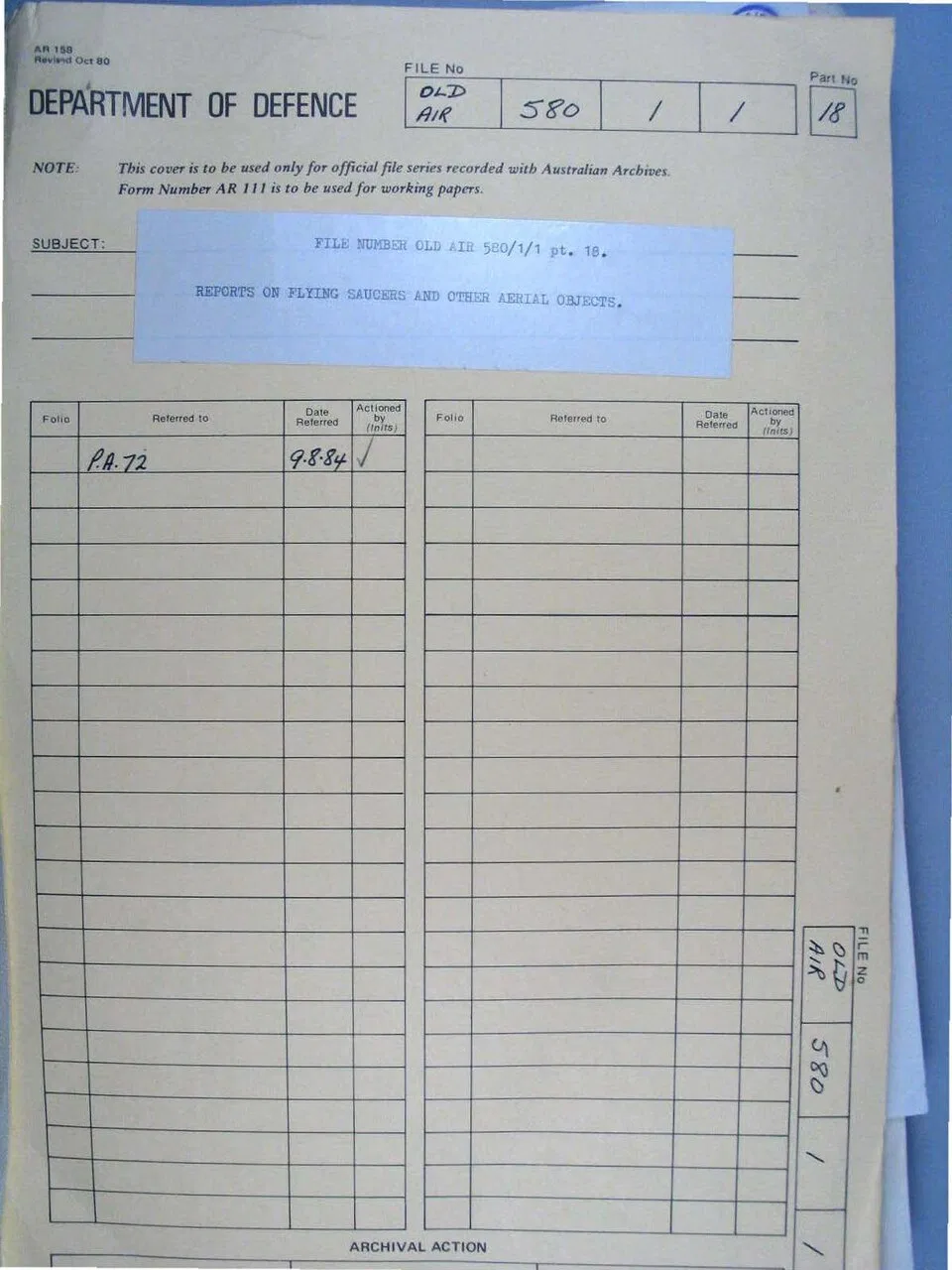
The Royal Australian Air Force collected UFO reports because an unidentified object in Australian airspace might have been an aircraft, missile, balloon, satellite component or other technology with defence significance. During the Cold War and early space age, authorities could not safely assume that every strange light was harmless. The RAAF therefore treated “unusual aerial sightings” as an air-security and intelligence problem, not as evidence that alien spacecraft were visiting Australia.[ABC News]abc.net.auABC NewsHow Bill Chalker became one of the first civilians to access the RAAF's UFO files - ABC News…
For Victoria, these files matter because they show how officials would have approached reports near Melbourne’s airports, air routes and military facilities. They also clarify why famous incidents such as Westall can remain historically important without having a clear official conclusion. The RAAF’s system was designed to identify conventional objects and detect possible threats; it was not a comprehensive scientific programme capable of resolving every brief, poorly recorded or retrospectively reported sighting.
Cold War reasons for recording strange objects
The RAAF began receiving “flying saucer” reports in an environment shaped by rapid changes in aviation and military technology. Jet aircraft were flying higher and faster, radar networks were expanding, guided missiles were being developed, and the United States and Soviet Union were placing satellites into orbit. Rockets, high-altitude balloons and re-entering spacecraft produced sights that many members of the public had never encountered before.
Former RAAF intelligence officer Brett Biddington has explained that the practical concern was not “green men”, but understanding the emerging world of rocketry, satellites and objects returning from space. Public reports could potentially help authorities locate fallen equipment or detect activity that had not been identified through normal channels. This was particularly relevant in a large country where military and civil observation networks could not continuously watch every area.[ABC News]abc.net.auABC NewsHow Bill Chalker became one of the first civilians to access the RAAF's UFO files - ABC News…
The clearest evidence of this security logic comes from the RAAF’s own correspondence. Internal papers stated that sightings were investigated from the standpoint of the “security of Australian air space”, rather than as a scientific study of extraterrestrial life. The Department of Air also said that it was concerned with any possible threat to national security, while acknowledging that its assessment procedures did not extend to detailed scientific investigation.[Internet Archive]archive.orgInternet Archive Full text of "Australian UFO FilesInternet Archive Full text of "Australian UFO Files
This distinction explains why files could be marked restricted or handled by intelligence staff without containing extraordinary conclusions. Classification often reflected military procedures, the identities of witnesses, aircraft movements or the responsibilities of the intelligence branch. It did not, by itself, mean that officials had confirmed an alien craft.
The national-security purpose is especially clear in records from sensitive testing areas. At Woomera and within the wider prohibited area covering weapons facilities in South Australia, unusual sightings occurred against a background of missile, aircraft and nuclear-related trials conducted under tight security. An unidentified object near such a site demanded attention regardless of whether its eventual explanation was a balloon, astronomical object, aircraft or observation error.[NAA]naa.gov.auNAAUFO sightings at weapons testing site, Woomera | naa.gov.auNAAUFO sightings at weapons testing site, Woomera | naa.gov.au
Victoria did not contain an equivalent weapons range, but it had its own reasons for careful reporting. Melbourne was surrounded by busy civil aviation routes and important airfields, including Moorabbin, Essendon and later Tullamarine. RAAF facilities at Point Cook and Laverton also placed military aviation close to a large urban population. Reports from this environment had to be compared with training flights, airline movements, light aircraft, balloons and atmospheric effects before they could reasonably be treated as unexplained.
How a RAAF investigation worked
A sighting normally entered the system through a RAAF unit, police station, air traffic service, military witness or member of the public. Pilots were expected to report unusual observations through air traffic control, which could then forward details to the Air Force. The Directorate of Air Force Intelligence in Canberra held overall responsibility, while personnel at the nearest RAAF unit could interview witnesses and gather local information.[Internet Archive]archive.orgInternet Archive Full text of "Australian UFO FilesInternet Archive Full text of "Australian UFO Files
Reports and questionnaires sought the practical details needed for identification: the date and time, direction of travel, angular height, apparent size, colour, duration, sound, weather conditions and the observer’s position. Investigators also wanted to know whether the object behaved like an aircraft, whether more than one witness had seen it and whether any photograph, radar return or physical trace existed.
The system’s strengths were its access to aviation information and its ability to contact trained personnel. Its weaknesses were equally important. Most reports reached officials after the event, often without precise bearings, photographs or instrument records. Witnesses commonly described size and distance as though these could be judged directly, even though an unknown object against an empty sky provides few reliable visual reference points.
A report could therefore receive one of several broad outcomes:
- Identified: matched with an aircraft, balloon, meteor, planet, satellite or other known source.
- Insufficient information: potentially explainable, but lacking enough detail for a firm conclusion.
- Unidentified: no satisfactory identification could be made from the available evidence.
- Possible explanation: one or more conventional causes fitted the observation, although certainty was not possible.
The difference between “unidentified” and “unexplainable” is crucial. An unidentified entry meant that the investigators could not determine the source from the evidence supplied. It did not mean that they had demonstrated an object with capabilities beyond known science.
How conventional causes were assessed
The RAAF’s archived papers show a practical process of elimination rather than a specialised search for alien technology. Investigators compared sightings with known aircraft activity, meteorological information, celestial objects and balloon launches. A 1965 Canberra-area case, for example, was not positively identified, but officials considered a jet condensation trail, the planet Venus and a radar-reflecting weather balloon as possible explanations.[Internet Archive]archive.orgInternet Archive Full text of "Australian UFO FilesInternet Archive Full text of "Australian UFO Files
These were not arbitrary excuses. Venus can appear surprisingly bright and may be visible during daylight in favourable conditions. Meteors can seem to manoeuvre when seen through broken cloud or from a moving vehicle. Aircraft landing lights can appear nearly stationary when an aeroplane is approaching head-on, then seem to accelerate when it turns. High-altitude balloons can change apparent shape as they rotate, while their suspended instruments or parachutes may be mistaken for separate objects.
Satellites and space debris added further difficulty. Early spacecraft were unfamiliar to the public, and re-entries could produce formations of brilliant fragments travelling together across a large part of the sky. From an intelligence perspective, identifying such material mattered because it might reveal the origin and trajectory of human-made hardware. Public witnesses were therefore useful even when their reports contained no genuine mystery.
By 1971, an RAAF summary stated that it had received 572 reports since January 1960. The Department of Air assessed 93 per cent as explainable by contemporary scientific knowledge, 6 per cent as containing too little information for proper evaluation and 1 per cent as attributable to unknown causes. The figures should be read as administrative classifications rather than a controlled scientific experiment, but they show that unresolved cases formed only a small part of the total workload.[Internet Archive]archive.orgInternet Archive Full text of "Australian UFO FilesInternet Archive Full text of "Australian UFO Files
They also reveal why apparently conflicting percentages appear in later discussions. Different summaries covered different dates, and officials sometimes combined the “insufficient information” and “unknown” groups when describing the unresolved residue. A claim that several per cent remained unidentified therefore does not necessarily mean that officials regarded all of them as equally strong or anomalous.
What the files reveal about Victoria
The surviving archive is not a single, complete Victorian UFO dossier. Reports were distributed through national RAAF intelligence series, local unit files, civil aviation records and correspondence with members of the public. Archival indexes identify, for example, a file concerning an unidentified aerial object reported at Tullamarine on 3 April 1966, only three days before the better-known Westall event. The existence of such an entry demonstrates that reports around Melbourne could reach official channels, but it does not establish a connection between the two sightings.[Internet Archive]archive.orgOpen source on archive.org.
The more important lesson is that record survival is uneven. Some files contain questionnaires, witness letters and internal minutes; others preserve little more than a summary or administrative response. Records could also have been filed under an airport, intelligence subject, air-traffic matter or individual correspondent rather than under “UFO”. The absence of an obvious file bearing the name of a famous incident is therefore significant, but not decisive proof that no official contact or inquiry occurred.
Westall and the missing official trail
At Westall on 6 April 1966, numerous students and some adults reported one or more unusual objects over Melbourne’s south-east. Contemporary civilian investigators interviewed witnesses, while a school publication described private aircraft, mainly Cessnas, moving towards or around the reported objects. The Victorian Flying Saucer Research Society inspected the area, but no exhaustive contemporary official account has emerged from the surviving public record.[State Library Victoria Blogs]blogs.slv.vic.gov.austrange lights in the sky the westall ufo event 1966State Library Victoria BlogsState Library Victoria – Strange lights in the sky: The Westall UFO event, 1966…
This gap has encouraged claims that a RAAF or Department of Supply investigation was suppressed. Later witnesses have described uniformed personnel, official warnings and the removal of material. Such accounts deserve to be recorded, but most became public many years after the event and are difficult to test against contemporary documents.
The known RAAF policy makes some level of official interest plausible: a mass daylight report near Melbourne aviation routes was precisely the kind of event that could attract enquiries. Yet plausibility is not documentation. Without a located report, dated orders, named investigators or supporting unit records, claims of a formal military operation at Westall remain unproven.
The missing file also cuts both ways. It prevents officials from demonstrating that Westall was satisfactorily identified, but it also deprives extraordinary interpretations of radar data, technical measurements or a documented military assessment. The result is an unresolved historical case supported mainly by witness testimony and civilian records, not a declassified RAAF finding that an exotic craft was present.
Valentich and the limits of the “UFO file” label
The disappearance of Frederick Valentich over Bass Strait on 21 October 1978 illustrates a different type of Victorian aviation case. Valentich departed Moorabbin in a Cessna 182 and reported an unidentified object during radio contact before he and the aircraft disappeared. The transmission was real, the search was real and the loss remains unresolved because neither the pilot nor the main wreckage was recovered.[NAA]naa.gov.auNAAFlying saucers – fact or fiction? | naa.gov.auNAAFlying saucers – fact or fiction? | naa.gov.au
However, much of the official documentation belongs to civil aviation and search-and-rescue records rather than to a dedicated RAAF UFO investigation. This matters because the central official question was what happened to an aircraft and pilot, not whether extraterrestrial visitors existed. Later explanations have included spatial disorientation, mistaken identification of lights and loss of control, although the absence of wreckage prevents a conclusive reconstruction.
Valentich demonstrates why military and aviation connections can make a UFO story more credible in one sense but not another. Radio records confirm that the witness reported something unusual. They do not confirm the nature, distance or independent existence of the object he described.
Why some reports stayed unidentified
The RAAF’s unresolved category was produced mostly by evidential limits. A light seen for several seconds might have been impossible to match with a particular aircraft or meteor after the fact. An observer might provide no accurate direction, confuse local and standard time, or report the incident weeks later. Even a sincere and capable witness could be mistaken about speed, altitude or distance.
Three recurring problems affected Victorian reports:
Busy airspace. Around Melbourne, civil, military and recreational aircraft created many possible sources. Unless investigators had an exact time and direction, eliminating every aircraft could be difficult.
Coastal and atmospheric conditions. Bass Strait weather, low cloud, haze and temperature layers could distort lights or obscure the horizon. Reflections and unusual visibility conditions could make familiar objects appear displaced or strangely mobile.
Fragmented reporting. Accounts might be divided between police, newspapers, civilian UFO groups, air traffic authorities and the RAAF. Later researchers could therefore find one part of a case without the observations or checks needed to understand the whole event.
An unresolved classification should consequently be treated as a statement about the file, not the object. Some cases may represent genuinely unusual events. Others almost certainly remained open because the available information was too weak to support any conclusion.
Why the RAAF eventually stopped collecting reports
By the later Cold War, satellites, radar coverage and civil aviation systems had become more capable, while decades of reports had produced no compelling evidence of a new threat requiring a dedicated UFO function. In 1996 the RAAF formally ended routine collection and investigation of unusual aerial sightings, concluding that there was no scientific or other compelling reason to continue devoting resources to the work.[SBS Australia]sbs.com.auSBS Australia If you see an UFO, don't call the RAAF | SBS News | SBS NewsSBS Australia If you see an UFO, don't call the RAAF | SBS News | SBS News
That decision did not mean that Defence ceased caring about unidentified aircraft or hazards. Reports involving a possible hostile platform, aviation emergency, falling space debris or public-safety risk continued to belong with Defence, police or civil aviation authorities. What ended was the routine processing of public UFO reports as a distinct administrative category.[SBS Australia]sbs.com.auSBS Australia If you see an UFO, don't call the RAAF | SBS News | SBS NewsSBS Australia If you see an UFO, don't call the RAAF | SBS News | SBS News
The change also helps explain the modern divide between national-security reporting and civilian UFO research. Defence agencies assess potential threats through radar, intelligence and operational systems. Civilian groups collect personal sightings that do not present an immediate security concern. The two activities may overlap, but they ask different questions and apply different evidential standards.
What the official files do — and do not — prove
The RAAF files show that Australian authorities took unidentified aerial observations seriously when they might affect airspace security. They preserve witness statements, internal correspondence and efforts to compare reports with conventional causes. They also show that officials usually regarded UFO reports as products of astronomy, weather, aircraft, balloons, space activity or inadequate information rather than as evidence of extraterrestrial visitation.[ABC News]abc.net.auABC NewsHow Bill Chalker became one of the first civilians to access the RAAF's UFO files - ABC News…
For Victoria, the archive provides context rather than a final solution to its best-known mysteries. It explains why sightings near airports, military establishments and Bass Strait attracted official attention. It also reveals why a large witness count, an intelligence file or an unresolved label cannot by itself establish what was seen.
The most balanced reading is that the RAAF’s collection programme was a Cold War air-security measure that generated a valuable but incomplete historical archive. Most reports were conventionally explained. A small residue remained unidentified, usually because the evidence was limited. Westall, Valentich and lesser Victorian cases remain important not because the files confirm extraordinary craft, but because they expose the difficult boundary between unusual testimony, aviation risk, government procedure and conclusions that the surviving evidence cannot securely support.
Amazon book picks
Further Reading
Books and field guides related to Why Did the RAAF Collect UFO Reports?. Use these as the next step if you want deeper reading beyond the article.
UFO: The Inside Story of the US Government's Search for Alien...
"The full story of our national obsession with UFOs--and the covert, decades-long search by scientists, the United States military, and t...

UFOs and Government: A Historical Inquiry
Governments around the world have had to deal with the UFO phenomenon for a good part of a century. How and why they did so is the subjec...
The Report on Unidentified Flying Objects
Book Excerpt: ing can never be positively identified. It might have been a hallucination or it might have been some vehicle from outer sp...
eBay marketplace picks
Marketplace Samples
Live-tested eBay searches with available results related to this page.
Selected fromUFO poster oneBay.co.uk.


Current eBay listing
VINTAGE UFO FLYING SAUCERS COMIC ADVERTISING A2 POSTER PRINT


Current eBay listing
I Want To Believe UFO Poster Giclée Fine Art Heavyweight Print
Endnotes
1.
Source: archive.org
Title: Internet Archive Full text of “Australian UFO Files”
Link:https://archive.org/stream/AustralianUFOFiles/A703_554-1-30_Part%202_12055824_djvu.txt
2.
Source: archive.org
Link:https://archive.org/stream/AustralianUFOFiles/0%20-%20foia%20australia%20national%20archives%20file%20numbers%20notes_djvu.txt
3.
Source: naa.gov.au
Title: NAAFlying saucers – fact or fiction? | naa.gov.au
Link:https://www.naa.gov.au/blog/flying-saucers-fact-or-fiction
4.
Source: abc.net.au
Link:https://www.abc.net.au/news/2024-12-07/accessing-australia-secret-ufo-files/104673082
Source snippet
ABC NewsHow Bill Chalker became one of the first civilians to access the RAAF's UFO files - ABC News...
5.
Source: naa.gov.au
Title: NAAUFO sightings at weapons testing site, Woomera | naa.gov.au
Link:https://www.naa.gov.au/students-and-teachers/student-research-portal/learning-resource-themes/war/defence-equipment-and-weapons/ufo-sightings-weapons-testing-site-woomera
6.
Source: blogs.slv.vic.gov.au
Title: strange lights in the sky the westall ufo event 1966
Link:https://blogs.slv.vic.gov.au/our-stories/strange-lights-in-the-sky-the-westall-ufo-event-1966/
Source snippet
State Library Victoria BlogsState Library Victoria – Strange lights in the sky: The Westall UFO event, 1966...
7.
Source: sbs.com.au
Title: SBS Australia If you see an UFO, don’t call the RAAF | SBS News | SBS News
Link:https://www.sbs.com.au/news/article/if-you-see-an-ufo-dont-call-the-raaf/20fpw1f6x
8.
Source: naa.gov.au
Link:https://www.naa.gov.au/students-and-teachers/learning-resources/learning-resource-themes/environment-and-nature/weather-and-climate/cloud-seeding-operation-coast-sydney
9.
Source: naa.gov.au
Link:https://www.naa.gov.au/students-and-teachers/student-research-portal/learning-resource-themes/war/defence-equipment-and-weapons?page=1
10.
Source: naa.gov.au
Title: research guide the sinking of hmas sydney
Link:https://www.naa.gov.au/sites/default/files/2020-06/research-guide-the-sinking-of-hmas-sydney.pdf
11.
Source: naa.gov.au
Link:https://www.naa.gov.au/sites/default/files/2021-05/records-released-march-2021.pdf
12.
Source: Wikipedia
Title: Royal Australian Air Force
Link:https://en.wikipedia.org/wiki/Royal_Australian_Air_Force
13.
Source: Wikipedia
Title: Disappearance of Frederick Valentich
Link:https://en.wikipedia.org/wiki/Disappearance_of_Frederick_Valentich
14.
Source: airforce.gov.au
Link:https://www.airforce.gov.au/
15.
Source: airforce.gov.au
Title: Our Journey
Link:https://www.airforce.gov.au/about-us/history/our-journey
16.
Source: airforce.gov.au
Link:https://www.airforce.gov.au/about-us/bases
17.
Source: abc.net.au
Title: westall ufo mystery witnesses want answers
Link:https://www.abc.net.au/news/2026-04-06/westall-ufo-mystery-witnesses-want-answers/106126614
18.
Source: en.wiktionary.org
Link:https://en.wiktionary.org/wiki/RAAF
19.
Source: nationalarchives.gov.uk
Link:https://www.nationalarchives.gov.uk/explore-the-collection/explore-by-time-period/postwar/ufo-reports/
Additional References
20.
Source: youtube.com
Title: OZ Encounters
Link:https://www.youtube.com/watch?v=AAZNXPEaq0Q
Source snippet
RAAF UFO files Cold War Australia secret archives Inside the Australian UFO Archive: The Sea Fury, Maralinga, and the Valentich Mystery U...
21.
Source: youtube.com
Title: The Unidentified: Are we alone in the universe? | Under Investigation
Link:https://www.youtube.com/watch?v=bSMfOPw8JA0
Source snippet
Inside the Australian UFO Archive: The Sea Fury, Maralinga, and the Valentich Mystery...
22.
Source: youtube.com
Title: Schoolyard witnesses in mass UFO sighting demand answers | Australian Story
Link:https://www.youtube.com/watch?v=IhKyQkhOfoM
Source snippet
OZ Encounters - UFO's In Australia (FULL DOCUMENTARY)...
23.
Source: youtube.com
Link:https://www.youtube.com/watch?v=DZP-x4Ko_JI
Source snippet
The Unidentified: Are we alone in the universe? | Under Investigation...
24.
Source: cia.gov
Link:https://www.cia.gov/readingroom/document/cia-rdp81r00560r000100010001-0
25.
Source: facebook.com
Link:https://www.facebook.com/TheProjectTV/posts/52-years-on-and-the-reported-ufo-sighting-in-westall-continues-to-draw-community/10155716528468441/
26.
Source: reddit.com
Link:https://www.reddit.com/r/Futurology/comments/pj8o4d/australia_has_declassified_their_uap_files/
27.
Source: reddit.com
Link:https://www.reddit.com/r/UFOs/comments/1690o00/listen_to_the_actual_audio_of_frederick/
28.
Source: facebook.com
Link:https://www.facebook.com/ABCDarwin/posts/northern-territory-police-address-ufo-sightings-after-multiple-unusual-sightings/1368157208688792/
29.
Source: facebook.com
Link:https://www.facebook.com/WWLP22News/posts/scientists-gained-access-to-australias-military-files-on-ufos-and-did-some-resea/10159170341499099/