Within Northern Territory
Why Do Outback Lights Seem to Follow Cars?
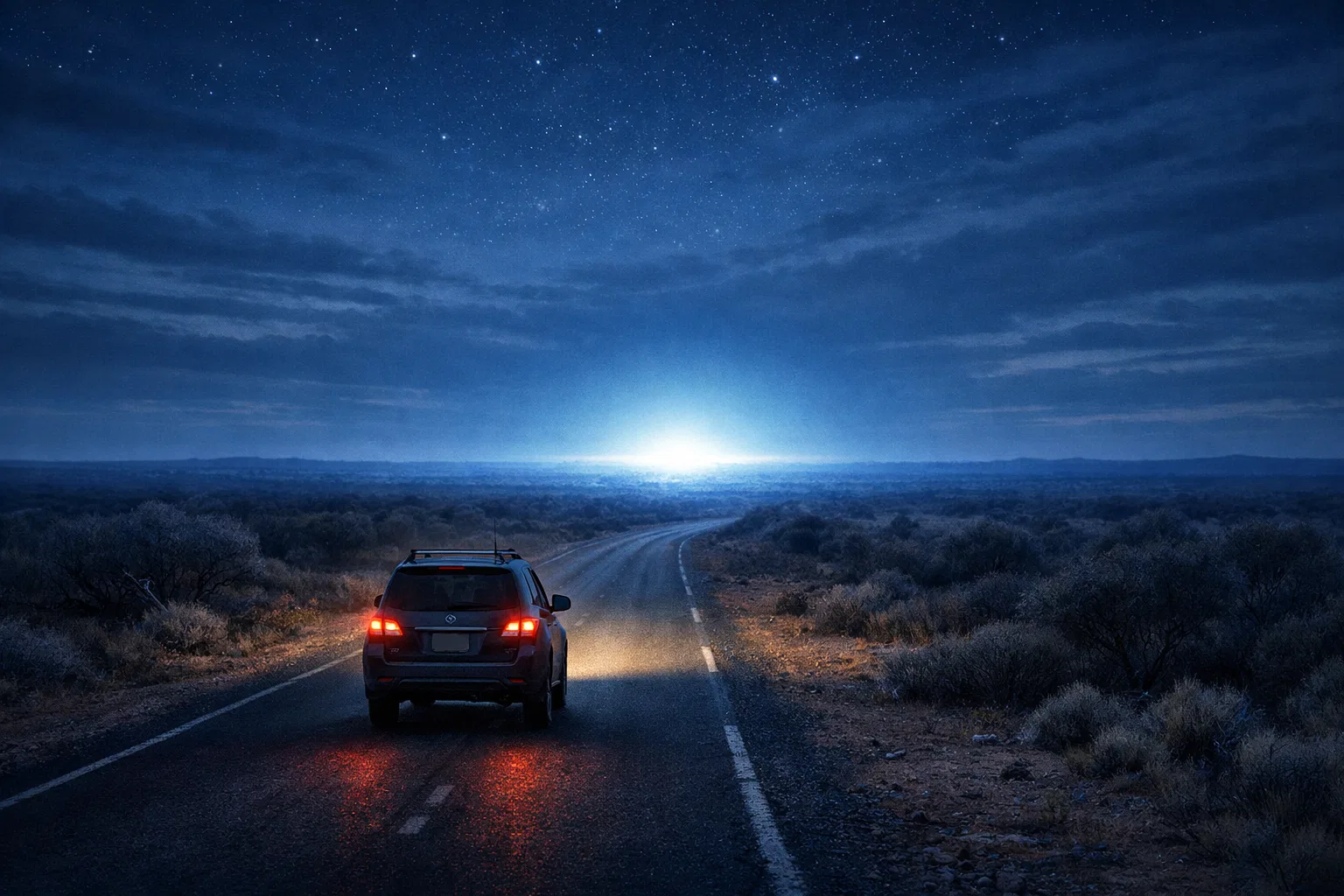
Min Min lights can appear to hover or follow travellers, and atmospheric optics offers a strong explanation for at least some reports.
On this page
- How travellers describe Min Min lights
- Why distance and movement are hard to judge
- How atmospheric refraction can create false lights
Page outline Jump by section
Introduction
Min Min lights are distant lights that seem to hover, change colour, retreat or keep pace with travellers on outback roads. In the Northern Territory, such descriptions overlap naturally with UFO reports from the Stuart Highway, the Barkly and other sparsely settled country. The strongest scientific explanation is not an unusual craft but an unusual view of an ordinary light: headlights, campfires or other sources can be bent over the horizon by layers of air at different temperatures. With almost no landmarks to reveal the light’s true distance, movement created by the observer’s own vehicle may then make it appear to follow or evade them.[nih.gov]pubmed.ncbi.nlm.nih.govPub Med The Min Min light and the Fata MorganaAn optical…by JD Pettigrew · 2003 · Cited by 23 — This explanation is based on the inverted mirage or Fata Morgana, where light is ref…
This does not prove that every unexplained light in the Territory is a Min Min mirage. Reports vary greatly, and most lack the measurements needed for a firm identification. It does mean that “it followed the car” is not, by itself, strong evidence of intelligent control. In the outback, atmospheric refraction and human depth perception can produce exactly that impression.
How travellers describe Min Min lights
The classic account begins with an isolated glow near the horizon. It may be white, yellow, orange or red, sometimes with blurred or shimmering edges. The witness cannot identify a lamp, vehicle or settlement beneath it. As the car continues, the light appears to maintain its position, pace the vehicle, move from one side of the road to the other or withdraw whenever the observer tries to approach it. Reports sometimes describe a light that disappears and later returns, or seems to respond when the car stops or changes direction.[nih.gov]pubmed.ncbi.nlm.nih.govPub Med The Min Min light and the Fata MorganaAn optical…by JD Pettigrew · 2003 · Cited by 23 — This explanation is based on the inverted mirage or Fata Morgana, where light is ref…
These features help explain why Min Min stories merge so easily with UFO narratives. A luminous object that remains apparently airborne, behaves unpredictably and cannot be reached may sound more like a controlled vehicle than a distant headlight. Around places already associated with UFOs, including the Stuart Highway corridor near Wycliffe Well, that interpretation is culturally available before any optical explanation is considered.
Yet “Min Min light” is not a precise scientific category. It is a name applied to a family of outback experiences that may have more than one cause. A slowly hovering light near the horizon, a brief meteor, a satellite, an aircraft landing light and a refracted vehicle headlamp can all be reported simply as a strange light. The term is therefore useful as a description of the experience, not as proof that every witness saw the same physical phenomenon.
Reports also extend well beyond the Northern Territory. Boulia and the Channel Country of western Queensland have the best-known public association with Min Min lights, while stories have been collected in Western Australia and elsewhere inland. Charles Darwin University reported a large response when researcher Curtis Roman sought personal accounts, showing that the phenomenon remains part of the wider outback imagination rather than a single local case.[ABC News]abc.net.aumin min lights seen in outbackABC NewsThe mysterious phenomenon of Min Min lights29 Sept 2018 — In the Kimberley in Western Australia some Aboriginal people believe th…
That national distribution matters for the Territory’s UFO history. It suggests that at least some remote-road sightings belong to a recurring Australian viewing problem: distant lights observed across open, thermally layered country. They should not automatically be grouped with reports involving a clearly structured object, close-range physical effects or reliable radar data.
Why distance and movement are hard to judge
A lone light in darkness provides remarkably little information. During daylight, the eye estimates distance from overlapping objects, surface texture, haze, familiar sizes and the apparent shift of nearby features as the observer moves. On an unlit outback road, most of those cues disappear. The witness may see only a point of light against a black sky or featureless horizon.
Without a known size, a bright light a great distance away can resemble a smaller one nearby. A witness who describes a “ball the size of a basketball” is usually reporting its apparent appearance, not a measured physical diameter. The same uncertainty affects altitude: a light assumed to be a few hundred metres away and above the ground may actually be many kilometres distant and close to the true horizon.
Movement is equally deceptive. As a car travels, a nearby tree or post sweeps quickly across the visual field, while a distant hill barely changes position. A sufficiently remote light therefore seems to accompany the observer. The Moon offers a familiar comparison: it appears to follow a moving car because its direction changes too little for the eye to register against nearby scenery. A refracted headlight need not be as distant as the Moon to create a similar effect; it only needs to be far enough away, and isolated enough, that the observer cannot detect the normal change in viewing angle.
Road geometry can add apparent manoeuvres. A highway may curve gently or rise and fall even when it feels straight at night. The line of sight to a distant source then shifts relative to the windscreen, roadside and horizon. A light may seem to cross the road, climb, descend or retreat. If the refracting layer itself changes, the image can also brighten, distort, split or disappear without any comparable movement by the source.
Shimmering air can make the effect seem active. Small variations in temperature and density alter the path by which the light reaches the observer. The image may bob, flicker or change shape, encouraging the impression that it is deliberately adjusting its position. In darkness, normal involuntary eye movements can further make an isolated point appear unstable because there is no fixed visual reference against which to judge it.
This combination explains one of the most persuasive details in outback stories: attempts to catch the light fail. If the apparent object is an image of a source beyond the horizon, driving towards where it seems to be does not lead to a hovering object at that location. The viewing geometry changes, the atmospheric path breaks down, or the distant vehicle turns away. The light then fades or vanishes, apparently retreating just as the witness approaches.
How atmospheric refraction creates false lights
The key mechanism is a temperature inversion. Air normally becomes cooler with height, but on calm, clear nights the ground can lose heat rapidly and cool the air immediately above it. Warmer air may remain over this shallow cold layer. The resulting change in air density alters the refractive index of the atmosphere and bends light rays rather than allowing them to travel in a simple straight line. The Bureau of Meteorology defines a mirage as an optical illusion caused by atmospheric refraction and explains that strong inversions can create a duct that redirects light over long distances.[bom.gov.au]bom.gov.auScience concerned with the processes and phenomena of the atmosphere, especially as a way to forecast the weather…. This part of Austr…
In a superior or inverted mirage, light from a source below the ordinary geometric horizon can curve downwards into an observer’s line of sight. The source itself remains hidden by the Earth’s curvature or intervening ground, while its distorted image appears above the horizon. At night, the observer sees only the luminous image, not the vehicle, campfire or settlement producing it.
This differs from the familiar “water on the road” mirage seen during hot days. That inferior mirage forms when very hot air near the surface bends light upwards, producing an apparent reflection below an object. Min Min conditions instead commonly involve colder air close to the ground beneath warmer air, allowing a remote light to appear elevated or suspended.
University of Queensland neuroscientist Jack Pettigrew developed the most detailed optical account after observing Min Min-like lights in western Queensland. In a 2003 paper in Clinical and Experimental Optometry, he argued that the defining properties could be explained by a Fata Morgana-type inverted mirage acting on natural or artificial light sources. The great and unsuspected distance of the source, he noted, was central to the mystery: the light reached the observer without the surrounding details that would normally identify it.[nih.gov]pubmed.ncbi.nlm.nih.govPub Med The Min Min light and the Fata MorganaAn optical…by JD Pettigrew · 2003 · Cited by 23 — This explanation is based on the inverted mirage or Fata Morgana, where light is ref…
Pettigrew also staged a field demonstration. He drove roughly ten kilometres from a campsite and directed his vehicle’s headlights towards the observers. Under inversion conditions, the group saw what looked like a separate light above the horizon, reportedly bobbing and changing through vivid colours. Switching the headlights off made the apparent Min Min light disappear; switching them on brought it back. A prominent mirage of distant terrain was visible the following morning, supporting the presence of the required atmospheric structure.[ABC News]abc.net.auABC News Mystery of the Min Min lights explained — ABC Science ArchiveABC News Mystery of the Min Min lights explained — ABC Science Archive
In another observation discussed in later summaries of his work, geometry linked a puzzling light to powerful truck headlights at an extreme distance. The precise reach of any particular mirage depends on terrain and atmospheric conditions, so such figures should not be treated as a standard Min Min range. The broader point is firmer: light from well beyond the distance a witness would ordinarily consider can, under suitable conditions, be redirected into view.[News]news.uq.edu.auNews UQ scientist unlocks secret of Min Min lightsNews UQ scientist unlocks secret of Min Min lights
Colour changes do not require the source itself to cycle through colours. Refraction can separate wavelengths slightly, while turbulence, dust, haze and changes in the optical path can alter which portions of the light reach the observer. Distorted headlights may therefore shift from white to yellow, orange, red or occasionally green. Multiple lamps can also merge into a single glow or be stretched into an apparently larger object.
Why the Northern Territory is well suited to the illusion
The Territory contains long roads across flat or gently undulating country, widely separated settlements and very dark horizons. Those conditions improve the visibility of weak distant lights while removing the visual clues needed to identify them. The Stuart Highway between Alice Springs and Tennant Creek is especially important to local UFO folklore because travellers spend long periods moving through open country where lights may have no obvious source.
Central Australian nights can also produce strong near-surface cooling, particularly under clear skies and light winds. A cold layer close to the ground beneath warmer air creates the type of inversion needed for superior mirages. The effect is not constant, which helps explain why a road may produce a striking experience on one journey and nothing unusual on the next.
Modern light sources widen the possibilities. A campfire once provided a stationary glow; vehicles, road trains, railway operations, mines, remote facilities and aviation lighting introduce brighter or moving sources. This offers a plausible reason why modern accounts often describe lights travelling or keeping pace, whereas older stories may emphasise a single persistent glow. It does not mean earlier cultural accounts can be reduced confidently to headlights, only that technological change affects what light is available for refraction.
The Territory’s sparse settlement can paradoxically make artificial lights seem less likely to witnesses. A driver who knows that the nearest town is far away may reasonably reject a streetlamp, yet overlook another road, a station property, an elevated worksite or a vehicle hidden beyond the horizon. Refraction means the apparent direction and elevation of the image may not point neatly to the source.
What the explanation does and does not settle
The refraction model is strong because it does more than attach a familiar label to an unexplained observation. It identifies suitable weather conditions, explains how a below-horizon source becomes visible and has been demonstrated using vehicle headlights. It also accounts for several recurring witness impressions at once: hovering, following, changing colour, apparent remoteness and disappearance during pursuit.[nih.gov]pubmed.ncbi.nlm.nih.govPub Med The Min Min light and the Fata MorganaAn optical…by JD Pettigrew · 2003 · Cited by 23 — This explanation is based on the inverted mirage or Fata Morgana, where light is ref…
It does not establish that every report has been solved. Most historical accounts lack temperatures at different heights, wind data, precise bearings, photographs, observer positions or records of traffic on distant roads. Without those details, investigators can often identify a plausible mechanism but cannot reconstruct the exact source. “Consistent with a refracted light” is therefore more accurate than claiming a definitive identification.
Some reports describe objects much closer than a horizon mirage, ground illumination, sharp shadows or apparently complex motion. Such details may point to another cause, but they do not automatically strengthen an extraordinary interpretation. Memories can exaggerate apparent distance and brightness, especially after a frightening experience, and later retellings often combine observation with inference. A genuine close-range case would need contemporaneous measurements or independent physical evidence before it could be separated confidently from perception error, ordinary lights or narrative embellishment.
Alternative proposals include luminous insects, glowing birds, combustible gas and electrically generated plasma. These ideas remain weaker as general explanations because no corresponding animal, gas emission or plasma source has been documented under controlled conditions with the necessary brightness and repeated behaviour. Recent media claims that Min Min lights are likely to be plasma are primarily personal interpretations rather than demonstrated identifications.[Wikipedia]WikipediaMin Min lightMin Min light
Nor should all Indigenous understandings be compressed into one story. Knowledge and interpretations differ between communities and countries. For example, Balanggarra ranger James Birch told the ABC that elders in his Kimberley community described the lights as old people’s spirits looking after Country, while Pitta Pitta elders have shared their own knowledge of Min Min lights in Queensland educational material. These accounts are culturally significant but should not be presented as a single universal Aboriginal explanation, or treated merely as early versions of modern UFO claims.[ABC News]abc.net.aumin min lights seen in outbackABC NewsThe mysterious phenomenon of Min Min lights29 Sept 2018 — In the Kimberley in Western Australia some Aboriginal people believe th…
How to assess an outback light report
A useful investigation begins by separating what was observed from what was concluded. “A white light remained five degrees above the eastern horizon for twelve minutes” is evidence. “It chased us” is partly an interpretation unless the observer can show how its distance and relative motion were established.
The most valuable details are the exact time and position, viewing direction, elevation above the horizon, weather, road heading, changes after bends or hills, and whether the light vanished when distant traffic changed direction. Investigators should check other roads, stations, mines, rail corridors, aircraft, astronomical objects and satellites rather than considering only sources on the witness’s own highway.
Photographs are most useful when they include the horizon, stars or landmarks. A zoomed image of a featureless glowing dot preserves almost none of the geometry needed for identification. Video should ideally begin before the camera zooms, continue through changes in the vehicle’s direction and record the dashboard time or location.
A refracted-light interpretation becomes stronger when the object remains close to the horizon, appears during calm inversion-prone conditions, changes colour or shape, and cannot be approached despite prolonged driving. It becomes weaker when several observers establish a nearby three-dimensional object from clearly separated positions, when reliable radar independently tracks it, or when physical effects are recorded under conditions that exclude ordinary causes.
For Northern Territory UFO history, the important distinction is not simply between “explained” and “unexplained”. A case may be unresolved because its records are too poor, not because all conventional explanations failed. Min Min lights show why remote-road testimony can be sincere, vivid and still misleading: the witness may accurately report an extraordinary-looking experience while being mistaken about the light’s distance, movement and source.
The most defensible conclusion
Atmospheric refraction offers a convincing explanation for a substantial class of Min Min and UFO-like lights seen from outback roads. It has the right physical conditions, can carry ordinary lights over the horizon and has reproduced central features of the reports in the field. Sparse scenery and night-time perception then amplify the illusion, particularly the sense that a light is hovering or following a moving car.
The remaining uncertainty lies mostly at the level of individual reports. Few Northern Territory stories contain enough data to identify the original lamp or vehicle after the event, and some accounts may involve entirely different causes. Min Min lights are therefore neither proof of extraterrestrial activity nor a universal answer to every unexplained light. Their real importance is methodological: they demonstrate how the Territory’s landscape and atmosphere can turn familiar sources into experiences that feel purposeful, close and profoundly strange.
Amazon book picks
Further Reading
Books and field guides related to Why Do Outback Lights Seem to Follow Cars?. Use these as the next step if you want deeper reading beyond the article.
In Plain Sight
An award-winning journalist investigates a story largely ignored by mainstream media but right there, in front of our eyes ... UFOs, UAPs...
The Demon-Haunted World
NEW YORK TIMES BESTSELLER • From the renowned astronomer and author of Cosmos comes a “powerful [and] stirring defense of informed ration...
The UFO Experience: A Scientific Inquiry
Cited by the New York Review of Books as "the best brief for visitation," this classic study presents an analysis of UFO reports and conc...
Seeing the Light: The Physics and Material World
The clearest and most complete non-mathematical study of light available—with updated material and a new chapter on digital photography....
eBay marketplace picks
Marketplace Samples
Live-tested eBay searches with available results related to this page.
Selected fromMin Min lights poster oneBay.co.uk.

Endnotes
1.
Source: onlinelibrary.wiley.com
Title: j.1444 0938.2003.tb03069.x
Link:https://onlinelibrary.wiley.com/doi/abs/10.1111/j.1444-0938.2003.tb03069.x
2.
Source: Wikipedia
Title: Min Min light
Link:https://en.wikipedia.org/wiki/Min_Min_light
3.
Source: Wikipedia
Title: Fata Morgana (mirage)
Link:https://en.wikipedia.org/wiki/Fata_Morgana_%28mirage%29
4.
Source: pubmed.ncbi.nlm.nih.gov
Title: Pub Med The Min Min light and the Fata Morgana
Link:https://pubmed.ncbi.nlm.nih.gov/12643807/
Source snippet
An optical...by JD Pettigrew · 2003 · Cited by 23 — This explanation is based on the inverted mirage or Fata Morgana, where light is ref...
5.
Source: media.bom.gov.au
Link:https://media.bom.gov.au/social/blog/292/mirrors-in-the-sky-demystifying-the-legend-of-the-flying-dutchman
Source snippet
Where this air meets a higher layer of warmer air, particularly in calm conditions, it can create an atmospheric duct that acts like a re...
6.
Source: abc.net.au
Title: min min lights seen in outback
Link:https://www.abc.net.au/news/2018-09-30/min-min-lights-seen-in-outback/10317058
Source snippet
ABC NewsThe mysterious phenomenon of Min Min lights29 Sept 2018 — In the Kimberley in Western Australia some Aboriginal people believe th...
7.
Source: cdu.edu.au
Title: researcher reports flood min min light stories
Link:https://www.cdu.edu.au/news/news-archive/researcher-reports-flood-min-min-light-stories
Source snippet
Charles Darwin UniversityResearcher reports flood of Min Min light stories28 Nov 2018 — A Charles Darwin University researcher appears to...
8.
Source: bom.gov.au
Link:https://www.bom.gov.au/glossary?f%5B0%5D=glossary_az_mobile_type%3A100334
Source snippet
Science concerned with the processes and phenomena of the atmosphere, especially as a way to forecast the weather.... This part of Austr...
9.
Source: bom.gov.au
Link:https://www.bom.gov.au/resources/learn-and-explore/fire-weather-knowledge-centre/how-weather-affects-fires
Source snippet
Recent research indicates a long-term trend towards increased risk factors for this phenomenon in south-east Australia...
10.
Source: abc.net.au
Title: ABC News Mystery of the Min Min lights explained — ABC Science Archive
Link:https://www.abc.net.au/science/archive/articles/2003/03/28/818193.htm?site=sydney&topic=health
11.
Source: abc.net.au
Link:https://www.abc.net.au/science/articles/2003/03/28/818193.htm
12.
Source: news.uq.edu.au
Title: News UQ scientist unlocks secret of Min Min lights
Link:https://news.uq.edu.au/2003-03-27-uq-scientist-unlocks-secret-min-min-lights
13.
Source: bom.gov.au
Title: About Australian Climate
Link:https://www.bom.gov.au/climate/about/?bookmark=iod
14.
Source: bom.gov.au
Title: iridescent rainbow cloud shines in 2026 australian weather calendar
Link:https://www.bom.gov.au/news-and-media/iridescent-rainbow-cloud-shines-in-2026-australian-weather-calendar
15.
Source: pfes.nt.gov.au
Title: nt.gov.au Traffic Operation
Link:https://pfes.nt.gov.au/newsroom/2025/traffic-operation-red-centre-nats
16.
Source: media.bom.gov.au
Title: bom.gov.au Explainer: what influences air temperature?
Link:https://media.bom.gov.au/social/blog/2544/explainer-what-influences-air-temperature/
17.
Source: abc.net.au
Link:https://www.abc.net.au/news/2019-05-20/meteor-over-central-australia-cctv-police-weather-light-bright/11129714
18.
Source: bom.gov.au
Title: Bushfire Weather
Link:https://www.bom.gov.au/weather-services/bushfire/about-bushfire-weather.shtml
19.
Source: bom.gov.au
Link:https://www.bom.gov.au/glossary
20.
Source: bom.gov.au
Link:https://www.bom.gov.au/glossary?f%5B0%5D=glossary_az_mobile%3AI
21.
Source: bom.gov.au
Link:https://www.bom.gov.au/resources/learn-and-explore/climate-knowledge-centre/climate-factors/frontal-systems
22.
Source: bom.gov.au
Link:https://www.bom.gov.au/resources/learn-and-explore/climate-knowledge-centre/climate-factors/indian-ocean-dipole
23.
Source: bom.gov.au
Link:https://www.bom.gov.au/resources/learn-and-explore/climate-knowledge-centre/climate-factors/southern-annular-mode
24.
Source: nt.gov.au
Link:https://nt.gov.au/driving/safety/road-rules-in-nt?SQ_PAINT_LAYOUT_NAME=multi-parent&curr=161170&print=yes
25.
Source: nt.gov.au
Link:https://nt.gov.au/driving/safety/check-road-conditions
26.
Source: lant.nt.gov.au
Link:https://lant.nt.gov.au/territory-stories
27.
Source: caseytours.com.au
Title: Min Min Lights
Link:https://www.caseytours.com.au/news/min-min-lights/
28.
Source: library.gov.au
Title: australian newspapers research guide
Link:https://www.library.gov.au/research/research-guides-0/australian-newspapers-research-guide
29.
Source: oldnews.com
Title: northern territory
Link:https://www.oldnews.com/en/newspapers/australia/northern-territory
30.
Source: trove.nla.gov.au
Link:https://trove.nla.gov.au/newspaper/article/18012995
Additional References
31.
Source: australiangeographic.com.au
Title: the min min mystery
Link:https://www.australiangeographic.com.au/blogs/need-to-know-with-dr-karl/2018/08/the-min-min-mystery/
Source snippet
Australian GeographicThe Min Min Mystery9 Aug 2018 — John Pettigrew used geometry to show a Min Min light was actually very bright truck...
32.
Source: youtube.com
Title: The Mysterious Min Min Light Haunting the Australian Outback No One Can Explain
Link:https://www.youtube.com/watch?v=9jZ1g7IUm_s
Source snippet
The Min Min Lights of Australia - These lights follow you...
33.
Source: youtube.com
Title: Min Min Lights: Mysterious Lights in the Australian Outback
Link:https://www.youtube.com/watch?v=NwiMQm3wk1I
Source snippet
The Mysterious Min Min Light Haunting the Australian Outback No One Can Explain...
34.
Source: youtube.com
Title: The Min Min Lights of Australia
Link:https://www.youtube.com/watch?v=x-d6jApQQBc
Source snippet
I Got Chased By a MIN MIN Light in Australia. UFO/ UAP?...
35.
Source: youtube.com
Title: I Got Chased By a MIN MIN Light in Australia. UFO/ UAP?
Link:https://www.youtube.com/watch?v=6WID8jBGxNU
Source snippet
Australia's Haunted Outback: The Min Min Lights...
36.
Source: facebook.com
Link:https://www.facebook.com/TheNTNews/posts/can-neither-confirm-or-deny-northern-territory-police-have-received-multiple-ufo/1505194630956170/
37.
Source: researchgate.net
Link:https://www.researchgate.net/publication/239920959_Hessdalen_Light_Phenomena_and_the_Inconsistency_of_the_Car-Headlight_Interpretation
38.
Source: facebook.com
Link:https://www.facebook.com/ABCNorthWestQLD/posts/-are-these-the-elusive-min-min-lights-check-out-this-video-taken-between-dajarra/875826447879344/
39.
Source: facebook.com
Link:https://www.facebook.com/TheNTNews/posts/an-nt-businessman-has-shed-light-on-recent-mystery-ufo-sightings-read-the-latest/1507264437415856/
40.
Source: northernterritory.com
Link:https://northernterritory.com/things-to-do/outdoor-activities/astronomy