Within Witness Reliability
Why Skilled Pilots Can Misread Bright Lights
Even experienced aviators cannot reliably infer the distance, size or speed of a bright point when the sky provides no reference cues.
On this page
- Why distance is hard to judge
- How apparent hovering and movement arise
- What aviation expertise can and cannot resolve
Page outline Jump by section
Introduction
Experienced pilots are often treated as especially reliable UFO witnesses, and with good reason: they spend thousands of hours recognising aircraft, navigation lights, weather and normal aviation activity. Yet one important limitation remains. When a pilot is looking at a single bright light against an otherwise empty sky, neither flying experience nor careful observation can reliably reveal how far away the light is, how large it is or how fast it is moving. Human vision depends heavily on background reference points to judge distance and motion, and those cues largely disappear when only an isolated point of light is visible. This limitation is central to assessing aviation-related UFO reports around Canberra and elsewhere in the Australian Capital Territory. A pilot’s testimony can establish that an unusual light was genuinely observed, but it cannot by itself prove that the light was close, manoeuvring dramatically or represented an unknown object.[Civil Aviation Authority]caa.co.ukCivil Aviation Authority CAP737 Flight-crew human factors handbookCivil Aviation AuthorityCAP737 Flight-crew human factors handbookFebruary 23, 2023…
Why distance is hard to judge
Human depth perception works best when nearby objects, terrain, cloud layers or a visible horizon provide reference points. A solitary light against a dark or featureless sky offers almost none of these cues. The observer therefore cannot easily determine whether the source is a nearby drone, a distant aircraft, a bright planet, a balloon reflecting sunlight or another object many kilometres away.
This is not simply a problem for inexperienced observers. Aviation human-factors guidance notes that visual judgement becomes significantly less reliable when external references are absent. During night operations or approaches over dark terrain, pilots are specifically trained to rely more heavily on instruments because visual impressions alone can be misleading.[Civil Aviation Authority]caa.co.ukCivil Aviation Authority CAP737 Flight-crew human factors handbookCivil Aviation AuthorityCAP737 Flight-crew human factors handbookFebruary 23, 2023…
For Canberra-related sightings, this matters because many reports describe a bright point rather than a structured object. Without independent range measurements from radar, multiple viewing positions or accurate photographic data, estimates of size and speed remain uncertain regardless of the witness’s flying experience.
How apparent hovering and movement arise
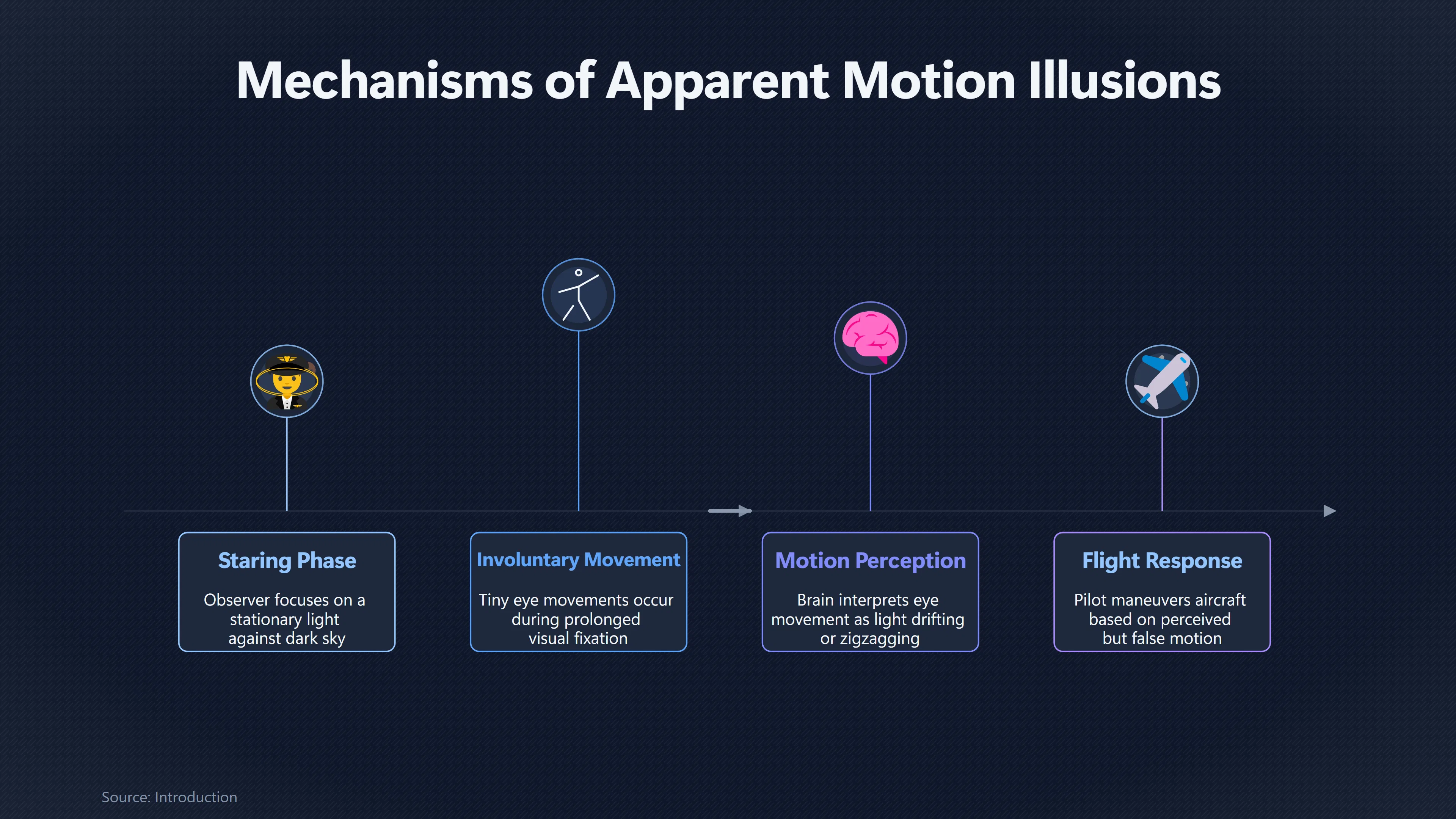
One of the best-known visual phenomena affecting isolated lights is autokinesis. When a person stares at a stationary light against a dark, featureless background for several seconds, tiny involuntary eye movements can create the powerful impression that the light itself is drifting, zigzagging or changing direction. The observer experiences genuine motion even though the light may be stationary.
Aviation authorities have long recognised autokinesis as a hazard. The phenomenon is included in pilot training because it has contributed to incidents where pilots attempted to manoeuvre in response to an apparently moving light rather than trusting their flight instruments.[Federal Aviation Administration]faa.govFederal Aviation Administration Chapter 8. Medical Facts for PilotsFederal Aviation Administration Chapter 8. Medical Facts for Pilots
Other effects can produce similar impressions:
- A distant aircraft flying almost directly towards the observer shows very little sideways movement, making it appear to hover.
- Small changes in the observer’s own aircraft attitude can make a fixed light seem to move.
- Thin cloud, haze or atmospheric layers can alter brightness, making a light appear to pulse, accelerate or recede.
- Slight head movements or changing visual focus can exaggerate apparent motion when no surrounding landmarks are visible.[Civil Aviation Authority]caa.co.ukCivil Aviation Authority CAP737 Flight-crew human factors handbookCivil Aviation AuthorityCAP737 Flight-crew human factors handbookFebruary 23, 2023…
None of these mechanisms means that every unusual light has an ordinary explanation, but they demonstrate why reports of dramatic motion require independent corroboration before being interpreted as evidence of extraordinary flight behaviour.

What aviation expertise can and cannot resolve
Professional experience remains valuable. Pilots and air traffic controllers usually recognise standard navigation lights, understand local air traffic patterns and are accustomed to estimating the behaviour of known aircraft. Their reports therefore deserve careful attention rather than casual dismissal.
However, aviation expertise has clear limits.
A pilot can often state with confidence that a light did not resemble routine traffic or that it occupied an unexpected part of the sky. The same pilot is far less able to determine the true distance, physical size or acceleration of an isolated light without additional reference information. Human visual perception imposes those limits regardless of training. Aviation human-factors guidance consistently emphasises that experience reduces some errors but cannot eliminate fundamental perceptual illusions.[Civil Aviation Authority]caa.co.ukCivil Aviation Authority CAP 719 Fundamental Human Factors ConceptsCivil Aviation AuthorityCAP 719 Fundamental Human Factors ConceptsFebruary 15, 2002…
This distinction is particularly important when assessing historical reports from Canberra Airport. A professional witness increases confidence that an observation was sincere and carefully made. It does not automatically validate estimates of impossible speed, sudden acceleration or extreme proximity.
Why this matters for Canberra’s UFO history
The well-known Canberra Airport sighting of July 1965 illustrates this balance. The involvement of airline pilots and airport personnel makes the observation historically significant because the witnesses were familiar with ordinary aviation operations. At the same time, the object was principally described as an unusually bright light rather than something whose distance or physical dimensions could be measured directly.
As later discussions have shown, disagreements over whether the light could have been Venus, a high-altitude balloon or another conventional object largely stem from uncertainty about its true position and range. Once distance becomes uncertain, estimates of size, speed and manoeuvrability also become uncertain.
Understanding these visual limitations helps explain why many aviation-related UFO reports remain unresolved rather than confirmed. A credible witness and an unexplained observation are not the same as proof of an extraordinary object. In the Australian Capital Territory’s UFO history, recognising both the strengths and the limits of pilot testimony leads to a more balanced assessment of cases that continue to attract public interest.
Amazon book picks
Further Reading
Books and field guides related to Why Skilled Pilots Can Misread Bright Lights. Use these as the next step if you want deeper reading beyond the article.
Human Factors in Aviation
Fully updated and expanded, the second edition of Human Factors in Aviation serves the needs of the widespread aviation community - stude...
The Invisible Gorilla
NEW YORK TIMES BESTSELLER • Our minds don’t work the way we think they do. Two renowned psychologists explain how and why our intuitions...
Visual Perception: A Clinical Orientation
Provides a solid foundation for courses in visual perception. Featuring hundreds of drawings and photos, it covers the mechanisms and ass...
eBay marketplace picks
Marketplace Samples
Live-tested eBay searches with available results related to this page.
Selected frompilot poster oneBay.co.uk.

Endnotes
1.
Source: caa.co.uk
Title: Civil Aviation Authority CAP737 Flight-crew human factors handbook
Link:https://www.caa.co.uk/publication/download/14984
Source snippet
Civil Aviation AuthorityCAP737 Flight-crew human factors handbookFebruary 23, 2023...
Published: February 23, 2023
2.
Source: faa.gov
Title: Federal Aviation Administration Chapter 8. Medical Facts for Pilots
Link:https://www.faa.gov/Air_traffic/publications/atpubs/aim_html/chap8_section_1.html
3.
Source: caa.co.uk
Title: Civil Aviation Authority CAP 719 Fundamental Human Factors Concepts
Link:https://www.caa.co.uk/publication/download/12250
Source snippet
Civil Aviation AuthorityCAP 719 Fundamental Human Factors ConceptsFebruary 15, 2002...
Published: February 15, 2002
4.
Source: caa.co.uk
Title: The results of the survey were co
Link:https://www.caa.co.uk/newsroom/news/new-study-on-electronic-conspicuity-published-by-aviation-regulator/
Source snippet
New study on Electronic Conspicuity published by aviation regulator | UK Civil Aviation AuthorityNovember 16, 2023 — The milestone report...
Published: November 16, 2023
5.
Source: caa.co.uk
Link:https://www.caa.co.uk/data-and-publications/publications/documents/content/cap2583/
Source snippet
Investigation into the Human Factors Effects of Electronic Conspicuity Devices in UK General Aviation | UK Civil Aviation AuthorityNovemb...
6.
Source: faa.gov
Title: Chapter 8. Medical Facts for Pilots
Link:https://www.faa.gov/air_traffic/publications/atpubs/aim/aim0801.html
7.
Source: faa.gov
Title: Perceived Pitch Versus Actual Pitch
Link:https://www.faa.gov/data_research/research/med_humanfacs/aeromedical/aircraftaccident/charlotte
8.
Source: caa.co.uk
Title: caa paper 200703
Link:https://www.caa.co.uk/data-and-publications/publications/documents/content/caa-paper-200703/
9.
Source: faa.gov
Link:https://www.faa.gov/air_traffic/publications/atpubs/aim_html/chap7_section_6.html
10.
Source: faa.gov
Link:https://www.faa.gov/air_traffic/publications/atpubs/aip_html/part2_enr_section_5.3.html
11.
Source: faa.gov
Link:https://www.faa.gov/air_traffic/publications/atpubs/aip_html/chap7_section_6.html
12.
Source: caa.co.uk
Link:https://www.caa.co.uk/aeromedical/medical-standards/pilots/medical-conditions/visual/
13.
Source: caa.co.uk
Link:https://www.caa.co.uk/aeromedical/medical-standards/pilots/medical-conditions/visual/visual-system-guidance-material-gm/
14.
Source: caa.co.uk
Link:https://www.caa.co.uk/aeromedical/medical-standards/pilots/medical-conditions/visual/guidance-following-eye-surgery/
Additional References
15.
Source: youtube.com
Title: Tips for Flying at Night | Lesson in a Full-Motion Flight Simulator
Link:https://www.youtube.com/watch?v=07EzurC4kkU
Source snippet
Spatial Disorientation Explained: Deadly Flight Illusions Every Pilot Must Know Epic Flight Academy · 10K views PPGS Lesson 14.2 | Aerome...
16.
Source: pubmed.ncbi.nlm.nih.gov
Link:https://pubmed.ncbi.nlm.nih.gov/29557053/
Source snippet
2018 Mar 19;42(5):79. doi: 10.1007/s10916-018-0935-4. OPTICAL ILLUSIONS AND SPATIAL DISORIENTATION IN AVIATION PILOTS Miguel Ángel Sánche...
17.
Source: medium.com
Title: Your Senses in the Shadows
Link:https://medium.com/faa/your-senses-in-the-shadows-5ed018e015b5
Source snippet
Nighttime Visual Illusions and Spatial… | by FAA Safety Briefing Magazine | Cleared for Takeoff | MediumJanuary 17, 2025 — AUTOKINESIS Th...
Published: January 17, 2025
18.
Source: youtube.com
Title: Spatial Disorientation Explained: Deadly Flight Illusions Every Pilot Must Know
Link:https://www.youtube.com/watch?v=6BD9fyyIJzY
Source snippet
PPGS Lesson 14.2 | Aeromedical: Illusions...
19.
Source: journals.sagepub.com
Link:https://journals.sagepub.com/doi/full/10.1177/00187208261419347
Source snippet
Allison, Elizabeth L. Irving, Sion Jennings, Laurie M. Wilcox, 2026February 11, 2026 — VISUAL ILLUSIONS IN AVIATION: SIMULATING THE BLACK...
Published: February 11, 2026
20.
Source: youtube.com
Title: Night Illusions (Private Pilot Lesson 15d)
Link:https://www.youtube.com/watch?v=y_HvgmQ3NJs
Source snippet
Tips for Flying at Night | Lesson in a Full-Motion Flight Simulator...
21.
Source: faraim.org
Link:https://faraim.org/faa/aim/chapter-7/section-7-6-14.html
22.
Source: youtube.com
Title: How to Recognize and Overcome Spatial Disorientation
Link:https://www.youtube.com/watch?v=YatlPrTZUNs
Source snippet
Night Illusions (Private Pilot Lesson 15d)...
23.
Source: youtube.com
Title: PPGS Lesson 14.2 | Aeromedical: Illusions
Link:https://www.youtube.com/watch?v=ZBPmFaqECdM
Source snippet
How to Recognize and Overcome Spatial Disorientation...
24.
Source: faraim.org
Title: AI M § 8-1-5 Illusions in Flight | Aeronautical Information Manual | FAR/AIM.org
Link:https://www.faraim.org/faa/aim/chapter-8/section-8-1-5.html