Within Northern Territory UFOs
Why Are Remote Skies So Easy to Misread?
Dark skies, broad horizons and sparse landmarks make distant aircraft, satellites and vehicle lights easier to misjudge.
On this page
- How flat horizons distort distance and speed
- Why aviation and satellite activity adds confusion
- How publicity changes what observers notice
Page outline Jump by section
Introduction
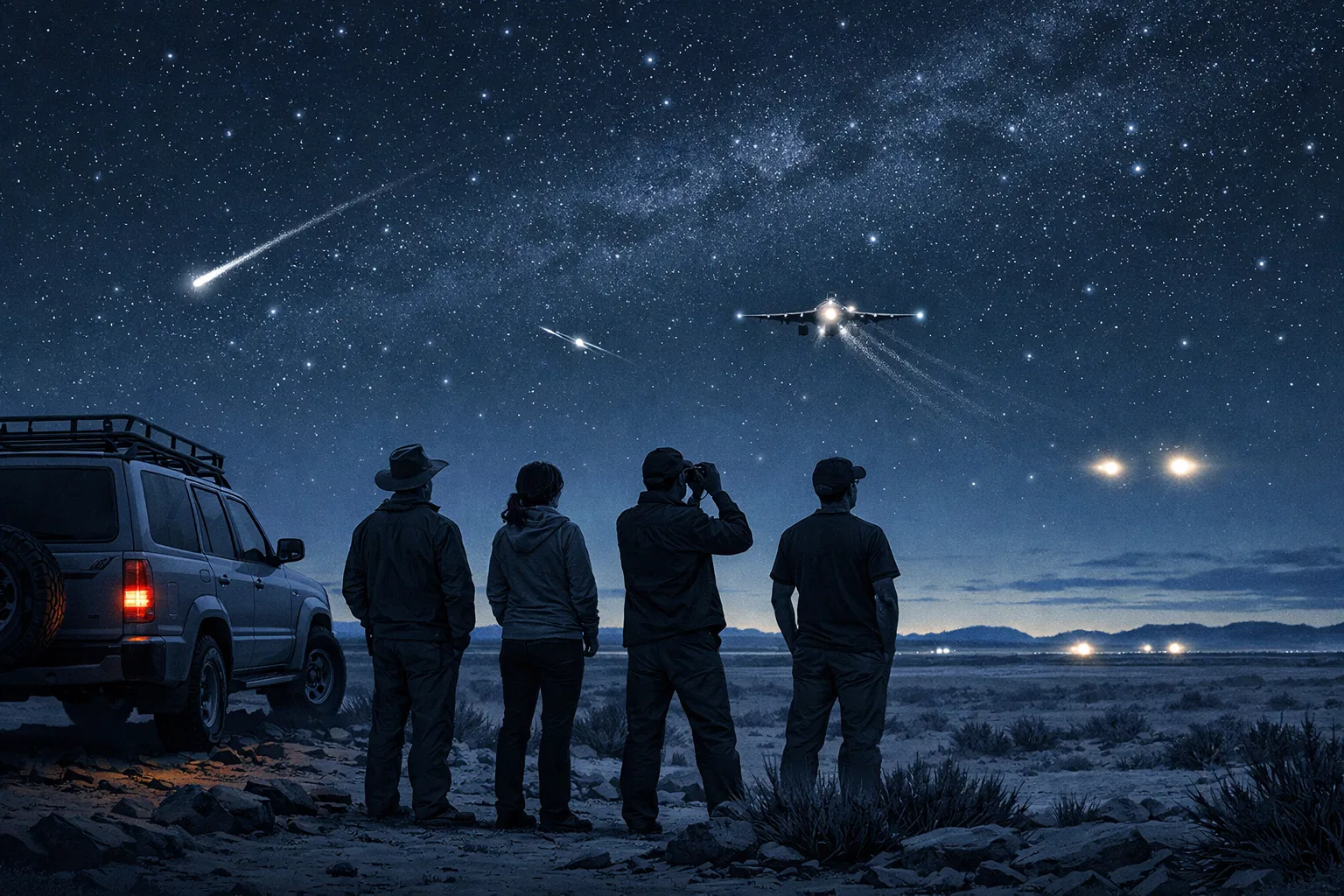
Remote skies produce more UFO reports chiefly because people can see more objects but have fewer reliable clues for judging them. The Northern Territory combines very dark nights, broad horizons, long sightlines and sparse ground lighting with regular civil, military and regional aviation. Under those conditions, an ordinary point of light may be visible from a great distance while giving away almost nothing about its size, altitude, direction or speed.
That combination creates a reporting paradox. The Territory is an excellent place to notice satellites, aircraft, meteors and distant vehicle lights, yet it can be a poor place to identify them from sight alone. Research elsewhere has found that public UFO reports are more common where skies are unobstructed and where aircraft or military activity gives observers more things to see. This does not prove that every Northern Territory report has a conventional explanation, but it helps explain why remote country generates so many sincere yet difficult-to-resolve accounts.[nature.com]nature.comGiven the potential security and safety risks they pose, as well as scientific curiosity, there is increasing interest in understanding w…
How flat horizons distort distance and speed
A light in darkness does not carry its own scale. Unless an observer can compare it with a building, hill, cloud layer or known aircraft, there may be no dependable way to tell whether it is a small object nearby or a powerful light many kilometres away. Apparent brightness is not enough: a faint nearby lamp and a bright distant searchlight can look remarkably similar.
This problem is especially strong over flat or gently undulating country. A light near the horizon may remain visible for a long time without revealing whether it is airborne, mounted on a vehicle or shining from a distant settlement. Headlights, road trains and machinery operating beyond an observer’s immediate surroundings can consequently appear suspended above the ground. Heat haze, dust and uneven layers of air can further blur or displace lights close to the horizon.
Aviation authorities treat the lack of visual references as a serious safety problem, not a peculiarity of UFO witnesses. The Australian Transport Safety Bureau describes how darkness and an absence of surrounding lights can impair depth perception and create false impressions of height, attitude and position. Its guidance on the “black hole” illusion concerns pilots approaching isolated runways, but the underlying lesson applies more broadly: human vision estimates distance and movement poorly when a bright target is surrounded by featureless darkness.[ATSB]atsb.gov.auATSBAvoidable Accidents No7 - Visual flight at night accidentsDecember 16, 2013 — 17 Dec 2013 — This 'black hole illusion' can lead pilots to initiate an aggressiv…
Several common UFO descriptions can arise from this uncertainty:
- “It hovered.” A distant light moving directly towards or away from the observer changes its angular position very slowly and can look stationary.
- “It followed the car.” A remote light may keep roughly the same bearing as the observer drives, much as the Moon seems to travel alongside a vehicle.
- “It suddenly accelerated.” A change in viewing angle, brightness or the observer’s own movement can create an impression of rapid speed without showing the object’s actual velocity.
- “It vanished instantly.” Aircraft may turn away, pass behind thin cloud or switch off landing lights; satellites can disappear abruptly when they enter Earth’s shadow.
- “It made impossible turns.” Small involuntary eye movements, changes in attention and the absence of fixed reference points can make a lone light seem to wander.
These effects do not mean that witnesses are careless or inventing what they saw. They show why honest testimony may accurately record an impression while remaining unreliable as a measurement of distance, size or performance.
Darkness reveals more than it explains
The Northern Territory’s low levels of artificial light make faint objects easier to notice. Tourism material promotes Central Australia as an exceptional stargazing region because of its dark skies, dry atmosphere and isolation from large coastal cities. The same visibility that reveals the Milky Way also exposes observers to a much busier sky than many urban residents realise.[Northern Territory]northernterritory.comNorthern TerritoryStargazing“The Red Centre one of the best locations for stargazing in Australia because there is no light or atmospheri…
A person who watches for only a few minutes may see several satellites, an aircraft at high altitude, a meteor and bright planets. Someone unfamiliar with their normal behaviour may reasonably regard one of them as extraordinary. Darkness therefore increases both the quantity of observable phenomena and the chance that an unfamiliar one will be reported.
The absence of light pollution can also make ordinary lights appear unusually intense. An approaching aircraft’s landing lamps may dominate an otherwise black horizon before its navigation lights or engine noise become noticeable. Once it turns, the bright forward-facing lamps may fade suddenly, creating an apparent disappearance. A light can likewise seem silent because it is much farther away than the observer assumes or because sound arrives later and is masked by wind, traffic or a running engine.
Clear skies do not solve the identification problem. They improve visibility but provide no automatic information about range. In practical terms, an observer may see an object more clearly while knowing less about where it is.
Why aviation and satellites add confusion
The Northern Territory depends heavily on aviation because its communities and services are separated by immense distances. Darwin and Alice Springs are its principal aviation centres, while regional routes connect places including Katherine and Tennant Creek. The Territory Government also supports new domestic and international services, meaning that unfamiliar flight paths and changing schedules can introduce lights that local observers do not expect.[nt.gov.au]nt.gov.auOpen source on nt.gov.au.
Not every visible aircraft will appear on the route a witness imagines. Planes may be climbing, descending, holding, approaching from an angle or flying hundreds of kilometres beyond the assumed location. Helicopters, charter services, medical flights and military activity add further variety. A distant aircraft seen nearly head-on can resemble a stationary white or orange orb; after it turns, separate red, green and flashing lights may suddenly become apparent.
Australia’s aviation safety material acknowledges how easily lights are misread at night. The Civil Aviation Safety Authority notes that a missing natural horizon can cause people to treat roads, cloud lines or other illuminated features as a false horizon. Its medical guidance also identifies confusion between stars and ground lights as an example of normal visual processing failing when information is limited or ambiguous.[Civil Aviation Safety Authority]casa.gov.auOpen source on casa.gov.au.
Satellites create another large category of reports. They are usually seen because they reflect sunlight, particularly after sunset or before sunrise, when the observer is in darkness but the satellite remains illuminated high above Earth. They may brighten, fade or vanish when their orientation changes or their orbit carries them into shadow. Unlike aeroplanes, most do not show regular blinking navigation lights.[nasa.gov]science.nasa.govOpen source on nasa.gov.
Starlink deployments have made this source of confusion more conspicuous. Newly launched satellites may appear as a procession of evenly spaced lights, while later orbital arrangements and reflections can produce less familiar patterns. A documented 2022 incident involving reports from five airline pilots over the Pacific was reconstructed using orbital and flight data; researchers concluded that an unusual arrangement of recently launched Starlink satellites explained the lights. The case is important because trained observers, multiple witnesses and photographs did not by themselves prevent misidentification.[arXiv]arxiv.orgOpen source on arxiv.org.
Why a moving observer sees strange motion
Many Northern Territory stories arise on roads rather than from fixed observation sites. That matters because the witness is moving while trying to judge another light whose distance is unknown.
When a car changes direction or passes trees, poles and low ridges, a distant light can appear to jump sideways, stop or reverse. Nearby foreground objects move rapidly across the observer’s view, while a faraway light hardly shifts. The brain may attribute the resulting relative motion to the light rather than to the vehicle.
Road conditions can strengthen the effect. Long straight sections encourage sustained viewing of a light near the horizon. Bends produce sudden changes in bearing. Dust can obscure and reveal it repeatedly, while road gradients may make it rise or fall against the skyline. A road train’s elevated lamps, several vehicles travelling in line, or machinery operating on remote land can create multiple lights whose spacing and movement are hard to interpret from kilometres away.
The most dramatic estimate is often the least secure: that an object crossed a huge distance in seconds. Without knowing its range, an observer knows only how quickly its angle changed. A small nearby object can sweep across the field of view faster than a large distant aircraft, even though its real speed is lower. Claims of extraordinary acceleration therefore require independent ranging, radar, triangulation or another form of measurement before they can be treated as evidence of extraordinary performance.
How publicity changes what observers notice
Physical conditions explain why lights are visible and ambiguous; publicity helps determine which ambiguous lights become UFO reports. Once a location gains a reputation, visitors are more likely to watch the sky, remember unusual observations and describe them through the language of UFOs.
Wycliffe Well offers the Northern Territory’s clearest example. According to ABC reporting, the site’s transformation into an alien-themed attraction followed newspaper publicity in the late 1980s. The business then collected sightings, ran night tours and marketed itself as Australia’s UFO capital. Its former operator recalled that calls arrived from around the world after the story appeared. The sequence does not show that reports were fabricated, but it demonstrates how media attention created more observers, an obvious place to submit accounts and a ready-made interpretation for unexplained lights.[ABC News]abc.net.auABC News How a tiny outback NT roadhouse went from Australia'sABC News How a tiny outback NT roadhouse went from Australia's
Publicity can change reporting without changing the underlying sky. Visitors expecting unusual activity are more likely to spend time looking upwards than motorists simply stopping for fuel. They may compare experiences, alert one another to faint lights and treat an uncertain observation as noteworthy. Reports can then attract further visitors, producing a feedback loop in which reputation generates observation and observation reinforces reputation.
Research into UFO-reporting patterns supports caution about treating report totals as a direct measure of unusual objects. A large geographical study found that visibility, open sky and proximity to likely aerial activity were associated with reporting rates. Other research examining tens of thousands of reports has treated the data as a record not just of objects in the sky, but of human reporting behaviour.[Nature]nature.comGiven the potential security and safety risks they pose, as well as scientific curiosity, there is increasing interest in understanding w…
The effect should not be exaggerated. Publicity does not explain the detailed content of every sighting, and attempts to link report increases to particular social events have produced mixed results. One study found that reports rose in 2020 but did not find strong support for several proposed pandemic-related social causes; the authors also identified the arrival of highly visible Starlink formations as a major complication. Material changes in the sky can therefore occur alongside changes in attention and reporting.[ResearchGate]researchgate.netResearch Gate(PDF) Social factors and UFO reports: was the SARS-Co VResearch Gate(PDF) Social factors and UFO reports: was the SARS-Co V

What makes a remote-sky report useful
A remote location does not make a sighting worthless. It makes careful documentation more important. The most useful reports record exact time, position, viewing direction, duration, weather, angular size and the observer’s movements. Investigators also need the original photographs or video, not compressed social-media copies, together with checks against aircraft tracking, satellite predictions, astronomical objects and known local activity.
Multiple witnesses improve a case only when their positions and observations can be compared. Several people standing together may share the same missing distance cues and the same mistaken assumption. Witnesses separated by a known baseline can be more valuable because their sightlines may allow triangulation.
The distinction between “unidentified” and “extraordinary” is crucial. A report may remain unresolved because the time is approximate, the direction was not recorded or flight and satellite data are unavailable. That is an information gap, not positive evidence of an exotic craft. Scientific proposals for studying unidentified aerial phenomena therefore emphasise synchronised cameras, radar, environmental instruments and triangulation rather than relying on visual impressions alone.[arXiv]arxiv.orgOpen source on arxiv.org.
For Northern Territory UFO history, remote skies are best understood as a report-producing environment. They offer unusually good opportunities to see distant lights, combined with unusually poor opportunities to estimate what those lights are doing. Aviation, satellites, road traffic and heightened expectations supply plausible explanations for many recurring descriptions. A small residue may remain unidentified, but without measurements or independent records, remoteness usually weakens the evidence even as it strengthens the experience.
Amazon book picks
Further Reading
Books and field guides related to Why Are Remote Skies So Easy to Misread?. Use these as the next step if you want deeper reading beyond the article.
NightWatch: A Practical Guide to Viewing the Universe
A practical guide to viewing the universe.
The Backyard Astronomer's Guide
Discusses the practical aspects of stargazing, including how to choose appropriate equipment, contending with light pollution, taking suc...
The UFO Handbook: A Guide to Investigating, Evaluating, and R...
An explanation of the usual reasons for confusing IFOs (identified flying objects) with UFOs and a survey of the tools used to investigat...
eBay marketplace picks
Marketplace Samples
Live-tested eBay searches with available results related to this page.
Selected fromUFO art print oneBay.co.uk.
Endnotes
1.
Source: nature.com
Link:https://www.nature.com/articles/s41598-023-49527-x
Source snippet
Given the potential security and safety risks they pose, as well as scientific curiosity, there is increasing interest in understanding w...
2.
Source: atsb.gov.au
Title: ATSBAvoidable Accidents No
Link:https://www.atsb.gov.au/sites/default/files/media/4475634/ar-2012-122.pdf
Source snippet
7 - Visual flight at night accidentsDecember 16, 2013 — 17 Dec 2013 — This 'black hole illusion' can lead pilots to initiate an aggressiv...
Published: December 16, 2013
3.
Source: atsb.gov.au
Title: AO2007009 001
Link:https://www.atsb.gov.au/sites/default/files/investigation-reports/AO2007009_001.pdf
Source snippet
Collision with terrain, 2 km west of Esperance Aerodrome...17 Oct 2008 — The 'black hole' illusion is a particular visual illusion...
4.
Source: atsb.gov.au
Link:https://www.atsb.gov.au/investigations/ao
Source snippet
e an approach path at night with no visual cues between the aircraft and the intended runway on...Read more...
5.
Source: dcceew.gov.au
Title: light pollution
Link:https://www.dcceew.gov.au/environment/biodiversity/conservation/light-pollution
6.
Source: nt.gov.au
Link:https://nt.gov.au/driving/industry/aviation-and-airports
7.
Source: dtbar.nt.gov.au
Link:https://dtbar.nt.gov.au/news/2025/red-centre-to-the-reef-alice-springscairns-flight-takes-off
8.
Source: newsroom.nt.gov.au
Link:https://newsroom.nt.gov.au/article?id=14621
9.
Source: dtbar.nt.gov.au
Link:https://dtbar.nt.gov.au/news/2025/airasia-expands-its-presence-in-the-nt
10.
Source: casa.gov.au
Link:https://www.casa.gov.au/sites/default/files/2021-06/safety-behaviours-human-factor-for-pilots-9-human-information-processing.pdf
11.
Source: casa.gov.au
Title: Civil Aviation Safety Authority Guidelines
Link:https://www.casa.gov.au/guidelines-medical-assessment-aviation
12.
Source: casa.gov.au
Title: Civil Aviation Safety Authority AC 61-05 v1.1
Link:https://www.casa.gov.au/night-vfr-rating
13.
Source: science.nasa.gov
Link:https://science.nasa.gov/skywatching/
14.
Source: apod.nasa.gov
Title: Astronomy Picture of the Day APOD Search Results for “sun”
Link:https://apod.nasa.gov/cgi-bin/apod/apod_search?tquery=sun
15.
Source: apod.nasa.gov
Link:https://apod.nasa.gov/apod/ap260427.html
16.
Source: arxiv.org
Link:https://arxiv.org/abs/2403.08155
17.
Source: researchgate.net
Title: Research Gate(PDF) Social factors and UFO reports: was the SARS-Co V
Link:https://www.researchgate.net/publication/368458403_Social_factors_and_UFO_reports_was_the_SARS-CoV-2_pandemic_associated_with_an_increase_in_UFO_reporting
18.
Source: arxiv.org
Link:https://arxiv.org/abs/2305.18566
19.
Source: unexplained.co
Link:https://www.unexplained.co/news/nwt-drillers-ufo-sighting
20.
Source: budget.nt.gov.au
Title: nt.gov.au Tourism | NT Budget
Link:https://budget.nt.gov.au/industry-outlook/tourism?query=2026
21.
Source: dtbar.nt.gov.au
Link:https://dtbar.nt.gov.au/news/2025/trifecta-of-new-routes-for-the-nt
22.
Source: newsroom.nt.gov.au
Title: nt.gov.au Article | Northern Territory Government Newsroom
Link:https://newsroom.nt.gov.au/article?id=f90b87f162c6c0a5a4fe194b40049a6e
23.
Source: dtbar.nt.gov.au
Link:https://dtbar.nt.gov.au/news/2025/new-airnorth-route-servicing-alice-springs-cairns
24.
Source: jointheterritory.nt.gov.au
Title: nt.gov.au Flying to and from the Territory | Join the Territory
Link:https://jointheterritory.nt.gov.au/move/moving-from-interstate/flying
25.
Source: researchgate.net
Title: (PDF) An environmental analysis of public UAP sightings and sky view potential
Link:https://www.researchgate.net/publication/376519968_An_environmental_analysis_of_public_UAP_sightings_and_sky_view_potential
26.
Source: atsb.gov.au
Link:https://www.atsb.gov.au/investigations/ao
27.
Source: atsb.gov.au
Link:https://www.atsb.gov.au/investigations/ao
28.
Source: atsb.gov.au
Title: avoidable wirestrike
Link:https://www.atsb.gov.au/media/news-items/2015/avoidable-wirestrike
29.
Source: newsroom.nt.gov.au
Title: nt.gov.au Article | Northern Territory Government Newsroom
Link:https://newsroom.nt.gov.au/article?id=10854
30.
Source: nature.com
Title: Worldwide variations in artificial skyglow | Scientific Reports
Link:https://www.nature.com/articles/srep08409
31.
Source: science.nasa.gov
Title: identifying ufos and uaps
Link:https://science.nasa.gov/solar-system/skywatching/night-sky-network/identifying-ufos-and-uaps/
32.
Source: nationalarchives.gov.uk
Title: UF O reports
Link:https://www.nationalarchives.gov.uk/explore-the-collection/explore-by-time-period/postwar/ufo-reports/
33.
Source: science.nasa.gov
Link:https://science.nasa.gov/moon/moonlight/
34.
Source: science.nasa.gov
Title: earthshine 83782
Link:https://science.nasa.gov/earth/earth-observatory/earthshine-83782/
35.
Source: science.nasa.gov
Title: moon phases
Link:https://science.nasa.gov/moon/moon-phases/
36.
Source: nasa.gov
Title: why can you see the moon during the day we asked a nasa scientist episode 19
Link:https://www.nasa.gov/solar-system/why-can-you-see-the-moon-during-the-day-we-asked-a-nasa-scientist-episode-19/
37.
Source: ceres.larc.nasa.gov
Title: satellite missions
Link:https://ceres.larc.nasa.gov/instruments/satellite-missions/
38.
Source: svs.gsfc.nasa.gov
Link:https://svs.gsfc.nasa.gov/12792
39.
Source: science.nasa.gov
Link:https://science.nasa.gov/sun/
40.
Source: atsb.gov.au
Link:https://www.atsb.gov.au/sites/default/files/media/29971/b20070063.pdf
41.
Source: atsb.gov.au
Link:https://www.atsb.gov.au/sites/default/files/2024-05/FAA-H-8083-3B%20Chapter%2010.pdf
42.
Source: atsb.gov.au
Title: Special edition
Link:https://www.atsb.gov.au/sites/default/files/media/5774849/special_vf_86.pdf
43.
Source: atsb.gov.au
Link:https://www.atsb.gov.au/sites/default/files/investigation-reports/ao2011043.pdf
44.
Source: atsb.gov.au
Link:https://www.atsb.gov.au/sites/default/files/media/5774807/asd_111_80.pdf
45.
Source: atsb.gov.au
Title: aair200304282 001
Link:https://www.atsb.gov.au/sites/default/files/investigation-reports/aair200304282_001.pdf
46.
Source: atsb.gov.au
Link:https://www.atsb.gov.au/sites/default/files/investigation-reports/ao2011017.pdf
47.
Source: casa.gov.au
Title: caap 174 1 night vision imaging helicopters
Link:https://www.casa.gov.au/sites/default/files/2021-08/caap-174-1-night-vision-imaging-helicopters.pdf
48.
Source: casa.gov.au
Link:https://www.casa.gov.au/sites/default/files/2021-06/safety-behaviours-human-factor-for-pilots-6-situational-awareness.pdf
49.
Source: casa.gov.au
Link:https://www.casa.gov.au/sites/default/files/2021-11/flight-instructor-manual-aeroplane.pdf
50.
Source: casa.gov.au
Title: flight examiner handbook
Link:https://www.casa.gov.au/sites/default/files/2023-07/flight-examiner-handbook.pdf
51.
Source: casa.gov.au
Title: visual flight rules guide
Link:https://www.casa.gov.au/sites/default/files/2022-02/visual-flight-rules-guide.pdf
52.
Source: casa.gov.au
Title: CAA P 5.13-1
Link:https://www.casa.gov.au/sites/default/files/2021-08/caap-5-13-1-private-ifr-rating.pdf
53.
Source: casa.gov.au
Title: night vision imaging helicopters
Link:https://www.casa.gov.au/night-vision-imaging-helicopters
54.
Source: invest.nt.gov.au
Title: ground stations
Link:https://invest.nt.gov.au/opportunities/space/ground-stations
55.
Source: invest.nt.gov.au
Link:https://invest.nt.gov.au/opportunities/space/haps
56.
Source: nt.gov.au
Link:https://nt.gov.au/driving/safety/driving-with-road-trains
57.
Source: ouci.dntb.gov.ua
Link:https://ouci.dntb.gov.ua/en/works/4EweyOK9/
58.
Source: nature.com
Link:https://www.nature.com/articles/s41599-024-04182-z
59.
Source: arxiv.org
Link:https://arxiv.org/html/2505.03013v1
60.
Source: consult.basingstoke.gov.uk
Link:https://consult.basingstoke.gov.uk/submission/bsgd-c14-dlp25-2984
61.
Source: pmc.ncbi.nlm.nih.gov
Link:https://pmc.ncbi.nlm.nih.gov/articles/PMC10721628/
Source snippet
and (3) If so, can these patterns be explained by physical and/or built environment factors?To answer these questions, we use UFO sightin...
62.
Source: northernterritory.com
Link:https://northernterritory.com/gb/en/articles/stargazing
Source snippet
Northern TerritoryStargazing“The Red Centre one of the best locations for stargazing in Australia because there is no light or atmospheri...
63.
Source: abc.net.au
Title: ABC News How a tiny outback NT roadhouse went from Australia’s
Link:https://www.abc.net.au/news/2024-07-22/wycliffe-well-alien-roadhouse-stuart-highway-ufo-capital/104102510
64.
Source: journalofscientificexploration.org
Link:https://journalofscientificexploration.org/index.php/jse/article/view/2681
65.
Source: nuforc.org
Link:https://nuforc.org/sighting/?id=198308
66.
Source: nuforc.org
Link:https://nuforc.org/sighting/?id=197990
67.
Source: nuforc.org
Link:https://nuforc.org/sighting/?id=197881
68.
Source: abc.net.au
Link:https://www.abc.net.au/news/2026-04-06/westall-ufo-mystery-witnesses-want-answers/106126614
69.
Source: pubs.usgs.gov
Link:https://pubs.usgs.gov/publication/70274517
70.
Source: abc.net.au
Link:https://www.abc.net.au/news/2025-09-24/unexplained-uap-sightings-reported-across-midwest-wa/105803264
71.
Source: nuforc.org
Link:https://nuforc.org/sighting/?id=190304
72.
Source: nuforc.org
Link:https://nuforc.org/sighting/?id=187166
73.
Source: nuforc.org
Link:https://nuforc.org/sighting/?id=182924
74.
Source: abc.net.au
Link:https://www.abc.net.au/news/2018-02-23/curious-adelaide-ufo-sightings-across-australia/9466950
75.
Source: abc.net.au
Title: Was it a bird? Was it a plane? What flew over the Sunshine Coast?
Link:https://www.abc.net.au/news/2016-10-08/unusual-lights-spotted-over-queensland-sky/7913818
76.
Source: abc.net.au
Title: UF O spotted over eastern Australia
Link:https://www.abc.net.au/news/2010-06-05/ufo-spotted-over-eastern-australia/855590
77.
Source: nuforc.org
Link:https://nuforc.org/sighting/?id=25605
Additional References
78.
Source: ess.utah.edu
Title: UAP Sightings Soar Across the Western US
Link:https://ess.utah.edu/blog/posts/2024-2025/11-2024-uap-sightings.php
Source snippet
This research was published by Scientific Reports, and featured in an @theU article titled "The West is Best to Spot UFOs" and in Utah Al...
79.
Source: youtube.com
Title: These UFOs are Starlink Flares, 100%
Link:https://www.youtube.com/watch?v=Ea8BCl2yVU0
Source snippet
This video explains how visual illusions like autokinesis and false horizons occur at night when flying over dark, featureless terrain, w...
80.
Source: defense.gov
Link:https://www.defense.gov/News/News-Stories/Article/article/3368109/dod-working-to-better-understand-resolve-anomalous-phenomena/
81.
Source: usgs.gov
Link:https://www.usgs.gov/publications/support-management-actions-protect-night-sky-quality-insights-visitors-state-and
82.
Source: facebook.com
Link:https://www.facebook.com/officialraejohnston/posts/rae-johnstons-car-shakes-as-she-travels-down-a-red-dirt-road-in-remote-northern-/1516576976524682/
83.
Source: rr0.org
Link:https://rr0.org/time/2/0/2/3/Medina-Brewer-Kirkpatrick_AnEnvironmentalAnalysisOfPublicUapSightingsAndSkyViewPotential_ScientificReports/
84.
Source: facebook.com
Link:https://www.facebook.com/LandlineABC/videos/australias-monsters-on-outback-roads-abc-landline/591706950567403/
85.
Source: astronomy.org.au
Link:https://astronomy.org.au/amateur/light-pollution/
86.
Source: australasiandarkskyalliance.org
Link:https://australasiandarkskyalliance.org/news/
87.
Source: dokumen.pub
Link:https://dokumen.pub/parallels-ancient-insights-into-modern-ufo-phenomena-0998187143-9780998187143-i-6277054.html